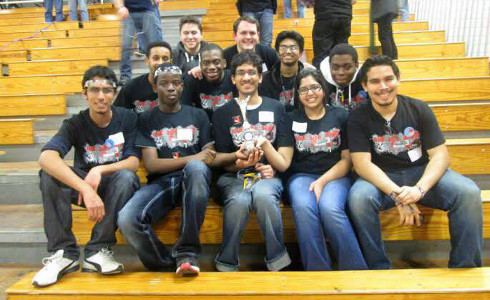
I recently spoke with “The Bot Side,” a high school robotics team from the Community Charter School of Cambridge, about its participation this spring in the FIRST Tech Challenge (FTC), an international robotics competition for students grades 7-12.
The FTC event is one of four different international robotics competitions organized by the not-for-profit organization FIRST (for Inspiration and Recognition of Science and Technology). The specific FTC challenge changes each year, and students are given just a few short months between the release of the new assignment and the first competitive event to create a competent robot.
In FTC challenges, robots must complete many elaborate and difficult tasks in the time frame of just a few minutes. For this spring’s event, robots earned points by performing each of the following tasks: putting plastic blocks in baskets balanced on a see-saw, pausing at the center of a bridge, hanging from a beam, crank-raising a flag, and finishing in an end-zone before time was called. (For more on how the competition worked, watch this video.)
Participants had to design their machines within certain parameters. For instance, the robot had to complete some of its tasks autonomously (without remote-control), it had to fit completely inside an 18-inch cube, and it needed to be built from scratch.
To construct their machine, The Bot Side’s older members recruited teammates, trained them, and assigned responsibilities according to experience. Like most teams, The Bot Side also had a student outreach manager (Ishrat, the only female member), who was in charge of creating promotional materials, managing the team website and external communications, and coordinating scrimmages and educational events in cooperation with other organizations.
FIRST describes robots entered in FTC challenges as being based on a “modular robot platform,” which translates to some motors, wheels, and rugged aluminum scaffolding. But the materials that participants use are a far cry from the types of snap-together kits you can buy at Toys-R-Us—there are no instructions for assembly, and most teams end up adding their own specialized components. “Most people have this idea that you get a kit, and then you start,” said Neal Landry, The Bot Side’s mentor, but “it’s not a kit—you just go.”
The Bot Side members fabricated their own specialty parts, wrote their own lines of code for autonomous behavior, read and interpreted extensive competition rulebooks, troubleshot required competition hardware components, and even solicited funders to back the purchase of practice arenas and additional hardware.
Even the slightest tweak in the design of a robot’s physical features or code can have a large effect on the points earned. For example, a hook that The Bot Side team installed as an afterthought enabled their bot to hang from the cross beam, giving them a last-second point boost that got them to the state competition.

Each student I spoke with from The Bot Side was obviously passionate about and competent in his or her area of expertise. Arnav, a senior who led the software team, explained that he strongly preferred the versatility of the RobotC language to the more user-friendly LabView coding environment.
Two members of the hardware team, Stephen and Sammuel, walked me through the components of the robot that were designed specially to meet the “block-scooping” task. After prototyping in cardboard, they ultimately fabricated a giant scoop from lexan polycarbonate and mounted it on a lifter frame.
Ishrat explained to me the advantages of collaborating with other experienced teams, and highlighted the outreach initiatives she had led to expose more students to robotics in the community.

The FTC replicates the types of experiences students would get spending time in a technical field, and is regularly held up as an example for how to recruit and train future engineers. Indeed, The Bot Side team amassed an impressive list of skillsets and accomplishments that would surely make any headhunter, let alone college admissions counselor, lean forward with interest. And even though the students admitted to regularly being frustrated and spending tons of out-of-school hours on the robot, their overwhelming attitude was one of gratitude for the fun they had and friends they made.
What’s more, while the team didn’t make it to the national competition this year, every single graduating senior from the group has been accepted to a competitive four-year college and is planning to pursue a degree in a STEM field.
Related Links
FIRST Tech Challenge video
SciFri article: “Robot Roundup”
SciFri video: “Robotic Games of Glory”
SciFri conversation: “Technology’s Odd Couple Teams Up for Science”
Featured photo courtesy of The Bot Side.
Technology’s Odd Couple Teams Up For Science
Meet the Writer
About Ariel Zych
@arieloquentAriel Zych is Science Friday’s director of audience. She is a former teacher and scientist who spends her free time making food, watching arthropods, and being outside.