Subscribe to Science Friday
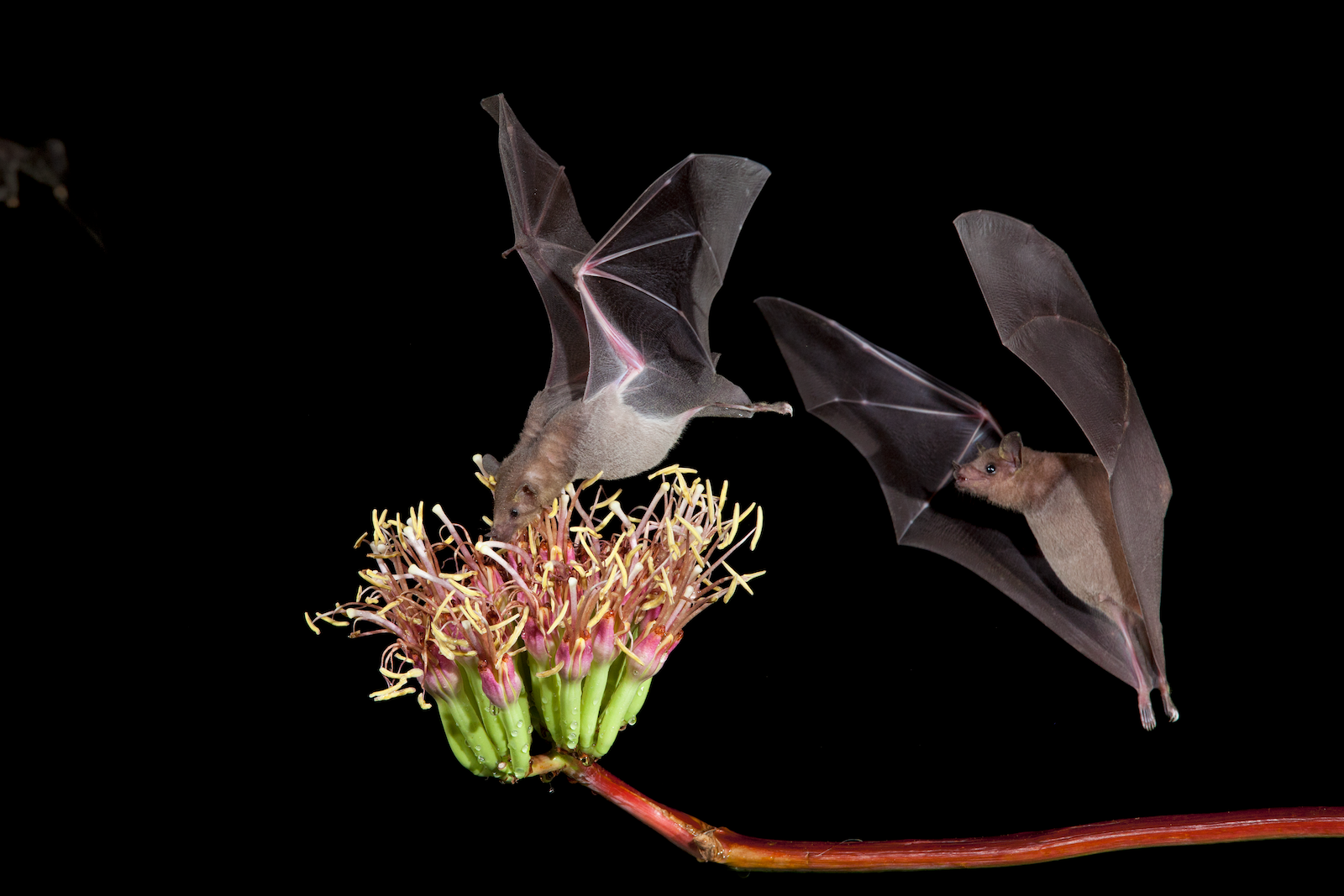
You might think about bats as flitting around in the dark and hunting insects, but some species feed on fruits or flowers—and play an important role as pollinators. One place that role is crucial is in the relationship between bats and agave plants. Bat conservationist Kristen Lear joins Host Ira Flatow to describe efforts to restore agaves in the Southwest and Mexico, which has consequences for bats, for the ecosystems around the agave, and for your liquor cabinet, since agave is the source of drinks like tequila and mezcal.
Plus, journalist Dan Fagin joins Ira to discuss his recent New York Times article on a new technology that is letting researchers follow individual monarch butterflies over the course of a thousand-mile migration.
Sign Up For The Week In Science Newsletter
Keep up with the week’s essential science news headlines, plus stories that offer extra joy and awe.
Segment Guests
Kristen Lear
Dr. Kristen Lear is director of the Agave Restoration Initiative at Bat Conservation International, based in Austin, Texas.
Dan Fagin
Dan Fagin is a science journalist and the director of the Science, Health & Environmental Reporting Program at New York University.
Segment Transcript
[AUDIO LOGO] IRA FLATOW: I’m Ira Flatow, and this is Science Friday. Today on the podcast, we look at two marvels of a migration in Mexico. We’ll hear how researchers use tiny tracking devices attached to individual monarch butterflies to record their epic voyage south. But first, how the dietary needs of a migrating bat influences what ends up in your Margarita glass. OK, let me explain. When you think about bats, chances are you think of the ones you see at dusk flitting about to hunt insects, right? But some species of bats like to eat fruits or flowers, not bugs, and they play an important role as pollinators.
Now, one place that the pollinator role is crucial is in the relationship between bats and agave plants. And that has consequences both for the ecosystems around the agave and for your liquor cabinet, since agave is the source of drinks like tequila and mezcal. Now you get it, right? Well, here to explain this seemingly strange connection is Dr. Kristen Lear, Director of the Agave Restoration Initiative at Bat Conservation International. Welcome to Science Friday.
KRISTEN LEAR: Hi, there. Thanks for having me.
IRA FLATOW: You’re welcome. What kind of bats are we talking about here?
KRISTEN LEAR: So there’s three species of nectar-feeding bats that we’re talking about that migrate between Mexico and the US and that feed on the nectar of agave plants. Unfortunately, one of them is endangered– the endangered Mexican long-nosed bat– and that’s why we’re working to protect them.
IRA FLATOW: All right. So explain to me the connection between the bats and the agave.
KRISTEN LEAR: Yeah. So these bats, the three species, are migratory. They mate in Central Mexico, and then the pregnant females, while they are pregnant, they undergo a long-distance, over-700 mile migration northward up to Northern Mexico and the US Southwest. And along that route, they’re feeding on these beautiful blooming agave plants that have these nectar-filled flowers that provide the fuel for this migration. And then once those pregnant mothers reach Northern Mexico and the US, in some areas, it is only agave plants that are available and providing nectar for these bats and for these mothers to sustain them and help them feed their babies.
IRA FLATOW: Yeah. And so I guess it’s critical for the survival of the plants then, too?
KRISTEN LEAR: Yeah, yeah. These bats, as they’re feeding from the agave flowers– they’re kind of these clumsy fliers when they go up to the agave flowers, and they kind of clumsily fall onto the flowers and they get covered in pollen, and then they spread that pollen over miles between different agave plants. These bats can fly 50 kilometers or more one way from a roost at night to go feed and then go back to their roost. So they’re really spreading that agave pollen across those different agave populations and really helping maintain the genetic diversity of those plants.
IRA FLATOW: I would have never thunk that a bat is a pollinator.
KRISTEN LEAR: They’re kind of the overlooked pollinator because they’re out at night. We get to see butterflies and bees and hummingbirds during the day, but these bats are this mysterious, unknown pollinator, just because they’re out at night and we don’t get to see them.
IRA FLATOW: So can the agaves reproduce without the bats?
KRISTEN LEAR: Some agave species also reproduce asexually– so through rhizomes, for example, under the ground. They have these little pups, or baby agaves, that grow out from the mother plant. But some species of agaves only reproduce sexually, through pollination and seed production. So you have a mix. And even for the agaves that can clone themselves or reproduce with pups, if you’re a clone, you’re genetically identical to the mother plant. So if you clone too much over time, that population of agaves is too genetically similar and bad things can happen– pests, outbreaks, disease outbreaks can come through and wipe out that agave population because there’s no genetic diversity to protect them.
IRA FLATOW: So as we’re drinking our tequila drinks, we should know that without flowering agave, we would have no tequila or mezcal?
KRISTEN LEAR: Correct. Yep. These bats and these agaves have evolved together, and without those bats, we would not have those lovely products that we so enjoy.
IRA FLATOW: We should hoist one, right? While we’re drinking, and–
KRISTEN LEAR: We should.
IRA FLATOW: –toast the bats.
KRISTEN LEAR: We definitely should.
IRA FLATOW: I’m going to remember that. So you want to be nice, then, to your agave plants. What are the threats? What is threatening their lives?
KRISTEN LEAR: Yeah. So you just mentioned harvest of agaves for liquor, like tequila, mezcal, bacanora– that can be done unsustainably or sustainably. So depending on how it’s done, it can either support bats or not support bats. But beyond direct harvest of agaves, there are other big threats to agaves, like grazing. Cattle love to eat the growing stalks of the agaves because they’re really full of sugar, and they’re really kind of a treat for the cattle. So in places that have this unsustainable grazing, these cattle are eating the agaves, and they’re also kind of getting rid of the natural, native grasses that sustain agave populations.
So grazing, land use change in general, expansion of agriculture, and then droughts. Drought is a big thing that’s impacting a lot of ecosystems, including agaves. Agaves are pretty drought-tolerant, but when you have extreme drought for extended periods of time, that’s leading to losses of agaves and leading to things like wildfires that also–
IRA FLATOW: Wow. Climate change.
KRISTEN LEAR: Yeah, it’s all tied. It’s all exacerbated by that.
IRA FLATOW: I know that you’re trying to help the bats by restoring the agave, but beside the relationship with bats, why is agave so important?
KRISTEN LEAR: So at Bat Conservation International, we’re working to restore these agave plants through the Agave Restoration Initiative. Of course, our angle is the bat angle. Right? We want to save these bats. But agaves are so important economically, right? For tequila, mezcal, bacanora, all these products that we get– agave syrup that we can buy at the grocery store– they’re this really important economic product, but they’re also culturally important in many communities in Mexico and in the US.
They support erosion control. So if you plant an agave, their root systems help sustain the soil and help maintain healthy lands and healthy soils. There’s many other uses– medicinal uses– for agaves. Cattle fodder– you know, you can chop up agaves and feed them to your cattle and goats, especially in times of drought, when there’s no natural grass fodder out there. So all of these reasons are reasons that people want to protect and restore agaves, besides just protecting the bats.
IRA FLATOW: OK. So give me your pitch to the people living on or near agave land for why they should protect the agaves. Is it money? Is it the environment? Or everything? Or all of that?
KRISTEN LEAR: Yeah, I mean all of it. But I really think it comes down to, what’s your angle? What is driving you? We all come at conservation or land restoration from different angles. Say you’re a person in the US. We work with a lot of private landowners in the US or community groups. They love agaves because they’re beautiful plants. They’re iconic desert and grassland plants, so they want to plant and restore agaves to beautify their landscapes. That’s one angle.
Or if you’re a cattle rancher in an ejido in Mexico, we work a lot with communities in Mexico. You want to have sustainable food– fodder for your livestock. Planting agaves and restoring the land helps you feed your livestock and maintain your livelihood. And then there’s the crazy bat nerds, the bat people who want to save the bats, right? I think we all come at it from a different angle, but we all get to the same goal.
IRA FLATOW: Yeah. Speaking of saving the bats, are there things people can do to help the bats, like building bat boxes, things like that?
KRISTEN LEAR: Yeah. So some species of bats do roost in bat boxes or bat houses. These three nectar-feeding bat species do not roost in those bat boxes, but other species do. So in cases where there’s habitat that’s being destroyed, or you’re doing an exclusion of bats from your house, that would be a great time to put up a bat house– to help provide a shelter for them.
But also, one thing you can do anywhere you live is plant a bat garden. You can plant night-blooming flowers. Agaves, of course– if you’re in an agave area, you can plant agaves. But even if you’re not, you can plant native night-blooming flowers that open at night and attract nocturnal insects that our insectivorous. bats can eat. So you have your own little bat buffet and bat smorgasbord in your garden, and you’re supporting bat populations by planting a bat garden.
IRA FLATOW: That is cool. All right. So how has the restoration effort been going? Can you track the progress?
KRISTEN LEAR: Yeah, it’s been going great. So we have been working on the Agave Restoration Initiative for about seven years now, and we have planted a little over 180,000 of these agaves across that binational migratory corridor. We have over 100 partners that we work with in the US and Mexico, including ejido communities, private ranchers and landowners in the US, tribes, government groups, NGOs, et cetera. We run the gamut.
And we’re also not just planting agaves. We’re restoring the land, so we’re working with communities to implement sustainable grazing and management practices. We support community green business enterprises that support native habitats. And all of this together is helping to restore that binational nectar corridor.
IRA FLATOW: So you’re hopeful that this is working, your effort is making a difference with all these problems.
KRISTEN LEAR: Yes. We also monitor the roosts of these bats– you know, where they’re living. And we are seeing the numbers starting to stabilize for the endangered Mexican long-nosed bat. So there is hope that what we’re doing is working and that what we’re doing will continue to support these bats long into the future.
IRA FLATOW: Well, I want to thank you very much, Dr. Lear. I will never look at my drink again the same way. Thank you for taking time to be with us today.
KRISTEN LEAR: Absolutely. Thank you. And yeah, next time, just raise your glass to the bats.
IRA FLATOW: I’ll be doing that, I hope. Doctor Kristen Lear, Director of the Agave Restoration Initiative. That’s at Bat Conservation International. She is based in Loveland, Colorado.
[UPBEAT MUSIC]
After the break, the tech that lets researchers keep tabs on butterflies on a thousand-mile voyage and what they’re learning from that flight data. Stay with us.
[AUDIO LOGO]
Turning from bats to butterflies, by now, the annual fall migration of monarch butterflies is over. The eastern population has moved to Central Mexico to overwinter, and the western population has camped out in coastal California. That migration can mean a flight of thousands of miles, which makes you wonder, how in the world do monarchs do that?
Joining me now is science journalist Dan Fagin. He’s author of a recent article in The New York Times detailing how researchers are tracking individual butterflies as they migrate. He’s also director of the Science, Health, and Environmental Reporting Program at New York University. Welcome to Science Friday.
DAN FAGIN: Thanks, Ira.
IRA FLATOW: OK. So how do you go about tracking a single butterfly?
DAN FAGIN: Well, we really couldn’t do it until very recently– or I guess it would be more accurate to say that we’ve done it in very primitive ways for many years. It used to be that all you could do was put a sticker tag on a monarch and hope someone would find it, look at the number on it, and at least know where that monarch came from. There’s now a technology that creates a radio tag that’s small enough that it can actually be glued to the thorax of a monarch butterfly. And for the first time, we know not only where these journeys start and end, but we know everywhere that monarchs go in between, and it’s pretty amazing.
IRA FLATOW: You mean it’s small enough that it doesn’t load down the butterfly so it can’t fly?
DAN FAGIN: Well, we know that monarchs can fly with these tags. It surely affects them somewhat. But we’ve had tests of monarchs flying all the way from as far as Ontario, and they’ve been tracked all the way to Mexico. So at least some of them, a significant percentage of them, are not affected by the tags– at least not to the point where it prevents them from migrating.
IRA FLATOW: OK. So you have these little radio transmitters, right, on each of the monarch butterflies. And how do they transmit? Who picks them up?
DAN FAGIN: That might be the coolest part. They’re solar-powered, right? So there’s not a big, heavy battery that the monarchs need to carry. But what’s most interesting is that the information gets continuously downlinked, I guess you could say, to anyone who has a cell phone that is Bluetooth-enabled. As long as your cell phone is on, you are helping to track these butterflies.
IRA FLATOW: And that’s how those little iPhone tags work also, don’t they?
DAN FAGIN: Correct. It’s how your Find Your Phone works. So as a result, there are literally billions of potential monitoring stations for these tags. And you can get very robust data. It’s not perfect data. There are still spots that are not well-covered, but there are so many Bluetooth-enabled cell phones that there are not very many of these dead spots. In fact, some of the Monarchs have even been tracked over the ocean because they come close enough to a passing boat, for example.
IRA FLATOW: [CHUCKLES] No kidding. All right, so now that they’ve collected all this data, have they found anything surprising about the migrations?
DAN FAGIN: Yeah. I had a good conversation with Chip Taylor, who’s the founder of Monarch Watch. And Chip was very surprised by some of the things that these paths show. For one thing, monarchs get blown way, way off-track. And yet, in many cases, they have the ability to right themselves and eventually head south again. And Chip, for one, was surprised by just how drastically they can get blown off of their general southwestern course. So that’s one surprise.
I think another one is that there’s been a lot of controversy over how many of these monarchs really make it. We know that a lot of them don’t. There are so many perils along the way, and it’s very exhausting for them. They have strong wings, but it’s a lot to ask them to fly thousands of miles. And yet– judging from these tagged monarchs, we have about 400 so far that have been tracked this year– a pretty decent percentage of them make it down to the Mexican side. So in some ways, that’s good news. It suggests that more of these monarchs can survive the journey, maybe, than many experts thought.
IRA FLATOW: I guess, finally, what is the problem that these tagged flights are trying to solve?
DAN FAGIN: Generally speaking, the migration is this wondrous, amazing thing. And people have a real emotional connection to this butterfly. They’ve grown up with it. Its habitat is most of North America during the summer. So they love it, and yet, this migration is certainly in trouble.
We know, from measuring the size of the Mexican colonies, that there have been drastic reductions in the numbers of monarchs that make it all the way to Mexico, and thus are able to continue their yearly multi-generational lifecycle. So we really need to understand what’s happening on these migratory paths if we want to save the migration itself, because there are serious questions, Ira, as to whether we will see migrating monarchs 20 years from now, 30 years from now.
IRA FLATOW: What a shame that would be.
DAN FAGIN: Yeah, it really would be. I mean, people love this butterfly. And if we want to make progress in protecting it, we need to really understand its migration much better. And until now, until this year, the paths that monarchs took were almost a complete mystery. And now we know, after a century of studying monarchs. And it’s really quite amazing.
IRA FLATOW: Well, thank you. Dan, this has been quite fascinating. Thank you for sharing what you found out about them.
DAN FAGIN: Thanks. It was good to be with you, Ira.
IRA FLATOW: Dan Fagin, science journalist and Director of the Science, Health, and Environmental Reporting Program at New York University. And you’ll find a link to his article on the butterfly migration all there on our website at ScienceFriday.com/Monarch.
[UPBEAT MUSIC]
This episode was produced by Charles Bergquist. I’m Ira Flatow. Thanks for listening.
Copyright © 2025 Science Friday Initiative. All rights reserved. Science Friday transcripts are produced on a tight deadline by 3Play Media. Fidelity to the original aired/published audio or video file might vary, and text might be updated or amended in the future. For the authoritative record of Science Friday’s programming, please visit the original aired/published recording. For terms of use and more information, visit our policies pages at http://www.sciencefriday.com/about/policies/
Meet the Producers and Host
About Charles Bergquist
As Science Friday’s director and senior producer, Charles Bergquist channels the chaos of a live production studio into something sounding like a radio program. Favorite topics include planetary sciences, chemistry, materials, and shiny things with blinking lights.
About Ira Flatow
Ira Flatow is the founder and host of Science Friday. His green thumb has revived many an office plant at death’s door.