Mushroom Foragers Find Connection And Belonging Outdoors
Mushroom hunting is increasingly popular. A new wave of foraging groups by and for people of color could also help close the “nature gap.”
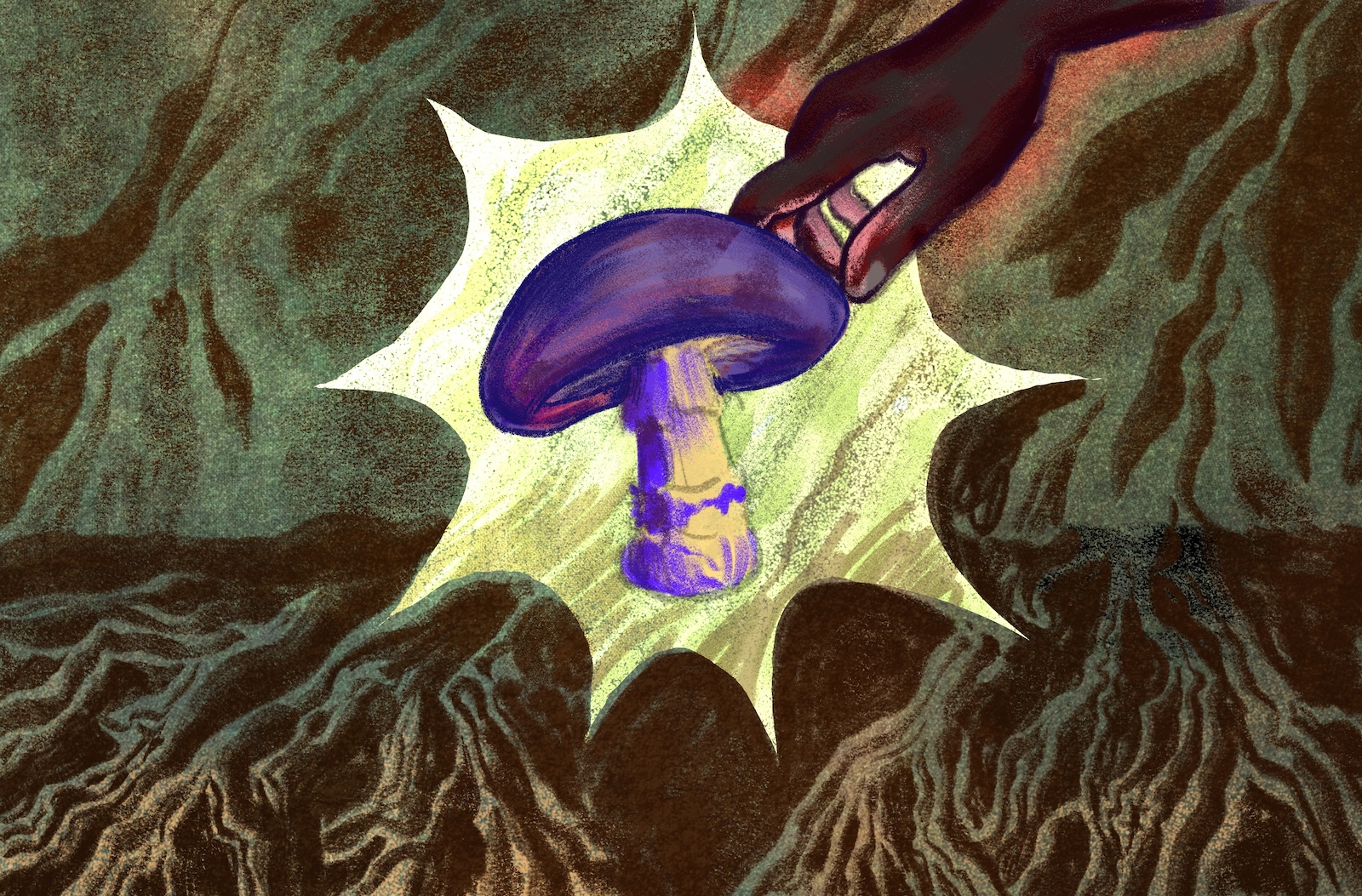
Illustration: Arantza Pena Popo
For Tony Cineus, finding the perfect mushroom is almost like falling in love: “The first time I found a morel, it was like my heart dropped. … The world paused for a second, and I just felt like I was finally doing something right for once. That’s how deep it was.”
Cineus was already an avid outdoorsman, but when he stumbled upon that first morel in a park in Stillwater, Minnesota, it sparked a new relationship, not only with nature, but also with his cultural identity. Cineus’ parents immigrated from Haiti and Mexico. Foraging makes him feel connected to his ancestors, who harvested much of their own food.
“When I forage mushrooms and prepare a Haitian dish that entails mushrooms, it just brings me back to my roots,” says Cineus, now the founder of The Mushroom Block, a project in Minneapolis that offers mushroom-growing workshops and trips to state parks or private lands where expert guides show new foragers how to identify edible mushrooms in season and poisonous ones. “What really got me hooked into foraging mushrooms was it felt so magical. You have to be there right at the right time to find them,” he says.

Anecdotal data shows that foraging and mushroom education groups have expanded over the past few years. Within this broader mushroom trend, groups run by and for people of color have also sprouted, creating communities that help close what researchers call the “nature gap”—the disparity in access and use of natural outdoor spaces that runs across racial and economic lines.
Research shows that white Americans are more than three times as likely to live in areas with easy access to public parks and urban outdoor spaces compared to people of color. White Americans also greatly outnumber Black Americans in outdoor recreational activities, like hunting, fishing, and wildlife watching, and in visits to national parks.
“Historically, we have been excluded from these spaces and here we are, trying to find our way back, essentially together, and to rewrite the narrative and not fall into the stereotype of ‘Black people don’t spend time outside. Black people don’t forage,’” says Hannah Vega, a photographer and founder of AfroForagers, a loose collective of more than 75 Black foragers nationwide.
Growing up, Vega hated the taste of mushrooms, but when she got into foraging during hikes with her now-husband, she found that wild mushrooms tasted more flavorful than ones in grocery stores. Twelve years later, Vega regularly forages in her backyard in Maryland and in local parks gathering mushrooms—trumpet-shaped chanterelles, snowy white lion’s manes, and leafy chicken-of-the-woods mushrooms are some favorites—as well as wineberries and nettles she uses in cooking.
She says that foraging not only ignites a “childlike curiosity” about the woods and helps her regain ancestral plant knowledge; it also changes her perception.
“It forces you to be mindful because of all the different things that you’re paying attention to when you’re foraging—obvious things, like the leaf shape, what other plant it’s growing next to on the landscape, microclimates, and things like that,” she says. “It really puts you in a different brainwave state where you’re slowing down, you’re more observant, you’re more mindful, you’re peaceful.”
AfroForagers aims to bring that experience to others and to undo some of the historic and modern-day barriers that limit access to wild spaces.
“It’s a multi-generational, social reproduction of exclusions, disfranchisements, and discrimination against people of color that led to what we see as the nature gap today,” says Dr. KangJae “Jerry” Lee, a University of Utah social and environmental justice researcher and the author of the book Violent and Verdant, which explores the history of violence and oppression in the US public parks system and potential solutions.
The United States has a long, complex history of controlling how people of color access outdoor spaces—from land theft and displacement of Indigenous groups to forced labor of enslaved people in white-owned fields. Shortly after the Civil War ended, laws restricting trespassing, hunting, fishing, and foraging in the North and South made it difficult and dangerous for free Black Americans to be in wild spaces.
Lee’s book details myriad ways in which pioneers of the American conservation and outdoor movements designed and casted outdoor spaces and recreational activities as being primarily for white, upper- and middle-class Americans through means ranging from discriminatory rules and park policing to financial divestment. Most public parks remained segregated until the 1960s, while zoning laws, redlining, and land use reforms disproportionately eliminated access to public parks and green spaces near communities of color.
Today, a wide body of scientific research shows that these disparities in access and use of natural spaces still exist and “are not coincidental,” Lee says.
Maria Pinto views foraging as an act of reclamation. Pinto became interested in the science of mycology after attending a party where someone brought a bag of freshly picked hen-of-the-woods mushrooms, some bigger than Pinto’s head. Hen-of-the-woods are sprawling formations—some weigh 50 pounds or more—and they create labyrinthine habitats for entire ecosystems, including tiny salamanders Pinto spotted skittering amongst the mushrooms’ petals.

The mushroom “turned from just being mere food to an object of fascination at that point,” she says. “This organism is making this beautiful work of art, this home for various creatures.”
Pinto’s book Fearless, Sleepless, Deathless is an essay collection that explores the hidden environmental and cultural histories of mushrooms and the ways that they’ve provided sustenance for marginalized peoples. She began leading foraging trips for people of color near Boston, Massachusetts, a few years ago. During one hike, Pinto was moved by the sight of adults giddily exploring the forest.
“It was a joy to look around and see other Black folks just playing in the woods. There was an extremely replenishing aspect to it,” she says. “It became clear to me that there needs to be a space where folks can kind of let their hair down and not feel like there’s anyone looking and casting judgment.”
Dr. Fushcia-Ann Hoover, a socio-ecological systems researcher at the University of North Carolina at Charlotte and a longtime forager, has experienced racial slurs and uncomfortable surveillance on outdoor trips. When she goes out with Outdoor Afro, a nonprofit that organizes outdoor activities led by and for Black people, there is this strong component of “we’re doing this together. We started together, we’ll finish together, and we’re checking in along the way to make sure everyone is doing OK,” she says.
Hoover adds that the uptick in foraging and outdoors recreation groups for people of color is a small, but meaningful step in closing the nature gap.
“We’re not going to solve the problem of racism,” she says, later adding that the real benefit of these groups is in “creating space where we can feel comfortable, we can be in community, and reclaim our right to be outside and enjoy those same things.”
Joy, Tony Cineus says, is central to the foraging experience, as is the magic of sharing food and knowledge and connecting with the living world.
“Even still to this day when I find mushrooms, it’s like running into an old friend,” he says. “It’s such a great feeling.”
Christina Couch writes about brains, behaviors, and bizarre animals for kids and adults. Her bylines can be found in The New York Times, NOVA, Smithsonian, Vogue.com, Wired Magazine, and Science Friday.