How Dating Apps Challenge Our Human Nature
“The Intimate Animal” explores how dating apps cause people to raise their expectations—and walk into first dates with preconceived notions.
The following is an excerpt from The Intimate Animal: The Science of Sex, Fidelity, and Why We Live and Die for Love by Dr. Justin Garcia.
When you purchase products through the Bookshop.org link on this page, Science Friday earns a small commission which helps support our journalism.
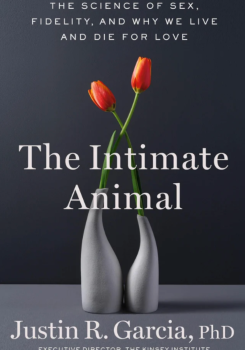
The Intimate Animal: The Science of Sex, Fidelity, and Why We Live and Die for Love
In a world of 8 billion people, where so many of us are living in densely populated cities and communities, in an age when a majority of the developed world has access to the internet and mobile technology, it’s incumbent upon those of us in the scientific research community to ask, “Why on Earth do so many of us feel so lonely and isolated?”
I believe one of the key answers is that the biological mechanisms evolution produced to help our species navigate human connection are flummoxed by the reality of the present moment. Evolutionarily speaking, we are not wired to deal with the deluge of data that defines our modern age. Today we can find endless potential partners on our smartphones, schedule a sexual hookup through an app, use customizable in vitro fertilization to procreate, check in on an ex through social media, marry people who were born thousands of miles away. These possibilities are in so many ways remarkable demonstrations of human ingenuity, but our species didn’t evolve in this type of environment, and neither did our sexual or relational behaviors. That’s not to say these changes are for the better or for the worse; rather, they are different challenges from the ones faced in Homo sapiens’s ancestral environments. Because of that mismatch, the human animal is simply ill-equipped to face today’s new interpersonal challenges.
The digital age has opened new possibilities for human connection, but it has also brought new obstacles when it comes to intimacy. People spend more time than ever on screens, and less time pursuing in‑person connections. With the emergence of technologies like video chats, short video clips, and the integration of images with sound, movement, and expression on dating app profiles, we are at a tipping point.
Young people are spending more time swiping on apps than meeting potential partners. Data collected over the last decade-plus from our annual Match study have shown unequivocally that more single Americans have met their most recent first date through the internet, particularly on dating apps (and this pattern seems to be occurring globally). By making it easier than ever to search for someone with the interests and the physical traits you most desire, anywhere in the world, these apps allow people from all walks of life to level up their partnering aspirations; after all, the chance of meeting your “perfect match” appears much greater once your choices are no longer limited to those who happen to cross your path. And our expectations have indeed risen. One large-scale recent study of online daters in four U.S. cities (New York, Boston, Chicago, and Seattle) found that both men and women tend to pursue potential partners who are about 25 percent more desirable than themselves. (Desirability rankings were based on the number of messages received and proportion of replies to messages sent, and by whom. If you contacted a much less desirable person, their desirability score would rise; if they contacted you and you replied, then your score would fall.)
The results are a mixed bag: Those billions of daily swipes yield an average match rate of less than 2 percent. In the 2021 wave of our national Singles in America survey, Helen Fisher and I found that nearly half of single adults felt technology has made it more difficult to forge real connections; interestingly, Gen Z and younger millennials were the most likely to say this. At least one recent study suggests that those who hold negative views about dating apps and websites carry that negative bias with them into their first dates, where it hovers over their new connections like a dark cloud blocking the sunlight.
New online and app-based dating markets are exploding, especially in Asia and Africa, and in parts of the world where women have only recently gained greater gender equality. Estimates suggest that, globally, more than 350 million people use these dating services every year. And it’s no longer just digital natives; older generations are increasingly adopting norms ushered in by tech-savvy young people, in a process social scientists call intergenerational cultural transmission, or the passing of information from one generation to another. Traditionally this happens from the top down; we learn from our parents and grandparents, who learned from their parents and grandparents, and the most useful stories, rituals, and skills are transmitted because they serve a social and cultural purpose.
With regard to contemporary dating technologies, though, this intergenerational pattern has reversed itself, and it has done so with shocking speed given the internet’s history as so evolutionarily recent that it’s a relative blink of the eye. A journalist from Colorado I spoke with told me her daughter had set her up with a dating profile right before heading off to college, as she wanted to make sure her single mom didn’t get lonely in an empty nest. More and more, we are seeing older generations finding their way onto dating sites, but they’re not always the ones doing the signing up. Kids take their parents’ pictures, teach them texting jargon, and help them navigate unfamiliar online platforms.
For a few years in a row, one of the fastest-growing dating websites in America was OurTime, which specifically caters to those age fifty and over. What’s interesting is that people signing up for OurTime are used to different dating norms than younger people today. How do you tell Grandma that the reason her last date isn’t texting her back is probably that she’s been ghosted? Or explain to Great-Uncle Leroy that he really should keep that private pic a private pic, or instruct him on how many successive texts is too many to send immediately following a date?
These are relatively minor issues of shifting social norms, but beneath the possibility dating apps provide to people of all ages is the reality that whether we are twenty-five or sixty-five, we are losing something when we shift courtship practices to internet platforms. This unprecedented opportunity comes with a cost. In a world that serves up all manner of digital connections, it is easy to forget that we’ve evolved to eventually need something more tangible.

Dr. Justin Garcia is an evolutionary biologist and executive director of the Kinsey Institute. He is the author of The Intimate Animal.