
Dr. Tyler J. Murchie is a biomolecular archaeologist who leads an ancient DNA research team at the Hakai Institute in British Columbia and is an Adjunct Assistant Professor at McMaster University in Ontario, Canada. His research uses ancient and environmental DNA to reconstruct past ecosystems and better understand species extinctions, climate-driven ecological change, and human–environment interactions across the Quaternary, with a particular focus on northwestern North America, the Canadian Arctic, and other long-term ecological archives. Tyler completed his PhD and postdoctoral research at McMaster University, following master’s and bachelor’s degrees in archaeological science at the University of Calgary.
His work has helped advance methods for recovering ancient environmental DNA from challenging materials, including permafrost sediments and coprolites, or palaeofaeces, and has contributed to research on the life history, evolution, and late survival of Ice Age megafauna such as woolly mammoths and mastodons. His broader research spans Arctic and subarctic ecological change, palaeoparasitology, human population genomics in Eurasia during the Roman Period, archaeological excavation, lithic technologies, and archaeogenetics in western Canada. Tyler’s team at Hakai, together with close collaborators including Dr. Hendrik Poinar at McMaster University and Dr. Duane Froese at the University of Alberta, is now focused on ancient environmental DNA from deep marine and Pleistocene permafrost sediments, wet-lab and computational methods development, and large-scale deep-time ecosystem reconstructions. This work is part of a joint NSERC Alliance-funded partnership between the Hakai Institute and McMaster University aimed at building ancient DNA research capacity across Canada.
Segment
Listen
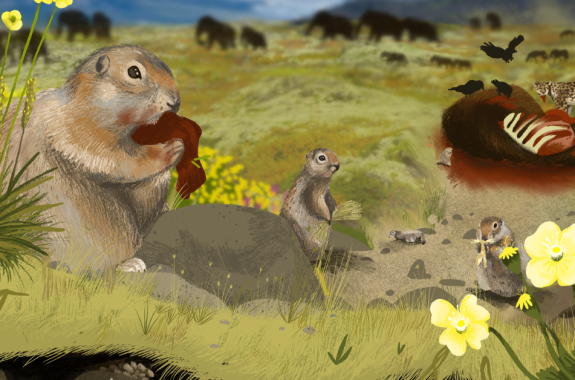
Squirrel poop drops Ice Age clues + The neuroscience of laughter
Ancient squirrel poop provides a snapshot of life during the last ice age. And, how different types of laughter originate in the brain.