Subscribe to Science Friday
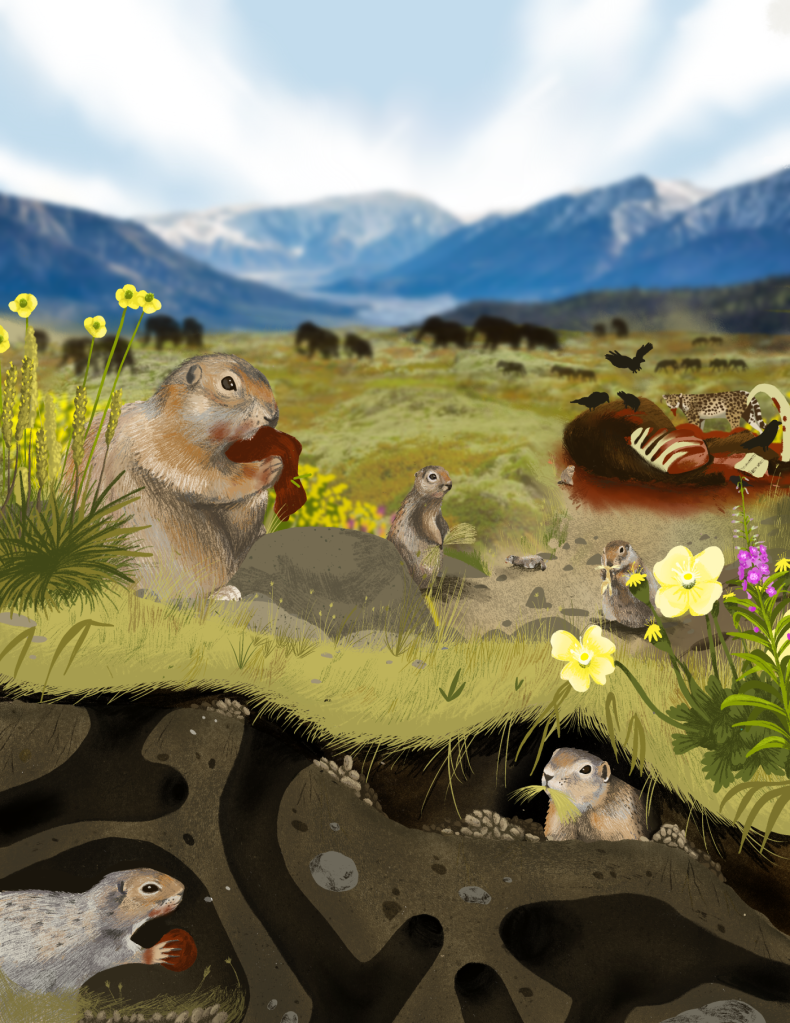
Hundreds of thousands of years ago, deep in the mountains of the Yukon, a ground squirrel pooped. That scat stayed frozen for millenia—until very recently, when researchers thawed it out and realized it was a literal data dump. They found traces of a surprising number of animals and plants, providing a detailed snapshot of life during the last ice age. Flora talks with biomolecular archaeologist Tyler Murchie about the gold mine that is ancient squirrel poop.
And, if you liked our poop jokes, you’ll want to hear how two different types of laughter are processed in the brain. Think big belly laughs versus polite chuckles in conversation. Ira chats with neuroscientist Sophie Scott about how these laughs originate and why we need them both.
Donate To Science Friday
Invest in quality science journalism by making a donation to Science Friday.
Segment Guests
Tyler Murchie
Dr. Tyler Murchie is a biomolecular archaeologist at the Hakai Institute in British Columbia and McMaster University in Ontario, Canada.
Sophie Scott
Dr. Sophie Scott is a professor of cognitive neuroscience at University College London in England.
Segment Transcript
FLORA LICHTMAN: This is Science Friday. I’m Flora Lichtman. Hundreds of thousands of years ago, deep in the mountains of the Yukon, a ground squirrel pooped. And that scat stayed frozen for millennia, until very recently, when researchers thought it out and found a real data dump.
Scientists analyzed the DNA in the droppings and identified traces of a surprising number of animals and plants, providing this new, detailed snapshot of life during the last Ice Age. Joining me now is the lead author on that study, Dr. Tyler Murchie, who studies ancient DNA at the Hakai Institute in British Columbia. Tyler, welcome to Science Friday.
TYLER MURCHIE: Thanks. It’s awesome to be here.
FLORA LICHTMAN: Thank you for being here. Is poop underappreciated in archeology? Is poop the new amber?
TYLER MURCHIE: I would definitely say so. At the beginning of the field, there is a lot of people who had worked with paleo feces to try to get DNA. But it’s always kind of been this undercurrent of the field because people really gravitate towards the big, amazing tusk of the woolly mammoth or these super cool bones. The idea of looking at poop, it’s not as flashy of a sample type.
And so a lot of these have just been in cold storage for some time. And I think this paper and some of our other ongoing work is really highlighting. You can get amazing, ancient biomolecules from unsuspecting sources old poop.
FLORA LICHTMAN: Yeah. So tell me a little bit about these specimens. Where did you find them? When were they from?
TYLER MURCHIE: Yeah. So a lot of this field work is done by folks like Scott Cocker and Duane Froese. And they go out to these areas in the Yukon that are these placer gold mines. And so the miners are there trying to thaw gold out of the permafrost sediments. And so they spray water cannons on the walls.
This thaws out the gold. It ends up in the river bottoms. But then the thing that they maybe don’t expect to find are tons and tons of fossils. And so tens of thousands of remains of mammoths and steppe bison and all the Ice Age critters you can imagine end up exposed.
But you also see in these large vertical exposures a whole bunch of pockets of ground squirrel burrows and these burrows and remains, in general, age between thousands of years ago to our oldest samples. Here are 700,000 years old, which is really ancient. Anatomically, modern humans maybe arose about 300,000 years ago, so twice as old and more than that.
FLORA LICHTMAN: So they’re sampling within these burrows?
TYLER MURCHIE: Yeah. And, well, part of the effort is to get up to these burrows and see, OK, what’s all in there? And a lot of them contain bits of plants. There’s unidentified bone, there’s seeds and nuts and all this kinds of stuff. And then there’s this whole midden, this latrine area that’s just full of poop. And there’s hundreds of poops, all kind of packed together in one spot. This is their pooping area.
And we thought, well, what if we looked at the DNA that’s inside those? I wonder what all’s in there?
FLORA LICHTMAN: Wow. So you bring it back to the lab, and then what’s the next step? What exactly are you analyzing?
TYLER MURCHIE: Yeah, so we’re trying to pull the ancient DNA out. And in part, that involves taking a small sample and then digesting the organic and inorganic parts of that to release the DNA. That ends up in solution. The funny part is that when you’re working with samples, usually there’s no smell. But with these samples, it was only once you put them in solution and digest it and you open the tube to pull out the super date. And then you realize, oh, wow, yeah, this is definitely liquefied poop right now.
FLORA LICHTMAN: The smell holds up. That’s kind of amazing. For 700,000 years?
TYLER MURCHIE: Yeah. Well, in part, they’ve been frozen in permafrost all that time. So it’s really spectacular preservation. Yeah. And so you’re trying to get the DNA out, and then you have to attach adapters to the ends of the fragments. And this is because when using high throughput sequencing technologies where we get hundreds of millions or billions of DNA sequences for every sample, you have to be able to identify which sample is which, and that took quite a lot of effort, because there’s so many partially degraded organics in poop that make, chemically, it quite challenging.
But then after you do all that, you have to then try to pull out the DNA you’re interested in, which is a whole other biochemical effort, because 90% of the sample is just DNA, that we don’t what it is. And so that just gets put into some other bin.
And then, of the 10% or so that we can identify, 99.9% of that is bacteria. And then, of the 0.1%, that other stuff is all the other things that are in there. And we’re really interested in here in case of the plants and animals.
FLORA LICHTMAN: Are you cross-referencing with a library or something? I mean, how do you do that? Is there a simple way to talk about it?
TYLER MURCHIE: Yeah, so NCBI, nucleotide database, people or genomicists, basically just upload all their DNA data for every organism they’ve ever discovered, and it just goes on this database. We then pull a local copy of this database, which is huge, hundreds of millions or it must be billions of reference genomes on there now, at this point, maybe not full genomes, but sequences anyway.
And then we, one by one, every 30 little base pair sequence of ancient DNA that we get, we align it to this gigantic database. And you have to use high performance computers to run through these enormous calculations to figure out what everything is. In this case, it took something like running continuously on four high-performance servers at four different universities, three to five months or so of continuous. And I was hogging the machines for most of that time. So it’s a lot of data.
FLORA LICHTMAN: Wow. Well, talk me through some of the highlights of what you found.
TYLER MURCHIE: Yeah. Well, when we first started, I thought it’s going to be mostly ground squirrel DNA and their gut microbiome, so the kind of bacteria and stuff that live in their guts. But I really wasn’t expecting to find woolly mammoth in steppe bison and horse and wolves and basically, a snapshot of the Ice Age in ground squirrel poop.
And even more DNA than we typically find even in the sediments in these areas. So it’s really this of enriched picture of all these different animals and plants and fungi and microbes. And not only are we getting individual little fragments of these organisms that we’re able to identify as oh, yep, this definitely belongs to this species of grass or this belongs to this type of herb.
We can actually start reassembling the genomes of these different organisms all at the same time, and stitch those back together to then look at how they’re related to other things today. And so there’s all sorts of applications you can get into. And kind of the–
FLORA LICHTMAN: Go ahead. No, go ahead.
TYLER MURCHIE: Oh, I was just going to say that the big question is, why is all this DNA in there? Why is it not just squirrel DNA?
FLORA LICHTMAN: I was going to ask, what did these squirrels get up to?
TYLER MURCHIE: Yeah, so one of the important parts is that Arctic ground squirrels, they are in hibernation or state of torpor for about eight months of the year. So they really are unconscious most of the time and in their burrows.
And so the period of the year that they’re actually awake, they need to be out on that landscape, getting everything they can for nutrition. And even when we first started, I just assumed ground squirrels were mostly eating nuts and seeds and stuff like that. I didn’t realize that they are really kind of like little bears, almost.
So we think there are so many big animals around. During the Pleistocene, there’s this paradox of productivity, tons of big organisms all over the place, and there is dead carcasses of mammoths around and such. And we think that they’re eating those remains and bringing back bones and bits of tissues to their nest to help make it through cold winter months during the Ice Age, during extremely cold periods of time.
FLORA LICHTMAN: I mean, is there anything about poop, in particular, that makes it a really good time capsule?
TYLER MURCHIE: Yeah, that’s another great question. I think, in part, it’s sort of a natural enrichment of the environmental DNA that’s on that landscape anyway. We’re shedding DNA all the time. And if that DNA ends up in the sediment, it can end up binding to minerals in the sediment and preserving long term.
I would think the DNA that passed through the digestive system of a squirrel, you wouldn’t think that that would have great preservation. So it’s kind of wild to imagine that these coprolites would be that well preserved. And so I don’t know if it’s just there are so much to begin with that it could make up for the fact that there is natural degradation from those microbes.
Or maybe there’s some other microbiome effect where the bacteria in the poop are protecting it from the other environmental bacteria that might break down that DNA. So that’s definitely an area that we want to get more into. I’m sure there’s some chemistry involved for why the DNA is preserving so well.
FLORA LICHTMAN: Did any of your findings challenge any assumptions of Ice Age ecosystems?
TYLER MURCHIE: Yeah. Well, one of them that’s kind of a tentative call in our assignments is we had hits to puma, which is a cougar, but there weren’t cougars as far as in Northern Yukon at that time. They really came from South America. But would we look at the hits to puma, they also match to American cheetah, but there wasn’t an American cheetah genome available on the reference database at the time. So it hit the next closest ancestor, which was cougar.
I suspect these are actually cheetah reads, American cheetah, which is, actually, it’s kind of a little bit of a misnomer. They’re not that closely related to cheetahs in Africa, but I think they initially thought they were. And so this is a little bit of a challenge of, well, were other cougars present here and much deeper in the past, or was it this other organism? There’s some more investigations needed there.
But then when we get into the squirrels, that’s a whole other can of worms in that there was maybe several additional species that have just been assumed to all be the same thing, in part, because people aren’t as interested in squirrels, so there hasn’t been as much effort into their own taxonomic evolutionary history.
So we’ve definitely, the one at 700,000 years old, seems like a totally different thing. And then the ones that are even there today are probably actually several species that have been grouped together into one thing.
FLORA LICHTMAN: When you walk down the street and you see scat on the ground, are you like, ah, there’s so much in it?
TYLER MURCHIE: I feel like definitely now I realize, oh yeah. Well, and especially from an environmental DNA perspective, just realizing we’re shedding millions of skin cells every day. There’s just so much DNA being released. And yeah, poop is full of DNA, but also, we’re just– you know the character, Pigpen, from Charlie Brown? Just releasing information all these incredibly small molecules of DNA all the time.
So there’s kind of gold mines all over the place in all these unsuspecting locations.
FLORA LICHTMAN: Dr. Tyler Murchie is a biomolecular archeologist at the Hakai Institute in British Columbia. Tyler, thank you so much.
TYLER MURCHIE: Thanks for chatting. This was great.
IRA FLATOW: I want you to think about the last time you had a big, old laugh. You know, the kind where you’re running out of breath, clutching your stomach. Your eyes are tearing up, and you just can’t seem to stop. There’s a fancy phrase for this. It’s called spontaneous or involuntary laughter.
Now, this feels like a very different kind of laugh in, let’s say how you might laugh making small talk with your neighbors or chuckling at Flora’s and my jokes. This is called voluntary laughter. And not only do these two types of laughs feel very different, but a new study found that they originate in different parts of the brain.
Joining me is study author, Dr. Sophie Scott at University College London. Dr. Scott studies how our brains process and produce speech. Welcome to Science Friday.
SOPHIE SCOTT: Thank you so much.
IRA FLATOW: Nice to have you. OK, Sophie, what did you find? Where do these different laughs come from?
TYLER MURCHIE: So there’s basically, in the human brain, two different ways that control how sounds are made. One is called the volitional motor system. And it’s associated with brain areas you actually only find in humans. And they are recruited when you are talking, when you are singing, when you’re using your voice in a volitional way. And by volitional, I don’t mean you’re paying attention to exactly how you make every single speech sound, but it’s a voluntary act. You could stop at any time.
And we also have an evolutionarily older system that’s running down the midline of the brain, and that is the one that we share with all other mammals. And it’s associated with much more involuntary, reactive, emotional sounds. So if you were really frightened by something, you’d be much more likely to start screaming than to say, I am frightened.
And that’s very different from that volitional motor network. And it seems to be consistent with that spontaneous, helpless laughter. It has a very different profile. As I said, once you’ve start it, you can’t stop doing it. Whereas that volitional laughter, which is actually most of the laughter you encounter, is more like that. And that happens in conversations.
And there in conversations, people time the laughter really, really precisely. So everyone laughs together at the end of a sentence, and then they carry on, and they start and stop at the same time. So that kind of motor control, that’s not possible with spontaneous laughter.
IRA FLATOW: Is that just a fake laughter then?
SOPHIE SCOTT: Well, it’s probably like a world of laughter, actually, because as I say, most laughter actually fits in that more volitional way. So if you look at people where there was a fantastic American psychologist called Robert Provine, and he pointed out that though we think laughter is about jokes and comedy. Most laughter happens for social reasons.
And of course, conversations, what we’re doing now, that’s how humans around the world maintain social interactions. So that laughter, its natural homes in those conversations. And in those conversations, sometimes people are laughing because something’s funny. That does happen, but also, they’re laughing because they might just catch a laugh from somebody else. They’re laughing contagiously, or they’re laughing to show agreement or understanding.
And people will use laughter to cover up other embarrassment or other emotions, or they’ll use laughter to deal with stress. So it’s like a hall of mirrors. Most of that I’ve just described would fit probably under that volitional network.
IRA FLATOW: Was the discovery that there are two kinds of laughter, and that they originate in two different parts of your brain, was that a surprising discovery? How did you figure that out?
SOPHIE SCOTT: I’d been thinking about the fact that it had to relate in some way to these different motor networks, but we didn’t have good evidence for this. And what was really nice about getting to work on this paper with Fausto Caruana is that he does really detailed mapping studies of what happens when you stimulate different brain areas. And he’d become interested in laughter. Because sometimes when you stimulate brain areas, you do get laughter. It’s what is called pre-surgical mapping. You are looking to see, identify brain areas which are involved in epilepsy.
And we’ve been using these data to study laughter because what it lets us do is actually relate in a really precise way which brain areas people are stimulating when they record examples of people laughing. So it gives us much greater precision and the ability to actually record while people are laughing, because a lot of other techniques like functional magnetic resonance imaging, they really can’t cope with the fact that people move a lot when they’re laughing. So this really does give us both precision, and also, it makes it actually possible.
IRA FLATOW: So you basically zap their brain, and they start laughing?
SOPHIE SCOTT: Yeah. And sometimes the laughter just seems to happen. And the people and it’s sort of mirthless. And other times, the laughter happens and people feel the sense that something was funny.
IRA FLATOW: Well, knowing all of this, do you think about your own laugh differently. I guess, is how I would put it?
SOPHIE SCOTT: I do. Many years ago, I’m talking about 1998, my father was desperately unwell and dying in a French hospital, and he lives at the end of the story. Don’t worry. But we were all sitting around waiting for doctors to do something, and he suddenly said, oh, we’ve laughed a lot, haven’t we?
And I said, yes, Dad, we have. We really have laughed a lot. And I didn’t work on laughter at the time. I thought about it, and it stayed in my mind. And then I started working on laughter, and I thought, oh, he’s right. The times in your day when you’re laughing with people, it can feel trivial and silly, like it’s just frivolous time wasting. You’re not achieving anything there.
But it’s actually probably the most important points in your day in terms of the making and maintaining the bonds you have with other people and feeling better together.
IRA FLATOW: Well, we can certainly use a lot more of that laughter, Dr. Scott. Thank you for taking time to be with us today.
SOPHIE SCOTT: Thank you.
IRA FLATOW: Dr. Sophie Scott is a professor of cognitive neuroscience at University College London.
Copyright © 2026 Science Friday Initiative. All rights reserved. Science Friday transcripts are produced on a tight deadline by 3Play Media. Fidelity to the original aired/published audio or video file might vary, and text might be updated or amended in the future. For the authoritative record of Science Friday’s programming, please visit the original aired/published recording. For terms of use and more information, visit our policies pages at http://www.sciencefriday.com/about/policies/
Meet the Producers and Host
About Flora Lichtman
Flora Lichtman is a host of Science Friday. In a previous life, she lived on a research ship where apertivi were served on the top deck, hoisted there via pulley by the ship’s chef.
About Rasha Aridi
Rasha Aridi is a producer for Science Friday and the inaugural Outrider/Burroughs Wellcome Fund Fellow. She loves stories about weird critters, science adventures, and the intersection of science and history.