Joining the NSA’s hidden team of Black codebreakers in 1950
In “Decoding the Devil,” a woman named Iris joins a hidden NSA unit of Black codebreakers decoding Soviet messages during the Cold War.
The following is an excerpt from “Decoding the Devil: Black Women Codebreakers and the Secret War Against Stalin’s Bomb” by Dr. Sarah Valentine.
When you purchase products through the Bookshop.org link on this page, Science Friday earns a small commission which helps support our journalism.
Decoding the Devil: Black Women Codebreakers and the Secret War Against Stalin's Bomb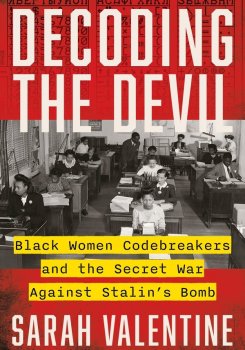
Buy the Book
On Iris’s first day at the National Security Agency, a white lieutenant marches her down to the basement of Operations Building A. The underground facility is even hotter than the sunbaked rooms upstairs. Before Iris sees the room, she feels it—the floor rumbles like she’s standing on empty tracks. As she approaches, the rumbling grows into a sound of a hundred teletype machines thundering like a freight train. Outside the door, she smells perspiration and machine oil, hints of the furious operation to break Stalin’s war machine.
When Iris opens the door, she finds scores of women in lace-collared blouses and men in smart suits working in controlled chaos: One group wrangles clunky machines that hiss, jam, and clatter out messages in Cyrillic. Another speed-reads continuous strips of Russian telegrams—raw intelligence from Soviet ministries on atomic production, weapons shipments, delayed deliveries. A third stamps and routes printouts to a dizzying list of branches, sections, and subsections—all working on the Russian problem.
In the long, windowless wing, like the belly of a whale, Iris takes her place amid the throng. She puts on a rubber apron and stands at an industrial ink press to stamp serial numbers on outgoing messages—for eight hours straight. She is a cryptologic clerk, grade 3, a role assigned to hires with highschool educations. With her master’s degree and aced training exams, she should be a cryptanalyst, grade 7. But it’s 1950, and Iris is Black. Her credentials don’t count.
Iris is part of Traffic Processing Division, the outfit that handles all the Agency’s Russian-language telegrams. The Agency’s white professionals won’t touch this kind of work—it’s too dirty, too tedious, too labor-intensive. But it’s the bedrock on which almost all the Agency’s Russian operations rely. The Black cryptologic clerks, most of them college educated like Iris, process more than one hundred thousand Soviet telegrams a day under crushing quotas and constant surveillance.
The only white person in the room is the armed Air Force guard at the door.
Everyone at the Agency knows the nickname for this division: “the plantation.”
But no one talks about it.
This story was never meant to be told.
The Black codebreakers who kept America’s intelligence machine running during and after World War II were hidden in plain sight—segregated, overworked, and written out of the official histories because they revealed an uncomfortable truth. For decades, their contributions were buried under layers of classified secrecy and institutional neglect—and no one outside the intelligence world knew they existed.
Now, as the intelligence community reckons with its past—and as our country continues to confront how race and labor have shaped every American institution—the Black codebreakers’ story demands attention. The Cold War may be over, but its infrastructure is still with us. The enmity between the United States and Russia, the legacy of nuclear weapons production. The surveillance systems, federal workforce structure, hierarchies of access and recognition all have roots in places like Arlington Hall and in stories like these.
Excerpted from DECODING THE DEVIL by Sarah Valentine. Copyright © 2026 by Sarah Valentine. Reprinted courtesy of Harper, an imprint of HarperCollins Publishers.
Dr. Sarah Valentine is the author of “Decoding the Devil: Black Women Codebreakers and the Secret War Against Stalin’s Bomb.”