Reclaiming health and humanity in a tech-filled life
“Body Electric” examines what technology and screens are doing to our minds and bodies, and how we can reclaim our well-being.
The following is an excerpt from “Body Electric: The Hidden Health Costs of the Digital Age and New Science to Reclaim Your Well-Being” by Manoush Zomorodi.
When you purchase products through the Bookshop.org link on this page, Science Friday earns a small commission which helps support our journalism.
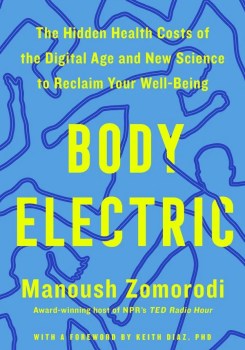
Body Electric: The Hidden Health Costs of the Digital Age and New Science to Reclaim Your Well-Being
I was scared to write this book.
This sounds ridiculous coming from someone whose job once required strapping into a rickety ex-Soviet military jet, forged visa in hand, and flying into Belgrade while protesters set their parliament on fire, but here we are. I’ve lugged a bulletproof vest across borders, been trained to deal with kidnapping situations (they literally yanked a sack over my head and tossed me into a van), and learned to decode stick signals left by guerrilla fighters to warn of homemade bombs. So why does typing words into a computer feel so risky?
Because in many ways, it is also hazardous. Writing a book requires sitting at a desk for months on end. And we’ve all heard what sitting does to us. For over a decade now, we’ve known that it’s the “new smoking,” thanks to a Mayo Clinic obesity researcher named Dr. James Levine. The numbers are indeed chilling: A 2024 study found that sitting more than ten hours a day significantly raises (by 40–60 percent!) the risk of heart attack, heart failure, and cardiovascular death.
So you can imagine why I’d be nervous about taking a year or so to sit and write a book.
But there’s more to it than just the sitting.
It’s the hours of searching, scrolling, and tapping; the long days living in Google docs, hunched over, squinting, attempting to focus within an inch of my brain’s capacity and function, as I click back and forth between screens, eyes bloodshot, dry, and irritated.
And I know it’s not just me.
Today, whatever our jobs or ages, our daily lives are shaped by endless emails, Zoom calls, texts, feeds, notifications. Remote workers toggle between apps for hours. Kids sit in classrooms on laptops all day, then spend their evenings doing homework online, watching YouTube, and texting friends. Older adults may be retired, but their days are still screen-filled: virtual classes, streaming TV, WhatsApp family chats.
Tapping, swiping, scrolling, sitting—it’s the rhythm of modern life. And it’s the source of our stiff necks, foggy minds, shoulders hiked up to our ears, energy drained, focus depleted, yet unable to sleep.
We tell ourselves this is simply the tradeoff for all the connection and convenience. This is just how it is. But our devices are doing more than leading us to sit for hours: They’re disrupting the quiet feedback loop between the body and the brain, leaving us exhausted, strangely disembodied, and feeling like crap.
Is this really the price of living in the twenty-first century? Can’t we live with our tech without feeling wrecked by it?
Big questions like this have always pulled me in. For years, I’ve been investigating how technology shapes us—our attention, our creativity, and our senses of self. My first book, Bored and Brilliant, grew out of a citizen science project where tens of thousands of people joined me in exploring how boredom (yes, boredom) could unlock creative breakthroughs. I explained the neuroscience behind why our brains aren’t built for all those pings and notifications—and together, we experimented with spending less time on our phones and more time letting our minds wander. The results were small but powerful: better sleep, clearer thinking, and moments of unexpected joy.
Since then, I’ve carved out my own beat—what I call the mind-body-tech connection: how our health is influenced by the tools we use every day, and how we can reclaim our humanity in a world designed to keep us glued to screens.
During the pandemic, my questions about the physical impact of our digital habits crystallized. Millions of us were tethered to our technology for work, school, socializing—everything—and any boundaries between our bodies and our devices completely dissolved. The result was an overwhelming fatigue that gave us new aches and pains, rising anxiety, and yet more trouble sleeping.
As we were emerging back into the world, I came across the work of Keith Diaz, a Columbia University Irving Medical Center researcher studying the physiological effects of sedentary behavior. His straightforward finding grabbed me: Simply getting up for a five-minute walk every thirty minutes reversed many of the negative effects of prolonged sitting. Blood sugar spikes, blood pressure, mood dips, fatigue—all vastly improved in his lab’s participants.
I was intrigued. But I had to ask: Could people actually take these breaks in real life? Outside the controlled confines of a lab, where we’re all chained to back-to-back virtual meetings or deep in “flow” at our desks, would anyone really interrupt themselves to move that often? Would I?
There was only one way to find out.
Keith and I ended up joining forces and designing what became a global clinical trial. We invited NPR listeners to participate, and within days, more than twenty thousand people from across the US and around the world signed up. For several weeks, participants experimented with building movement breaks into their screen-filled days. It wasn’t easy. People had to rethink routines and negotiate with their environments—meeting-heavy workplaces, demanding family schedules, ingrained habits. But for those who figured it out, the benefits were outsize:
This wasn’t just a life hack. It felt like the beginning of a cultural shift—a small but radical recalibration of how we move through our days. And that recalibration is increasingly urgent:
The World Health Organization warns that our sedentary lifestyles could lead to nearly five hundred million people developing preventable conditions—heart disease, diabetes, obesity—within this decade. The economic cost? Over $27 billion annually.
These statistics are some of the clear consequences of the habits we’ve slipped into: marathon days at our screens, nights slumped on the couch, scrolling but never really recharging.
This book is about helping individuals be part of the solution. And it goes beyond five-minute movement breaks.
We’ll use science to rebuild the natural rhythms our bodies crave, even as we stay connected:
Part 1 explores how we arrived here—biologically, culturally, and technologically—and introduces the Body Electric protocol: ways to weave movement breaks into your life to counteract the physical toll of sitting and screen time to help you feel better.
Part 2 examines how specific systems of the body—your eyes, lungs, posture, nervous system—are adapting to and rebelling against our tech-saturated lives, and offers small daily shifts to support them.
Part 3 looks outward at how these ideas can be applied across generations, from kids growing up online to older adults seeking longevity and vitality.
By the time you finish, you’ll have a tool kit for living a life that feels more grounded and embodied—your life, your way.
To be clear: This isn’t about unplugging from modern life. Most of us can’t go off the grid and don’t want to. My smartphone has been my lifeline, helping me balance a career and raise two kids, managing the invisible logistics of modern life—calendars, texts, reminders, all of it. I’m not anti-tech. I’m fascinated by it. Cautiously hopeful about what AI and other emerging technologies might bring. But tech isn’t neutral. It changes us. And right now, it feels like our bodies are collateral damage. When we’re overloaded, we can’t simply “upgrade the operating system.” But we can recalibrate and reclaim what makes us human. As I wrote this book, I practiced the very strategies you’re about to read. I took the breaks. I restructured my days. It worked.
Cultural shifts always start the same way: with one person at a time deciding, I don’t have to live like this. And proving it’s possible.
Imagine colleagues standing up mid-Zoom without apology. Not admonishing kids about screen time but asking if they’ve gotten their “stroll time.” Move breaks becoming as normal as coffee runs or Slack checks.
Join me and all the people out there who are getting their energy back. We can help lead the way.
Excerpted from BODY ELECTRIC: The Hidden Costs of the Digital Age and New Science to Reclaim Your Well-Being. Reprinted with permission from Flatiron Books; copyright (c) 2026 Manoush Zomorodi
Manoush Zomorodi is host of NPR’s TED Radio Hour and author of “Body Electric: The Hidden Health Costs of the Digital Age and New Science to Reclaim Your Well-Being.”