The laws of physics are just one window on reality
In “On the Equality of All Things,” Carlo Rovelli challenges the idea that physical laws can explain everything about the world.
The following is an excerpt from “On The Equality of All Things: Lessons on Physics and Philosophy” by Carlo Rovelli.
When you purchase products through the Bookshop.org link on this page, Science Friday earns a small commission which helps support our journalism.
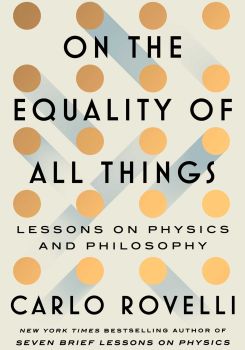
On The Equality of All Things: Lessons on Physics and Philosophy
Physics is often credited with a power it does not have: that of exhausting what can be known about the world. This is nonsense. Knowing the physical laws of the world does not amount to knowing the world. Thinking this is like thinking that having learned the rules of chess means knowing everything there is to know about chess. If that were the case, there would be no books that teach chess, and anyone who knew the basic rules would be equally good at playing it. There is much more possible knowledge about chess than the banal rules of chess-piece movement.
There is much more possible knowledge about the world than the simple equations of basic physics.
If we say that a car is nothing more than a collection of atoms obeying Newton’s laws of motion, we are saying something that is true, but irrelevant to life. Are we explaining how a car works? Of course not. No more and no less, as Wittgenstein astutely observes, than when we say that everything is explained by the will of God, or by fate. Natural laws, like God, serve as the stopping point in a chain of questions. In both cases, they do not explain; we are merely offered an irrefutable name to which we can delegate the work of explanation, whether this is possible or not.
If I say that the car broke down because the laws of physics dictated it should do so, I am saying something true, but useless— just as if I said that it broke down because God wanted it to. The only person who is competent enough to solve my car’s breakdown is not God and not the particle physicist: it is my trusted mechanic, because he has the conceptual and material tools suitable for repairing my car. Knowledge at a higher level (that of the mechanic) has its own value, greater than knowledge of elementary physical structure, because it allows us to understand, organize, and anticipate phenomena without getting lost in irrelevant details.
This high-level knowledge is effective for vast classes of phenomena that could even correspond to extremely different elementary situations. The same software runs on different computers; the same game of chess can be played on different boards; the same equations for critical phenomena apply to disparate physical systems; the same music can be played, read on the musical score, recorded on different media, and so on. A carburetor works the same way in a Toyota and a Land Rover. For this reason, higher-level knowledge is autonomous. It establishes its own conceptual frameworks, defines its objects, and has knowledge value by itself, irrespective of the underlying microphysics.
This is why we say that a carburetor “exists,” and so does an atom, and so does a soul. Each of these entities plays a working role in a partial and effective description of the world. We have these effective partial descriptions of the world. And they are all we have.
Some perspectives are more fundamental than others from their point of view, which is legitimate, just as others are more fundamental from their different, equally legitimate points of view. Because “fundamental” is a relative word. The bottle is “nothing but atoms,” just as the very notion of “bottle” is perspectival and social. And just as our access to the bottle occurs through our senses.
I see no contradiction between these perspectives, unless we ask about the “ultimate” foundation of everything and the “ultimate reality”: questions that strike me as meaningless. The bottle is real in the same sense that the atoms that compose it are real, and the international capitalist market that brought it to America from Italy is real. In each case, we use appropriate criteria of reality, slightly different in different cases. This is the equality of all things.
To say, as I often hear, that if we know the world’s fundamental physical equations then we know everything about the world, is, I believe, nonsense. To say anything useful about the world, the equations of physics are not sufficient: we would need to have already explored the immense vastness of their solutions. And that would still be useless. We would need to know something useful about what we have before us, to know conceptual structures suited to capturing specific aspects of the situations that interest us. Knowing whether what we have before us is understandable in its own terms is far more useful than to call on useless elementary physical laws.
Physics is less useful than it is sometimes said to be. Physics is overrated.
Excerpted from ON THE EQUALITY OF ALL THINGS. Copyright © 2026, Carlo Rovelli. Reproduced by permission of Scribner, an imprint of Simon & Schuster. All rights reserved.

Dr. Carlo Rovelli is an Italian theoretical physicist and the author of several books, including “The Order of Time,” and “On the Equality of All Things.”