Go foraging to try this acorn pancake recipe
Grab some acorns and hickory bark to try this recipe from “Happy Snacking, Don’t Die.”
The following is an excerpt from “Happy Snacking, Don’t Die!” by Alexis Nikole Nelson.
When you purchase products through the Bookshop.org link on this page, Science Friday earns a small commission which helps support our journalism.

Happy Snacking, Don't Die! Foraging and Vegan Recipes with Black Forager
Listen, I love any and all pancakes, but I really love these because they’re puffier than your average flapjack and the Acorn Flour brings a nuttiness that’s so unique and delicious. It’s not often that we think of the role flour plays to impart flavor to a finished dish, so let these babies surprise you in all the best ways. Don’t be intimidated by the smoked hickory syrup, either—it’s easier than it seems! But if you’re short on time (or, well, hickory bark), these pancakes are delicious with any syrup you’d like to use.
SERVES 2 TO 4 PEOPLE
FOR THE SYRUP
FOR THE PANCAKES
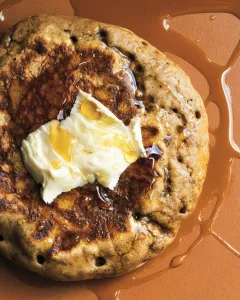
MAKE THE SYRUP: Preheat the broiler to 500°F. Fill a medium saucepan with 4 cups of water and set aside.
Place the hickory bark on a baking sheet and broil until fragrant and just slightly smoky, 5 to 6 minutes. Using tongs, immediately transfer the bark to the pan of water.
Set the pan over medium-high heat and bring to a boil. Reduce the heat to medium-low and simmer until the water is a medium amber color, about 15 minutes. Remove and discard the hickory bark.
Reduce the heat to low and add the brown sugar and salt. Stirring occasionally, gently heat the mixture until the brown sugar has dissolved completely, about 5 minutes. Remove the pan from the heat and set aside. From here you can let the syrup cool completely, and store in an airtight jar in the fridge for up to 2 weeks (unopened). Or you can use it right away!
MAKE THE PANCAKES: In a medium bowl, whisk together the all-purpose flour, Acorn Flour, sugar, baking powder, and salt. Add the milk, vinegar, and vanilla and whisk until smooth. Add the juneberries (if using) and stir to combine. Set aside.
In a large skillet over medium heat, melt a few teaspoons of butter. Working in batches, use about 1⁄4 cup of batter for each pancake and cook, undisturbed, until bubbles form on top, 3 to 4 minutes. Flip and cook until the underside is fully cooked, 1 to 2 more minutes. Transfer to a plate and repeat with the remaining batter. Remove the pan from the heat.
Serve warm with the Smoked Hickory Syrup.
TOOLS
Fill a large bowl with water and add the acorns. Discard any acorns that float.
Fill the quart-sized jar about halfway with cold water. Using your nutcracker of choice, shell the acorns and drop the acorn meat in the water.
In a blender, add the acorn meat and its soaking water. Top off with a bit more water. (You want to help the blender really grind these up.) Blend until the acorn pieces resemble large grits.
Set a fine-mesh strainer over the same quart jar. Carefully pour the blended acorn mixture through the strainer, keeping the grits in the strainer and the cloudy water in the jar. Set the strainer with the grits aside.
Add the reserved grits to a large bowl and cover with cool water. If you live with pets or small children, cover the bowl with a towel and set it somewhere out of their reach. Let the grits sit for at least 8 hours—I like to do this before I head up to bed for the night.
Pour off the soaking water and replace with cool, fresh water. Taste a grit. It will probably taste very gross and bitter the first time! This is the tannic bitterness we’re slowly coaxing out of these acorn grits. Repeat this process of soaking, draining, and replacing with fresh water, tasting as you go, until the grits no longer taste gross—in fact, they shouldn’t taste like much of anything once they’re done leaching out the tannins. This is the part that can take up to 10 days, so try and relax and let the acorns do their thing!
Important note: Your tastebuds are the boss. If your grits taste good but the water still isn’t totally clear, it is okay! Remember that a lot of foods and drinks have a certain level of tannins—wine, tea, chocolate, and a host of vegetables and fruits! You’re not trying to eliminate them completely, you just want them at a low, tolerable level.
In the same way we dehydrated the starch, we’ll dehydrate the grits. Drain out as much water as you can and spread the grits out on a baking sheet or food dehydrator tray. Set the tray in a sunny spot in your house (again, inside! Do not underestimate your neighborhood critters!) and let the grits dry, mixing and re-spreading them to dry evenly, for a few days. Or, if you do have a food dehydrator, dehydrate at 95°F until completely dry, about 24 hours. Let the grits cool completely.
Add the dried acorn grits to a spice grinder (you may need to work in batches) or a food processor and grind into a flour. Transfer the flour to a clean jar, seal, and store in a cool, dry place.
’Tis she, Goth Nut Drink! Nocino is a traditional Italian nut liqueur, fortified with warm spices and high-proof alcohol. While this is one of the lengthier recipes in terms of time before you can try the finished product, I haven’t yet met someone who has not deemed it worthwhile at the end. A loving warning: Give this at least six months’ steep time before trying it (and honestly, six months is still not enough time for me). Many a forager has, out of natural curiosity, tried a nocino before it’s done aging, only to find an acrid liquid reminiscent of a wet burp. Much like all of us, nocino only gets better with time. My best advice, to keep that curiosity at bay, is to let this age somewhere where you’ll kind of maybe a little bit forget about it? By the time you unearth it again, it’ll be ready.
The fun part is, once you know what a “basic” nocino tastes like, you can play around and make eclectic batches! I’ve included some flavor suggestions and greatest hits below.
MAKES ABOUT 1 QUART
FOR THE NOCINO
SPICE COMBINATIONS
Traditional Italian: vanilla beans, citrus peel, whole coffee beans, cinnamon sticks, star anise, fennel seeds
The Forager: dried spicebush berries, smoked hickory bark, roasted dandelion root, prickly ash leaves
The Olivia (named after my friend!): Meyer lemon peel, fresh juniper berries
In a large, clean jar, add the halved walnuts and spices of your choice. Completely cover in the vodka—you may not need all of it, depending on the size of your walnuts and what spices you’re using. Seal and store the jar in a cool, dark place for 6 to 8 months.
Set a fine-mesh strainer over a medium bowl. Strain out and discard the solids. Measure the volume of the resulting liquid. You’ll want to add that same volume of simple syrup, which we’ll make now. Let’s say you need about 2 cups of simple syrup.
In a medium saucepan over medium heat, combine 1½ cups of water with 1½ cups of sugar. Bring the mixture to a simmer and stir continuously until the sugar has completely dissolved, 3 to 5 minutes. Remove the pan from the heat and let cool completely.
In a large jar or bottle, combine the nocino with the syrup. Seal and store in a cool, dark place for up to 6 months.
Excerpted from Happy Snacking, Don’t Die: Foraging and Vegan Recipes with Black Forager. Copyright © 2026, Alexis Nikole Nelson. Photography Copyright © 2026 by JB Douglas. Reproduced by permission of Simon Element, an imprint of Simon & Schuster. All rights reserved.

Alexis Nikole Nelson is a forager and outdoor educator. She’s also the author of the foraging guide and cookbook “Happy Snacking, Don’t Die.”