Humans have always been composting
In “Compost after Reading,” a history of how humans have managed the decomposition process to replenish soil through the ages.
The following is an excerpt from “Compost After Reading: A Practical Manifesto for Purposeful Decomposition” by Cassandra Marketos.
When you purchase products through the Bookshop.org link on this page, Science Friday earns a small commission which helps support our journalism.
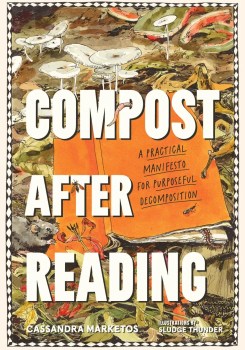
Compost After Reading: A Practical Manifesto for Purposeful Decomposition
Humans have been composting for as long as we’ve existed. We have discovered and rediscovered the value of our waste across the centuries, often through methods as simple as observing death. While browsing Compost Magazine, I discovered this quote dating back to the beginning of the second century, by the Greek philosopher Plutarch:
Nevertheless, it is said that the people of Massalia fenced their vineyards round with the bones of the fallen, and that the soil, after the bodies had wasted away in it and the rains had fallen all winter upon it, grew so rich and became so full to its depths of the putrefied matter that sank into it, that it produced an exceeding great harvest in after years, and confirming the saying of Archilochus that “fields are fattened” by such a process.
All the ingredients for a vigorous compost are present: the organic body, the leafy waste of the vines, the rain, and the ground. One wonders what Archilochus must have witnessed a thousand years prior—which fields were fattened and by whose corpses. These details of decomposition are lost to recorded history.
A set of clay tablets recovered from the time of the Akkadian Empire, thousands of years before Plutarch’s time, document what some believe to be a recipe for making compost. Similar references have been found in ancient Hindu texts. In China, a composting method involving oil cake amended with crop residue was recorded by Chen Fu around the year 1149 BCE. Later, around 385 BCE, Greek warrior and philosopher Xenophon advised farmers to gather weeds and allow them to rot in water, in order to create a green manure for the improvement of their fields.
Early Hebrew scripture references manure being mixed with street sweepings and organic refuse, forming a dung hill that was kept at the edge of the city, like an early version of a town dump. The Talmud describes the process: “They lay dung to moisten and enrich the soil; dig about the roots of trees; pluck up the seckers; take off the leaves; sprinkle ashes; and smoke under the trees to kill vermin.” Cleopatra, in 50 BCE, is reported to have made worms sacred after observing their connection to the cultivation of healthy soils. She enacted laws to make their removal from Egypt a crime punishable by death.
George Washington is referred to as “America’s first composter.” His preoccupation with finding ways to improve the poor soils at his home in Virginia led him to build a dung repository near his stables, where he brewed a mixture of manure and plant material to use as fertilizer. You can still tour a reconstruction of this site today. However, there is ample evidence that people were composting in America long before Washington. According to historian Jim Loewen, “Composting first appears in the historical record of what is now the United States in 1621, when Squanto showed the ‘Pilgrims’ how to put a fish in each corn hill, so the maize and squash would thrive.” He goes on to describe how different pieces of Indigenous languages outlined the use and meaning of compost for Native peoples: “Narragansetts called the fish ‘munnawhatteaugs,’ which means ‘fertilizer’ or ‘that which enriches the land,’ a word the English corrupted into ‘menhaden.’ The Abenakis of Maine called them ‘pauhagens,’ which also means ‘fertilizer,’ a name the English shortened to ‘pogies.’”
The history of compost is woven in this way through centuries. Every culture, at every turn, has arrived at the conclusion that dead and decaying matter is a vital source of life. It appears in our written records, our language, and, on occasion, the stone beneath our feet. For example, fossil evidence survives that suggests that ancient Scots planted their crops directly into composts made from manure, beginning about twelve thousand years ago.
John Adams was enthusiastic about manure and documented his preoccupation with it quite thoroughly in his diaries, which have been made available through the Massachusetts Historical Society.
In one of my common Walks, along the Edgeware Road, there are fine Meadows, or Squares of grass Land belonging to a noted Cow keeper. These Plotts are plentifully manured. There are on the Side of the Way, several heaps of Manure, an hundred Loads perhaps in each heap. I have carefully examined them and find them composed of Straw, and dung from the Stables and Streets of London, mud, Clay, or Marl, dug out of the Ditch, along the Hedge, and Turf, Sward cutt up, with Spades, hoes, and shovels in the Road. . . . This may be good manure, but it is not equal to mine.
Compost also appears as a kind of myth, or even a dream. One summer, my friend David wrote to me from a trip. He had just heard something exciting about “witches” in medieval France who gathered nightly around compost. Apparently, they were using the piles for warmth on cool evenings. “Los evangiles de ecreignes, I think, but I’m busy and will need to look later.” I translated the phrase and recorded it into a diary, but neither David nor I spoke of the witches again. We both forgot, distracted by other projects. It wasn’t until months later that I remembered and returned to those pages, searching for more information. But my notes did not contain the translation that I so clearly recalled having included before. Instead, under the header “Compost witches,” it read only: “Tea women of the people, who never yielded.”
Every living thing on Earth will die. That includes plants, animals, and humans. When we die, our bodies will begin to decompose. This process breaks large forms into smaller pieces and splits complex chemical arrangements into their individual molecules.
These components cycle back into the soil, forming the basis for all other growth. Roots grow. Shoots sprout. Leaves spread. Life, in all its infinite and complex capacities, regenerates. This is the fate of all organic matter. It is also the operating principle of any compost pile. Composting is the breaking down of once-living organic matter into nutrient-rich, biologically active fertilizer.
There is, however, an important distinction between “compost” and the plain fact of decomposition: the presence of the composter. The composter is tasked with stewarding the conditions of the compost pile. They determine whether decomposition will be hastened or proceed aimlessly, whether it will take place in an enclosed chamber or open heap, and whether it will be driven primarily by bacteria or perhaps fungi. Thus, composting happens anywhere that a composter takes it upon themselves to deliberately manage the process of decomposition. This includes a great variety of forms and approaches—all, in my view, legitimized by their intention and none excluded by the range of their outcomes.
Composting is simple, but for the beginner it can feel distantly complex, even magical. I encourage you to embrace that feeling. The composter performs a kind of spell, I like to believe, casting deep into the world for something far greater than themselves.
Compost is a great gift to the soil. This is in large part due to something we call” humus.” Humus is a dark, rich organic matter that is nutrient-dense, biodiverse, and smells richly of earth. It is the end product of decomposition; in other words, it is what remains when dead things can be broken down no further. It may seem like an ecological afterthought, mere leftovers, but humus is the whole point of your composting work. More than that, it could even be said that humus is the whole point of life on Earth. It is where we start from, in addition to where we will end.
It is humus that marks the difference between plain dirt and living soil, the thing that allows for the growth and flourishing of plants. It contains and releases elements and minerals, making them available for reuse as needed and in the precise quantities required for plants to thrive. Its microbial diversity works to break up toxins and suppress pathogens, and its molecular structure improves soil tilth, helping porous soils retain water and clay-like soils drain better. The range of its ability is matched only by the broad scope of its adaptability. Whatever is growing, whatever the conditions, humus will adjust to provide.
Exactly how humus does this is not totally understood. It cannot be identified by any singular molecular structure. Its innermost processes remain secret, having resisted scientific comprehension for centuries. In fact, the only thing consistent about humus is that it always seems to be different—to the point that some scientists wonder how to categorize it at all. “Humus cannot be regarded as a real substance,” writes German soil scientist Erhard Hennig, “but rather as a process, a formation, built from a multitude of constantly changing factors.” It can feel surreal that, when composting, we are casually creating such a remarkable, essential, and ultimately unknowable thing.
Humus occurs anywhere that organic material is able to accrue and decay, such as on forest floors, although it forms very slowly—in some cases, it can take a thousand years to form just 1 inch of humus. In places where it runs deepest, it forms a layer that is about a foot deep. Your backyard garden, if you have one, is not likely to contain an abundance of humus. The soil may be undernourished from decades of prior use or excessive use of synthetic fertilizers, or it may never have had much in the first place. That’s where compost can come in handy. Good compost replenishes the soil, restoring its capacity to both contain and provide.
Taken from Compost after Reading© Copyright 2026 by Cassandra Marketos, illustrations by Sludge Thunder. Published by Timber Press. Used by permission of the publisher. All rights reserved.
Cassandra Marketos is the author of “Compost After Reading: A Practical Manifesto for Purposeful Decomposition.”