Why the magnolia is an ancient revolutionary
In “How Flowers Made Our World,” magnolia blossoms offer a glimpse into the evolutionary history and global takeover of flowering plants.
The following is an excerpt from “How Flowers Made Our World” by David George Haskell.
When you purchase products through the Bookshop.org link on this page, Science Friday earns a small commission which helps support our journalism.
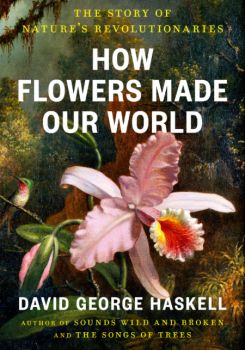
How Flowers Made Our World: The Story of Nature's Revolutionaries
A delicious aroma announces summer’s arrival in Atlanta. In front of office buildings in Midtown, my nose plunges into sweetened almond and tangerine, then resurfaces in a miasma of truck fumes. The scent brushes past me, too, on the scuffed lawns of city parks and along shady streets in older neighborhoods. To find the source of these delights, I look up. White flowers the size and color of porcelain dinner plates sprout from the branch tips of huge southern magnolia trees. A plume of scent streams from each bloom. These aromatic trails dance like ribbons in a breeze, so I can never know when one will warm me with its touch. Over the next month, this scant first bloom will grow. By June, a large tree can have one hundred or more flowers open at the same time.
The delights of magnolia flowers are portals into deep time. When Tyrannosaurus stomped through the subtropical forests of the late Cretaceous, magnolia‑like plants had been thriving for fifty or more million years. If magnolias were rare animals, they’d be corralled into theme parks, at the center of movie franchises, and be central characters in thousands of children’s storybooks. In the floral world, we don’t need a dinosaur movie; we live in one.
The Earth’s first flowers left traces of pollen in the fossil record about 130 million years ago, in the early Cretaceous. Studies of DNA suggest that flowers evolved before this, sometime between 150 million and 250 million years ago. This is astonishingly late in the evolution of life. Most of the major groups of complex animals evolved 500 or more mil-lion years ago. The first plants, none of which had flowers, came onto land at about that time, too. Flowers were latecomers, but when they finally showed up, the party really got going. Within a few million years of flowers’ appearance, perhaps as few as three million, the family tree of flowering plants splayed into almost all of the main branches that are still with us today. After this initial frenzy of diversification, evolution calmed down, producing new floral diversity at a more leisurely pace.
Ancestors of water lilies and of Amborella, a shrub known only from the island of New Caledonia in the southwestern Pacific Ocean, were among the earliest offshoots of the family tree. Magnolias were another early branch. The palm and lily branches of the family tree camelater, then came plants that would later become roses, sunflowers, and their kin. By the time fossil pollen shows up in rocks, evidence from genetic genealogies shows that all the major branches of the flowering plant family tree were established. By one hundred million years ago, flowering plants were flourishing all over the globe and, by ninety million, were dominating not only the understory where they first evolved, but forest canopies.
Truly, this was a revolution. In a few million years, the green‑brown world of tree ferns, conifers, and other ancient plants was overthrown by the flowering newcomers. Plants that had dominated the land’s surface for three hundred million years were suddenly in the shade of upstarts. Nothing was ever again the same. Most ecosystems are now founded on flowering plants. Our own species would never have evolved without them. We are sustained today by floral gifts, from the food on our tables to the perfumes on our skin. The Earth is a floral planet, and although we seldom realize it, we are a species almost entirely dependent on flowers.
Magnolias offer us an especially clear view of the revolutionary early days of flowering plant evolution because, although modern magnolia species all evolved in just the last few million years, they are little changed in their overall structure from more ancient times. Archaeanthus, for example, a plant known from 96.5‑million‑year‑old fossils, would not look much out of place in the magnolia grove of a modern botanic garden. Like living magnolias and their cousins the tulip trees, Archaeanthus flowers sprouted from branch tips. A ring of simple petals enclosed a central axis with female and male parts. The match between ancient and modern is not perfect—the fossil flowers are rangier than living magnolias and differ in some anatomical details—but is close enough to tell us that modern magnolias and tulip trees are, in many aspects of their biology, holdouts from ancient times. When biologists reconstruct a hypothetical ancestor of flowers by mapping floral characteristics onto a genealogy of living species, the speculative “first flower” is like a magnolia bloom, a shaggy bisexual, female atop male in a bowl of petals. For flowers, the term bisexual differs from its meanings among humans and refers to the presence of both female and male sex cells in the same bloom. In a bisexual flower, petals serve both pollen and eggs. This union of female and male into one structure was, as we shall see, a brilliant move, one that allowed flowers to work collaboratively with insect pollinators.
Glimpsing the earliest days of floral evolution offers more than a fun moment of time travel. We are transported to early scenes from one of the most consequential stories in evolution. When I sink my nose into a magnolia bloom, I’m face‑to‑face with an ancient revolutionary.
From How Flowers Made Our World by David George Haskell, published by Viking Books, an imprint of Penguin Publishing Group, a division of Penguin Random House, LLC. Copyright © 2026 by David George Haskell.
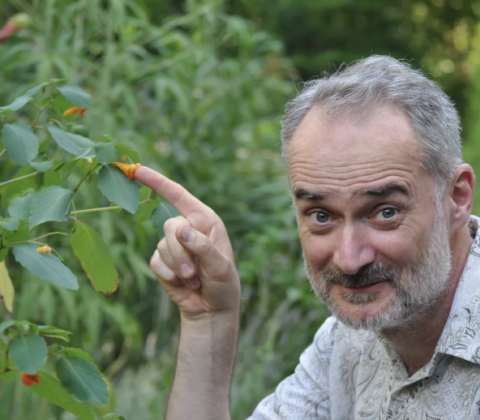
David George Haskell is a writer and biologist acclaimed for his lyrical explorations of the living world.