The Hidden Disease That Haunted A Family
Daisy Hernández’s journey to understand the history and devastating toll of Chagas disease began in her aunt’s hospital room.
The following is an excerpt from The Kissing Bug: A True Story of a Family, an Insect, and a Nation’s Neglect of a Deadly Disease by Daisy Hernández.
When you purchase products through the Bookshop.org link on this page, Science Friday earns a small commission which helps support our journalism.
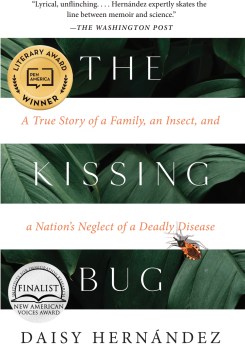
The Kissing Bug: A True Story of a Family, an Insect, and a Nation's Neglect of a Deadly Disease
The New York City hospital is a black, cavernous mouth. I am six, and I am not afraid. Bolting from the elevator, I am down the corridor ahead of my mother and baby sister, my sneakers squealing on the clean floors. The doors are half-open. The doors are invitations. A cuarto here belongs to us. The room holds Tía Dora, my mother’s sister, my auntie-mother.
A single window in the room screeches toward the ceiling, and Tía Dora is there with her pointy chin and thin face. The Spanish words tiptoe from her mouth. “Mi vida,” she murmurs when she sees my mother.
Tía Dora rises onto her elbows. The gown sways on her small frame. She smiles at me with approval. My mother has combed my black hair into two ponytails. My sister, almost a year old, giggles in her summer dress. Outside the Manhattan heat licks our faces, but in the hospital, in my auntie’s room, the cold air bites our ears.
The doctors have sewn a line of dark scars across Tía Dora’s belly. Las cicatrices. And they have told her a word my mother whispers when she thinks I am nor listening: Chagas.
No one in the hospital that day, or for many years after, told me that Chagas is a parasitic disease. Transmitted to humans by triatomine insects called kissing bugs, the parasite can often be eradicated with medication when a person is initially infected. Few people, though, are diagnosed and fewer receive treatment, which means the single-celled parasite Trypanosoma cruzi can spend up to thirty years in the human body, quietly interrupting the electric currents of the heart, devouring the heart muscle, leaving behind pockets where once healthy tissue existed. In the worst cases, the heart can eventually die.
The illness has come to be known in English as the kissing bug disease.
The corazón, the heart, is an accordion. It expands inside the rib cage, then squeezes. It belts out the familiar tune, the sacred thrumming that physicians in the early nineteenth century compared to a whip or, depending on the disease, a dog’s tongue lapping. In 1836, Dr. Peter Mere Latham insisted that the musical movements of the heart could not be rendered in paragraphs. “It is useless to describe them,” he wrote of the organ’s varied sounds. A physician had to learn by listening directly to a patient’s chest.
The kissing bug disease tampers with this music, and doctors cannot explain why most people live with the parasite without any symptoms, while 20 to 30 percent of chose infected suffer cardiac problems. To date, doctors cannot predict whose heart will be spared. Unless the infection is caught early, there is no cure. In a few infected people, like my auntie, the parasite strikes not the heart but the esophagus and the colon.
The Centers for Disease Control and Prevention (CDC) estimates that about three hundred thousand people with the kissing bug disease live in the United States. They are, like Tía Dora, immigrants. Close to six million people are currently infected, mostly in South America, Central America, and Mexico, and every year, more than ten thousand people die from the disease.
Tía Dora did not know these harrowing figures or that the parasite can be transmitted from a woman to her baby during pregnancy. In the United States, women are not routinely screened during pregnancy for the kissing bug disease, though each year more than three hundred babies may be born infected. My auntie also did not know that blood banks in the United States now screen people for the parasite the first time they donate. Fortunately, the disease does not spread like the common cold or Covid-19. Most people are infected from direct contact with a parasite-carrying kissing bug.
Formally called American trypanosomiasis, the disease is also known as Chagas after Carlos Chagas, the Brazilian doctor who discovered it in 1909 and was twice nominated for a Nobel Prize. The World Health Organization classifies Chagas as a neglected tropical disease. Others in that category include leprosy, sleeping sickness, and river blindness—afflictions the world has largely forgotten as they affect mainly poor people in countries beyond the borders of the United States and Western Europe.
The New Yorker has called the kissing bug disease the “redheaded stepchild” of vector-borne diseases—those caused when insects transmit pathogens—because even among the neglected, it has long been ignored.
I did not know any of this as a child. I only knew the hospital room that summer and Tia Dora with her pointy chin and the Spanish consonants in her mouth and how often the word Chagas made my mother sigh. I also knew that I wanted my auntie’s love and suspected even then the impossibility of that desire.
Excerpted from The Kissing Bug by Daisy Hernández. Copyright © 2021 Daisy Hernández. Published with permission from Tin House, an imprint of Zando, LLC.
The SciFri Book Club is reading The Kissing Bug in January and February. Join the conversation in our Community Space on Mighty Networks where we gather, read, and discuss science books together.

Daisy Hernández is a journalist and the author of The Kissing Bug: A True Story of a Family, an Insect, and a Nation’s Neglect of a Deadly Disease. She’s based in Chicago.