The journey to ‘poophoria’ starts with a conversation
A gastroenterologist was surprised to find that so many of her patients struggled with pooping—and they didn’t know how to talk about it.
The following is an excerpt from “You’ve Been Pooping All Wrong: How to Make Your Bowel Movements a Joy” by Trisha Pasricha.
When you purchase products through the Bookshop.org link on this page, Science Friday earns a small commission which helps support our journalism.
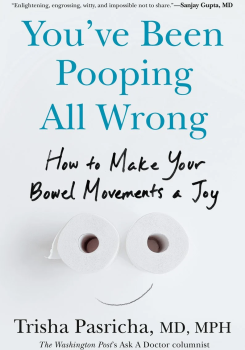
You've Been Pooping All Wrong: How to Make Your Bowel Movements a Joy
On a crisp autumn morning in Boston after I had spent almost a decade in medical training, Darren came to my newly minted gastroenterology clinic at the Massachusetts General Hospital dressed in a suit and tie. A college professor with two PhDs, he had been lecturing students that morning on the valence electrons of atoms.
He was uncomfortable. For years, he had felt sluggish and bloated. His bowel movements were sporadic at best. He wondered, Were they the issue?
I asked him what his last poop looked like. Was it pebbly and cracked? Smooth like soft- serve ice cream? Or perhaps a bit more like a muddy spring puddle?
He returned my stare, taken aback. “I don’t look at my stool.” He seemed embarrassed at the suggestion.
I maintained eye contact, now with equal parts fascination and sincerity.
“Why not?” I asked. I mean, c’mon, how could anyone not?
He laughed uncomfortably. “I don’t know. What is it supposed to look like?”
Now I was the one taken aback. Here was a grown man, more educated in so many ways than I, who didn’t know what poop “should” look like.
Had no one ever explained to him what a normal bowel movement was?
Over the next several months, I saw the same pattern over and over again. Star collegiate athletes, computer scientists, and PR mavens all began to show up in my clinic, puzzled about what colors were worrisome, how hard or soft a stool should be, or what daily activities secretly primed the gut to poop smoothly. Forget about treatment for any disease. What they often simply needed were the fundamentals of healthy pooping.
After pondering what was going on with all these people, I was forced to ask myself a question: Could it be that I was the anomaly— the weird one— here?
All the fascinating yet essential details I knew about this normal bodily process that I took for granted my whole life were completely unheard of by virtually everyone.
I began to realize that for others, a major void existed between when their parents potty-trained them as toddlers and the many years that followed into adulthood—people who now fumbled to even find the words to talk to their doctor about the subject. It was as if society just assumed we all had it under control.
And, sure, if everything I knew and loved about pooping were merely trivia, I’d be happy saving my treasure trove as delightful conversation starters for the next cocktail party.
But I was also observing something else more concerning: When it came to pooping, no one really had it under control.
Forty percent of Americans’ daily lives are disrupted by their bowels, and 15 percent have irritable bowel syndrome—numbers that skyrocketed after the Covid-19 pandemic as more and more people showed up to be seen in my clinic. Even people without any formal medical diagnosis struggle with pooping. Three out of four Americans can’t bring themselves to have a bowel movement in a public bathroom, and one in three can’t stay regular on vacation.
I get it. It’s not your fault.
I wouldn’t expect you to have stunning teeth if you were never shown a toothbrush. You would struggle to fall asleep if you never knew how to turn off your bedroom lights. But for all the hours our caregivers and dentists spent ensuring we were brushing our teeth properly and the lengthy bedtime routines that were a core part of our childhoods, no one talks about the fundamentals of pooping. And so many—even the highest of achievers—spiral into a quagmire of poor habits and toilet anxiety.
To make matters worse, we label poop and everything surrounding it as taboo, dirty, and perhaps even dangerous. And yes, several infections can be spread through feces. After the stressful—occasionally traumatizing—period of potty training, pooping becomes this nefarious entity we need to distance ourselves from as soon as possible, both physically and mentally.
Unless, of course, you embraced it.
So I began to develop a plan. I wanted to guide people—not just arm them with knowledge but really help them internalize the science and, dare I say, the joy of healthy pooping.
It starts with me saying this:
“You’ve been pooping all wrong. Throw out everything you thought you knew, and let’s start from the beginning.”
Then, you can take the first steps toward poophoria.
From YOU’VE BEEN POOPING ALL WRONG by Trisha Pasricha, MD, MPH, to be published April 7, 2026 by Avery, an imprint of Penguin Publishing Group, a division of Penguin Random House. Copyright © 2026 by Trisha Pasricha LLC.

Dr. Trisha Pasricha is a physician-scientist at Beth Israel Deaconess Medical Center and assistant professor of medicine at Harvard Medical School in Cambridge, MA.