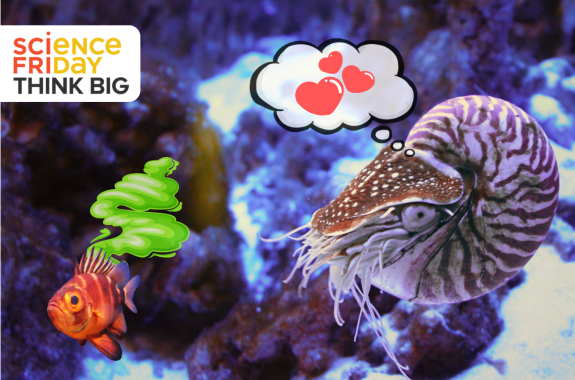
Have you ever heard the expression, “You can’t teach an old dog new tricks”? Well, researchers at Brooklyn College, CUNY Graduate Center, decided to try to teach an old species of cephalopod new tricks by testing the chambered nautilus’s memory.
Cephalopods, such as octopuses, squid, and cuttlefish, are fascinating marine creatures. One of them, the ancient chambered nautilus, was swimming the oceans before dinosaurs existed, and this species is still around today in the Indo-Pacific Ocean, living at depths ranging from 300 to 2,000 feet. Often referred to as a “living fossil,” nautiluses have remained remarkably unchanged for 500 million years, but their really, really old brains are very capable of learning new things.
Key ideas
This prehistoric cephalopod has survived across numerous geological eras thanks to evolutionary adaptations. The natural world offers countless examples of organisms adapting, or changing, slowly across generations to survive in specific environments.
The chambered nautilus is a great example of evolutionary adaptation. It lacks the sharp eyesight, camouflage, or ink defense of its cousin cephalopods, the octopus, squid, and cuttlefish. Instead, the chambered nautilus has developed a hard, compartmentalized shell that provides physical protection and buoyancy control, allowing the nautilus to adjust its position in water, sinking or rising whenever it wants. It’s similar to modern submarines that use ballast tanks filled with air or water to control buoyancy, or the rise and fall, in the ocean.
Because its sight is limited, the nautilus relies on over 90 suckerless tentacles outfitted with scent receptors, or chemosensors, to smell its prey, such as fish, crabs, and lobsters. This strong dependence on scent over vision means the chambered nautilus has a very large olfactory lobe, the region of the brain dedicated to interpreting scent information.
Scientists at Brooklyn College wanted to know more about the chambered nautilus’s sense of smell and its brain to better understand how it evolved to survive with limited sight. In its natural deep-sea habitat, the light is blue because the shorter blue wavelengths of visible light are able to travel farther in water, while other colors of light are absorbed. In addition, bioluminescent bacteria glow blue on decaying food a nautilus might eat. So scientists tested if a nautilus could associate blue light with food, drawing inspiration from Ivan Pavlov’s classical conditioning experiments with dogs in the 1890s.
But the results of the experiment were even more impressive than anticipated! When nautiluses were exposed to blue light, they extended their tentacles to search for food for up to an hour. That showed they could make short-term memories. A period of unresponsiveness followed, which researchers attributed to memory consolidation, when the brain converts new information that is saved and stored as long-term memory. After six hours, the nautiluses reacted to the light again, demonstrating this long-term memory. These findings confirm that the ancient nautilus is capable of both short-term retention and lasting memory consolidation.
While the jury may still be out on old dogs, we now know that the chambered nautilus, the remarkable living fossil, is more than capable of learning a few new tricks!
Discover the chambered nautilus with Dr. Gregory J. Barord
Think Big!
After you’ve watched the video:
- The chambered nautilus is currently on the endangered species list due to overfishing for its beautiful shells, which are used in jewelry and art. How would you raise awareness about the overfishing of the chambered nautilus? How could you persuade people to protect this animal?
- In the article, you learned that chambered nautiluses live 300–2,000 feet below the surface of the ocean. Given the depth at which it lives, why might the chambered nautilus have limited eyesight?
- The researchers found that the chambered nautilus responded to blue light, like the light found in its deep-sea habitat. Do you think other animals might respond strongly to colors in their environment? What are some examples?
Keep learning
- The chambered nautilus has become an endangered species because of overfishing. It matures slowly and doesn’t start reproducing until it’s 12 to 15 years old. Plus, the nautilus lays just 10 to 18 eggs per year, which take 12 months to hatch. As a result, the population of chambered nautiluses has been depleted faster than it can repopulate, increasing the risk of extinction. Learn more about conservation efforts and how you can help by visiting the website for Save the Nautilus, a nonprofit started by 11-year-old Josiah Utsch and joined soon after by his friend Ridgely Kelly.
- Chambered nautiluses have several very cool evolutionary adaptations. For example, their primitive eyes work like pinhole cameras. You can model their eyes by building a pinhole camera with instructions from Teach Engineering.
- Learn more about why the ocean looks blue with a video and article from the Ocean Learning Hub, by Woods Hole Oceanographic Institution.
- A renowned marine expert has disappeared moments before a symposium on the chambered nautilus—and it’s up to you to find them. Solve a super fun cephalopod puzzle to win this escape room–style game with “Endangered Rescue: Chambered Nautilus.”
Meet the scientist
Dr. Jennifer Basil is a professor in the Department of Biology at CUNY Brooklyn College. She focuses on marine science and animal behavior (ethology). Her work explores the thought processes of invertebrates, or creatures without backbones, to understand how complex brains and behaviors evolved over time. She also dedicates her time to the critical field of conservation biology.
NGSS Standards
- LS1.D: Information Processing – Each sense receptor responds to different inputs (electromagnetic, mechanical, chemical), transmitting them as signals that travel along nerve cells to the brain. The signals are then processed in the brain, resulting in immediate behaviors or memories.
– MS-LS1-8: From Molecules to Organisms: Structures and Processes – Gather and synthesize information that sensory receptors respond to stimuli by sending messages to the brain for immediate behavior or storage as memories. - LS4.A: Evidence of Common Ancestry and Diversity – Anatomical similarities and differences between various organisms living today and between them and organisms in the fossil record, enable the reconstruction of evolutionary history and the inference of lines of evolutionary descent.
– MS-LS4-2: Biological Evolution: Unity and Diversity – Apply scientific ideas to construct an explanation for the anatomical similarities and differences among modern organisms and between modern and fossil organisms to infer evolutionary relationships. - LS4.B: Natural Selection – Natural selection leads to the predominance of certain traits in a population, and the suppression of others.
– MS-LS4-4: Biological Evolution: Unity and Diversity – Construct an explanation based on evidence that describes how genetic variations of traits in a population increase some individuals’ probability of surviving and reproducing in a specific environment.
Credits:
Lesson by Svea Andersen
Developmental editing by Sandy Roberts
Copyediting by Erica Williams
Digital production by Sandy Roberts
Featured artwork for the activity by Sandy Roberts
Produced by Luke Groskin
Music by Audio Network
Additional Stills and Video Courtesy of Monterey Bay Aquarium, Robyn Crook, Peter Godfrey Smith, Henrik Steenfeldt Neils Ulmer Gary Friesen The Aquarium of the Pacific, Prelinger Archives, Shutterstock
Educator's Toolbox
Meet the Writer
About Svea Anderson
Svea Anderson is a twenty-year veteran educator who embraces challenges and consistently seeks opportunities for new learning.