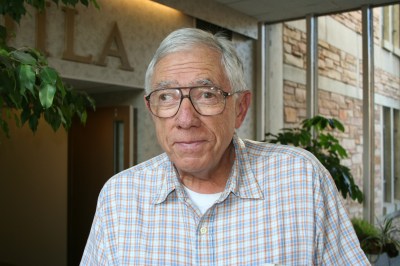
Judah Levine received a Ph. D degree from New York University in 1966. He had a NATO Postdoctoral Fellowship at Oxford University from 1966-67 and a second postdoctoral position at JILA (an institute on the University of Colorado Boulder campus that is operated jointly by NBS/NIST and the University) from 1967- 69. He joined the National Bureau of Standards in 1969; NBS was renamed NIST in the 1980s. He also has had a faculty appointment in the Physics Department of the University of Colorado, Boulder and an appointment as a Fellow of JILA from 1969 to the present.
Dr. Levine retired from the Time and Frequency Division of NIST in May, 2025, but continues to work on problems of time and frequency as a member of the faculty of the Department of Physics at the University of Colorado, Boulder, and also as a Fellow of JILA. His current interest are the definition and realization of the international time scales, TAI and UTC, and the methods of extending these time scales to the Moon and eventually to Mars and other planets. He also continues to work on methods for realizing clock ensembles for real-time applications and for distributing time and frequency information over channels with unstable delays.
During the 56 years that he worked at NIST as a staff scientist and later as a NIST Fellow, he designed and implemented the hardware and software that realizes the AT1 and UTC(NIST) time scales, which are the official time scales in the US for civilian applications, and which use the data from an ensemble of cesium standards and hydrogen masers. He also designed and operated satellite time scales at the NIST headquarters in Gaithersburg, Maryland and the NIST time-service radio station in Fort Collins, Colorado. These satellite time scales are synchronized to the primary NIST time scale in Boulder with an uncertainty of about 10 ns.
In addition to his work on the hardware and software aspects of time scales, Dr. Levine also designed and built the ACTS time service, which provides time signals derived from the NIST clock ensembles by using dial-up telephone lines, and the NIST Internet Time Service which responds to requests for time in a number of different formats by using messages transmitted over the Internet. The Internet Time Service is supported by 25 physical servers located at NIST in Boulder, NIST in Gaithersburg, radio station WWV in Fort Collins, and JILA in Boulder. The servers receive about 1 million requests per second; the number of requests has been increasing by a few percent per year for many years. In addition to providing standard NTP-format messages, the servers also transmit authenticated time messages to registered users and UT1 time to support the astronomical community.
He has published 165 papers and holds 2 patents. He is a Fellow of the American Physical Society and a Senior Member of IEEE. He has received numerous awards, including the Department of Commerce Bronze Medal, the Silver Medal and two Gold Medals, the Allan V. Astin Measurement Science Award, the Colorado Governor’s award for research impacts on information technology, the I. I. Rabi Award from the IEEE Ultrasonics, Ferroelectrics and Frequency Control Society, and the Distinguished Service Medal from the Precise Time and Time Interval Planning and Applications Conference. Dr. Levine is a member of the program committees of several time and frequency conferences, including the IEEE Frequency Control Symposium and the European Time and Frequency Forum.

Segment
Listen
Why are we changing the way we keep time?
Timekeeping scientists around the world voted to stop using leap seconds, but what does this mean for us?