Subscribe to Science Friday
 This article is part of The State of Science, a series featuring science stories from public media journalists across the United States. This story, by Elise Plunk, was originally published by Louisiana Illuminator.
Communities around Louisiana, in a bid to get more information about the environmental and health impacts of industrial pollution, are taking data collection into their own hands — despite a law restricting how their research findings can be used to enforce state regulations.
The practice is called community, citizen or participatory science, and it involves data collected from non-scientists that’s passed along to researchers who use their expertise to study and understand what they mean. From air quality to fisheries impacts, the grassroots-gathered information has the potential to inform the public about impacts of nearby industry.
“Our challenge for really a couple decades has been: How can we get something that can empower the communities to be able to speak for themselves, about the issues, with data?” said Marylee Orr, executive director of Louisiana Environmental Action Network.
The Louisiana-based nonprofit, long involved with community air monitoring projects, recently posted on its website an interactive air monitoring dashboard. The site gives continuous updates from air quality sensors placed at four locations along the Mississippi River in the heavily industrialized corridor between Baton Rouge and New Orleans. The dashboard also lists locations and readings from Louisiana Department of Environmental Quality monitors.
The system, funded by the U.S. Environmental Protection Agency, uses stationary air quality sensors to measure spikes in air pollutant levels. Toxic emissions such as sulphur dioxide, nitrous oxide and volatile organic compounds can be detected, recorded and displayed on the online dashboard, providing neighboring communities with information about potential health risks.
Similar efforts to get hard numbers for air and water quality concerns are also happening in Cameron Parish, where community air monitoring and water quality research partnerships are expanding. The area is the site of three liquified natural gas (LNG) terminals, and six more LNG facilities are either under construction or in the planning stages.
Environmental groups, including the Habitat Recovery Project and For a Better Bayou, have been working to secure funding for air quality monitoring equipment and underwater sound research in an attempt to find the source of air pollution and fisheries disruptions in the region.
“Stories hold weight, and science and data holds weight,” said Habitat Recovery Project director Alyssa Portaro. “When we put these two things together, it really gives a robust picture of what’s going on.”
Fishermen and advocates alike suspect air quality and fisheries problems in Cameron have ties to the nearby LNG facilities but have no independent data to back up their suspicions. The environmental groups received grants to buy monitoring equipment and hire fishermen to collect data and partner with scientists for research projects.
“Nobody knows exactly what’s going on out here,” said Sky Leger, a fisherman who works along Cameron Parish’s coast. He and his girlfriend, restaurant worker Karri Hooper, recently got involved with community science monitoring, in part, to help track whether noise from boat traffic and LNG facility construction is impacting adjacent fishing grounds.
Around the country, scientific communities have seen growing acceptance of data collection in partnership with non-scientists.
“There’s been increasing recognition of the power of these types of projects to collect really useful data,” said Bradley Allf, a postdoctoral research associate at Colorado State University who uses participatory science to study urban ecology and conservation.
Allf studied the concept of citizen science data collection for his doctoral thesis, saying the research technique has grown in popularity as well as acceptance within the scientific community over recent decades.
“There was some hesitation around whether we can really trust data collected by people who haven’t necessarily been trained in science,” Allf said. “I don’t think that’s very true anymore.”
Despite its expanding acceptance, the struggle to increase transparency around industry’s environmental impact in Louisiana with community-gathered data faces legal hurdles.
The Louisiana Legislature approved a law in 2024 enacting strict qualitative standards for community air monitoring programs in order to be considered valid data that state regulators could use for oversight or enforcement.
Air-monitoring equipment and analysis must use the most current EPA-approved techniques, and data must be analyzed at labs the Louisiana Environmental Laboratory Accreditation Program certifies, according to the legislation dubbed the Community Air Monitoring Reliability Act.
Environmental groups argue these standards, which can be costly, prices them out of being able to do research. The cost for the state’s preferred monitoring equipment runs up to $500,000, said former EPA official Larry Starfield, an adviser to Orr’s monitoring dashboard project
“That’s not something that is accessible,” said Misha Mayeur with the Habitat Recovery Project.
The equipment her group intends to buy with current grant proceeds costs around $20,000, cheaper than the regulatory monitors that cost more than their entire annual budget to buy.
The sensors the Louisiana Environmental Action Network uses for its stationary air monitoring in Southeast Louisiana, like those in Cameron Parish, aren’t up to the standards for regulatory enforcement in the 2024 state law. The regulatory monitors required in Louisiana to allege pollution violations cost around $500,000, said former EPA official Larry Starfield.
Even if the data can’t be used to enforce air quality standards for Louisiana, Orr said there’s still value in community awareness that could prompt change.
“If the data suggest a problem, it’s an opportunity for communities to invite companies to investigate their concerns,” said Orr.
Starfield said he hopes keeping the community informed could offer a way to let industry prove its willingness to cooperate and improve air quality.
“Many of the workers live in the community. Why wouldn’t you want to have a good relationship?” he said.
President and CEO of the Louisiana Chemical Association and Louisiana Chemical Industry Alliance president David Cresson responded to the launch of LEAN’s dashboard in a statement emailed to the Illuminator, saying the association was reviewing LEAN’s data and methodology.
“We hope to continue to work with LEAN to identify the areas of impact as indicated by their data, and if the specific source can be verified, take practical steps to remediate the issue,” Cresson said in a statement from the association.
And if industry chooses not to cooperate, Starfield said data can help encourage state and federal entities to get involved.
“The idea is to engage Louisiana [Department of Environmental Quality] and EPA in a situation where there’s a feeling that there’s a problem here, we’re seeing a pattern,” he said. “Certainly bringing in EPA and bringing in LDEQ and asking them to investigate … that’s absolutely a good thing.”
Fishermen in Cameron used their collective voice to engage state enforcement in August when they brought to light impacts to oysters, crabs and fish from dredging spills near the site where Venture Global’s CP2 LNG facility is being built.
Venture Global initially claimed there were no sediment spills or harmed fisheries. But at the urging of fishermen, the Louisiana Department of Wildlife and Fisheries sent a biologist to study the area, and the official later confirmed oysters had been killed.
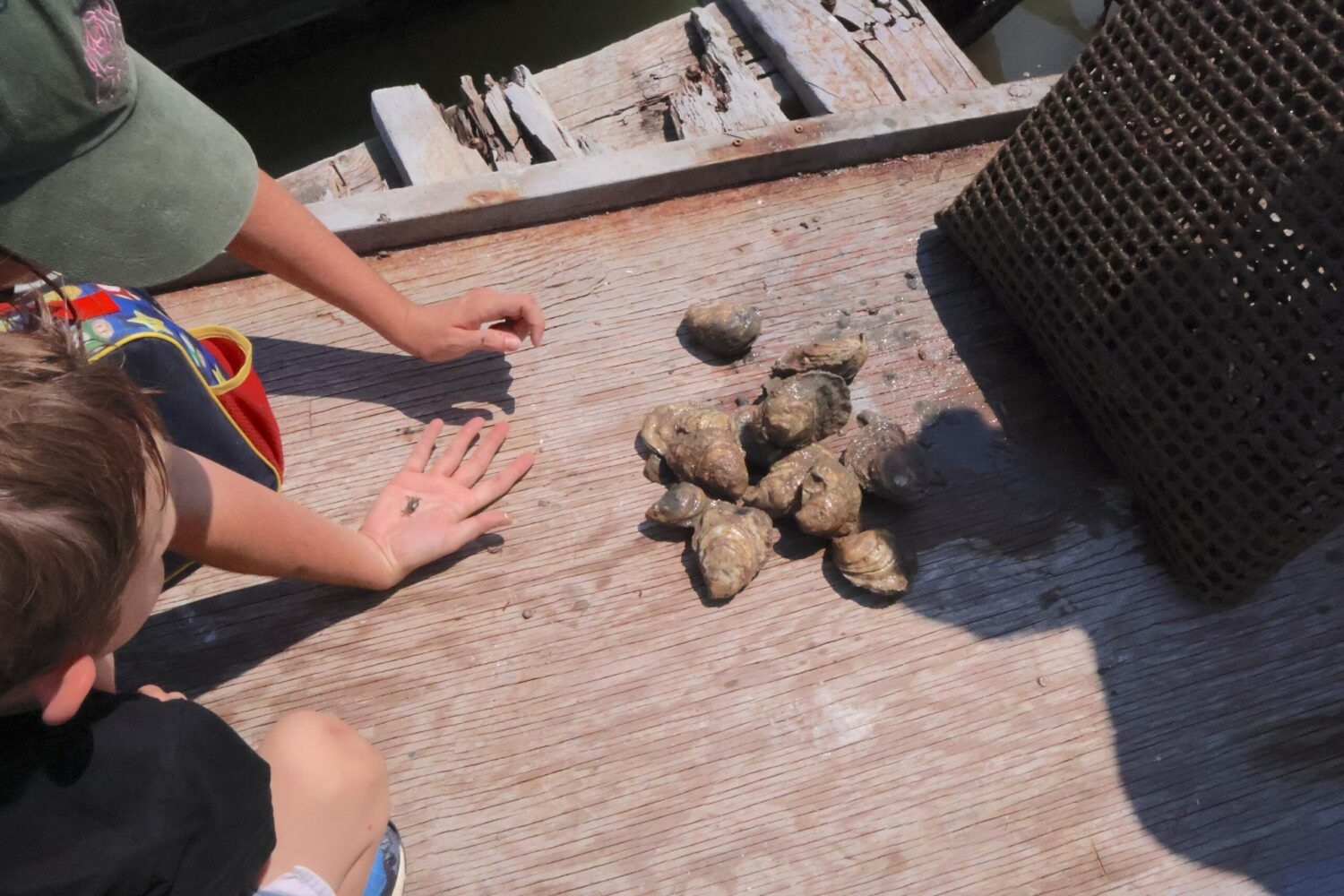
“The only thing that they’re going off of is by the reports of the people that Venture Global hired,” Leger said. “But we have the Louisiana Department of Wildlife and Fisheries coming out here and checking the oysters … and they are saying that there is very much so a problem with sediment being on top of those oysters in the lake.”
Portaro said this example is a strong argument for informing the community, as well as involving scientists, in documenting air and water quality issues in places like Cameron Parish.
“The fishermen were able to verify that, document it; then Fish and Wildlife came out and said, ‘Yeah, there is mud in the lake,’” said Portaro. “Sometimes the biologists on the job need the community keeping an eye on them, a well-informed community.”
Segment Guests
Elise Plunk
Elise Plunk is an environmental reporter and Report for America corps member at the Louisiana Illuminator.
Segment Transcript
IRA FLATOW: Now we’re going to pivot to a complex case study. A Louisiana law sets the bar high for community groups collecting scientific data. It may sound pro-science. Rigorous data is good, of course, but it prevents coalitions of citizens from being able to use data they collect about environmental toxins to enforce regulation. Here’s Flora with the rest of the story.
FLORA LICHTMAN: Joining me now to talk through this story is Elise Plunk, environmental reporter at the Louisiana Illuminator. And she’s based in Baton Rouge. Elise, welcome to Science Friday.
ELISE PLUNK: Hey, yeah, happy to be here.
FLORA LICHTMAN: Why are citizens collecting data in Louisiana? What are they monitoring? What are they looking for?
ELISE PLUNK: So Louisiana has a really long legacy of people living really close by to industry, whether that’s liquefied natural gas, like along the Coast of Cameron Parish, Louisiana, or refining facilities, anything throughout the region along the Mississippi River. So living in really close proximity to these places, air pollution and water pollution are concerns that very directly impact the people living nearby. So in an effort to inform themselves and inform community members about how exactly industry is impacting water they drink, the air they breathe, different groups across Louisiana are trying to organize and monitor the quality of air and water in different community science-oriented research and monitoring projects.
FLORA LICHTMAN: And why do these folks feel like they need to take this data collection into their own hands? Presumably there are agencies for this.
ELISE PLUNK: Yes, there is a agency in Louisiana called the Louisiana Department of Environmental Quality. They have the main role in deploying different devices that can check for different components in the air that would impact health. But community groups in Louisiana really want to push for more active monitoring within their localities.
They have a lot of issues with air quality permits being routinely violated, routinely exceeded the amounts of pollutants that industries are able to put into the air. They go above those limits fairly often, especially in Cameron Parish. The liquefied natural gas export terminals down there routinely violate air pollution permits. And there’s a couple of different analyzes and studies that go into that that I’ve cited in my reporting.
FLORA LICHTMAN: You interviewed Alyssa Portaro, who’s a community organizer in Cameron Parish, and you were on a boat with her. We have a clip from that. Let’s hear it.
ALYSSA PORTARO: This is– community science is something that came up over the last year talking with fishermen, where we’re like, these agencies aren’t doing anything to figure out what’s going on. What can we do?
ELISE PLUNK: Yeah the wind was whipping that day on the boat.
[LAUGHTER]
FLORA LICHTMAN: We can hear it. It’s like we were right there.
ELISE PLUNK: Yeah, definitely. I was working on a story about some sediment spills into bodies of water in Cameron Parish from some construction on a liquefied natural gas export facility. And Alyssa, several of the fishermen I spoke with and went out with on that trip were concerned that it was affecting oyster harvesting and shrimp in the area where they fish and collect oysters and have their livelihoods. So I was working on that story.
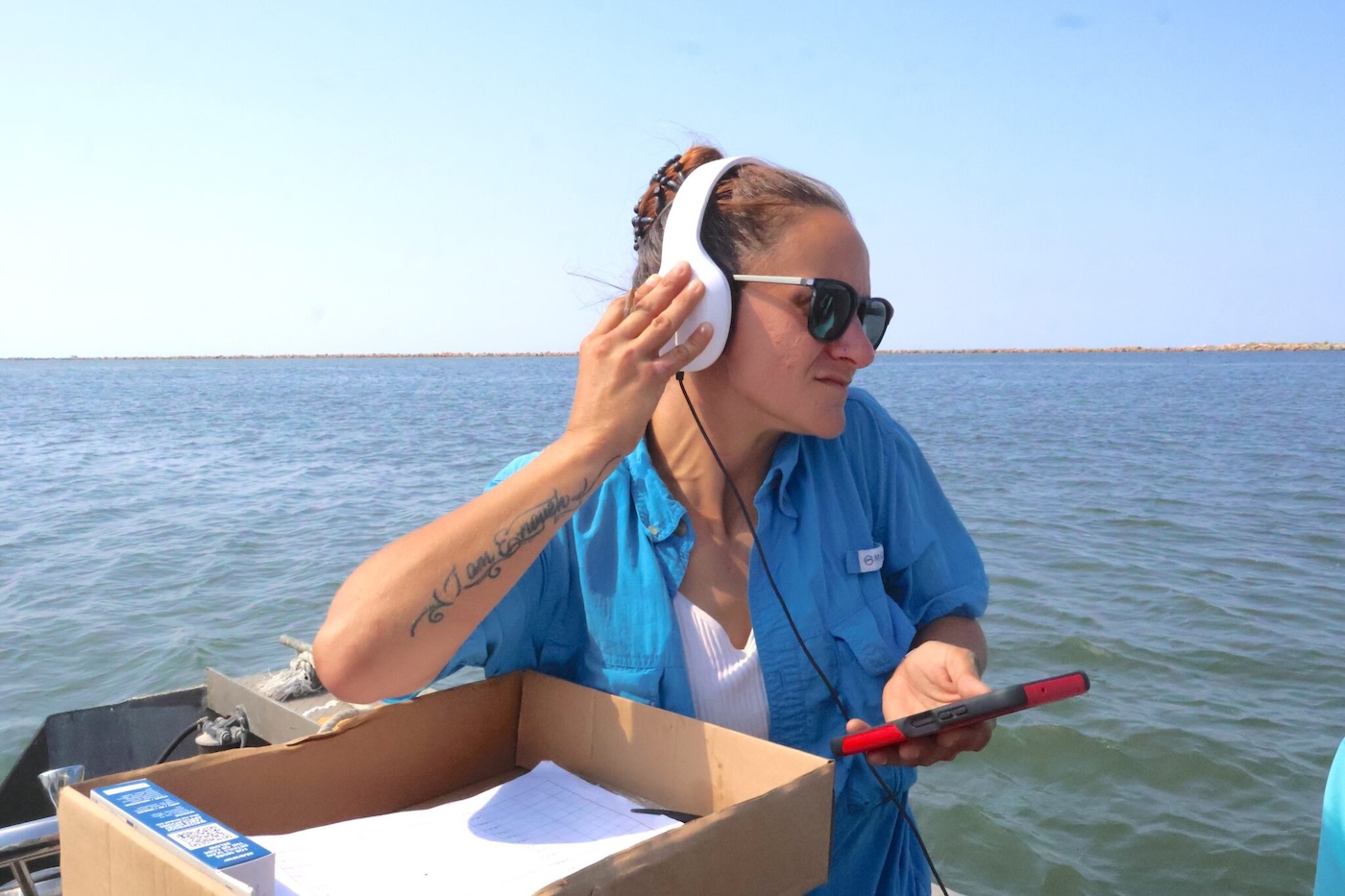
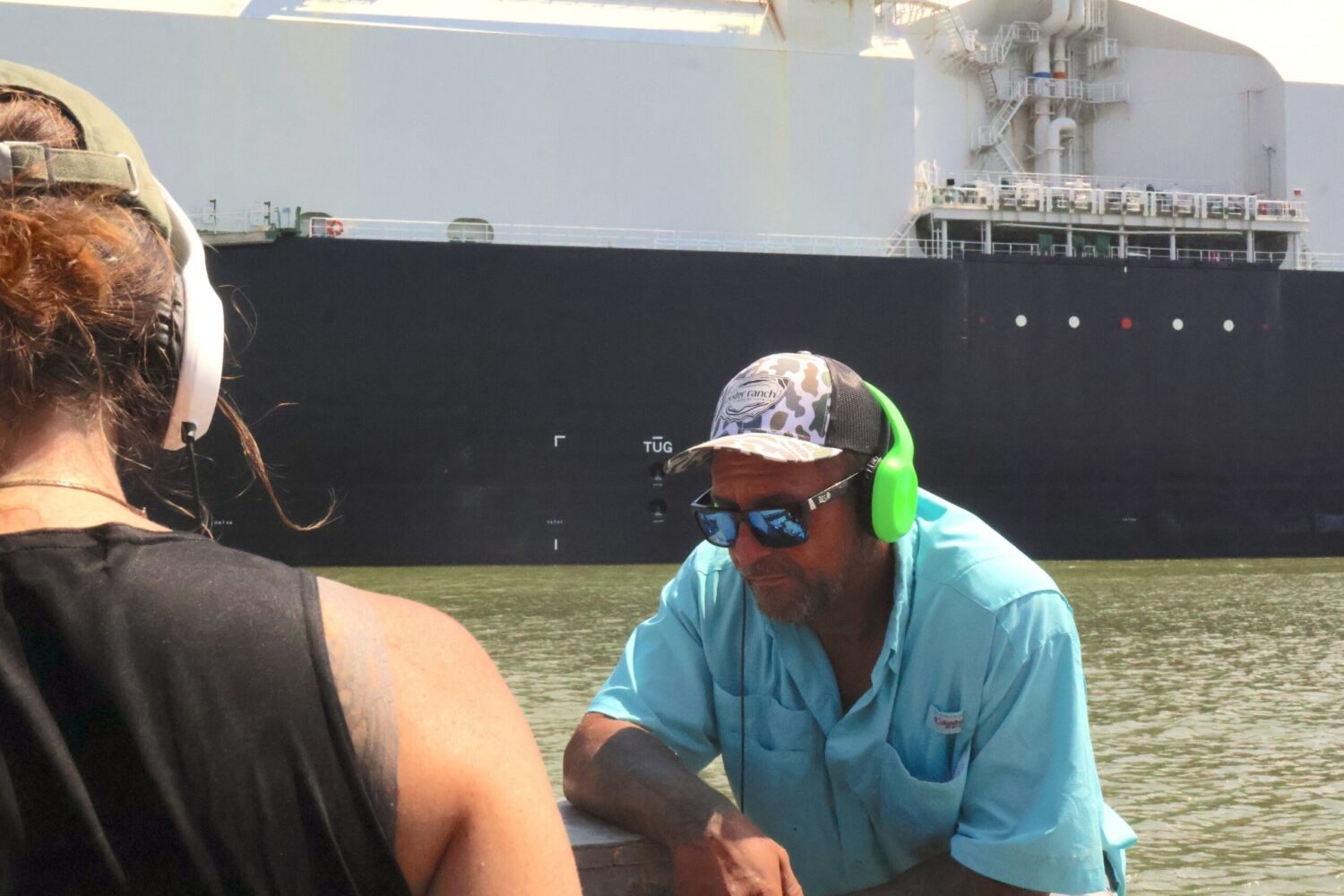
But as we were on the boat, they were conducting this research, where they would put microphones into the water and listen on headphones and note different levels of sound that would come from the readings on the instruments. And I didn’t know what they were doing. So I asked, what’s going on here? And Alyssa helped explain to me that they were concerned that noise levels from industry nearby was affecting the migration patterns of shrimp. But they didn’t exactly know how to prove this without having researchers investigate and determine why shrimp migrations weren’t happening as far into the estuary as they had used to and why fishermen weren’t catching as big of hauls of shrimp.
FLORA LICHTMAN: You have this community who is trying to collect data on environmental pollution. Tell us about the 2024 state law that puts a wrench into that.
ELISE PLUNK: In Louisiana, this is known as the CAMRA Law. The Community Air Monitoring Reliability Act. So it was passed in the Louisiana state legislature in 2024. And it makes the use of data for regulatory enforcement, meaning if a community member gathered data from an air monitor and it showed higher pollution levels than the nearby industry’s air pollution permit allowed for, it would not be able to enforce regulatory action against that industry unless it was an EPA-certified monitor, the kind of gold standard of air quality monitors.
FLORA LICHTMAN: Hmm, which are, I’m sure, expensive.
ELISE PLUNK: Yes, very much so. They can run upwards of hundreds of thousands of dollars, very sensitive equipment and very accurate equipment because of that, but something out of reach for a lot of these grassroots groups that are trying to monitor their air just within their own communities.
FLORA LICHTMAN: Right. It makes it almost impossible for these community science groups to gather data that could then be used to enforce the law, it sounds like.
ELISE PLUNK: Yes. Yeah.
LAURA UNGER: So it feels like there’s some complexity here, like we want environmental data to be rigorous, right? But we also want people to be able to hold industries accountable if there’s pollution. How are the people that you have talked to thinking about this? How are you thinking about this tension?
ELISE PLUNK: Yeah, it’s definitely something that I’ve gone back and forth over in a way, trying to figure out how to cover this because of course, robust, reliable data is the backbone of all of this. We want numbers we can count on and things that we can support ourselves with in a scientific manner when it comes to pollution monitoring. But I have spoken with several former EPA officials, scientists who work directly with these types of monitors. And I’ve asked, all right, so the gold standard monitors that are required for regulatory change, how different are they from the more common monitors that are more affordable that these community groups are using?
So the consensus is that the gold standard is the gold standard for a reason. It’s very accurate and the information you would ultimately want to have. But these other air monitors that groups are using have reliable data as well. So especially like in Cameron Parish, in particular, the habitat recovery project’s air monitor is funded by an EPA grant that was given out to help grassroots groups like this afford monitors for their air quality. So it seems to be that there’s a mismatch when it comes to the EPA has funded grants to buy these specific monitors, but different laws enacted are restricting their use. So there’s a misstep somewhere in here.
FLORA LICHTMAN: That’s interesting. Does this extend beyond Louisiana? Are there other places where laws like this are being passed or already exist?
ELISE PLUNK: Yes. So in Kentucky in the 2025 legislative session, I believe in March– it’s a little different in Louisiana because we have Mardi Gras. But I believe in March there was a law passed not quite as restrictive as Louisiana’s, but restricting the type of equipment you can use in order to enforce regulatory change for ambient air quality, pollution monitoring, that sort of thing. In Ohio and West Virginia, several times there has been verbiage inserted into legislation trying to do a similar thing, but nothing has passed out of the legislature so far.
FLORA LICHTMAN: It’s interesting. So there’s a little bit of a trend, it sounds like.
ELISE PLUNK: Yeah, there’s definitely state legislation popping up very similar to Louisiana’s law.
FLORA LICHTMAN: Hmm. Elise Plunk, environmental reporter for the Louisiana Illuminator, based in Baton Rouge. Thanks, Elise.
ELISE PLUNK: Yeah, thank you so much.
FLORA LICHTMAN: This podcast was produced by Kathleen Davis. And we love hearing from you, and you can reach us 24/7 on our listener line, 877-4SC-IFRI. We’ll see you next time. I’m Flora Lichtman.
[THEME MUSIC]
Copyright © 2026 Science Friday Initiative. All rights reserved. Science Friday transcripts are produced on a tight deadline by 3Play Media. Fidelity to the original aired/published audio or video file might vary, and text might be updated or amended in the future. For the authoritative record of Science Friday’s programming, please visit the original aired/published recording. For terms of use and more information, visit our policies pages at http://www.sciencefriday.com/about/policies/
Meet the Producers and Host
About Kathleen Davis
Kathleen Davis is a producer and fill-in host at Science Friday, which means she spends her weeks researching, writing, editing, and sometimes talking into a microphone. She’s always eager to talk about freshwater lakes and Coney Island diners.
About Flora Lichtman
Flora Lichtman is a host of Science Friday. In a previous life, she lived on a research ship where apertivi were served on the top deck, hoisted there via pulley by the ship’s chef.