Subscribe to Science Friday
The spotted owl has been a conservation flashpoint for more than 30 years. While habitat loss has been their historic foe, their most recent threat comes from within the owl family tree: the barred owl. Barred owls have expanded into the Pacific Northwest and are now outcompeting spotted owls for food and habitat. The US Fish and Wildlife Service has put forth a strategy that some experts say is the only way to save the spotted owl, and it could involve killing hundreds of thousands of barred owls.
Ecologist and spotted owl expert Rocky Gutierrez joins Host Flora Lichtman to break down the plan, and explain how we got to this point.

Further Reading
- Read more coverage of the Fish and Wildlife Service plan via LA Times.
Donate To Science Friday
Invest in quality science journalism by making a donation to Science Friday.
Segment Guests
R.J. “Rocky” Gutierrez
Dr. R.J. “Rocky” Gutierrez is an owl ecologist and professor emeritus at the University of Minnesota. He’s now based in Humboldt County, California.
Segment Transcript
FLORA LICHTMAN: Before we get going, what are you doing this Friday night? Because if you are in New York, I have the perfect evening all lined up. There will be wine. There will be beer. There will be cheese. There will be astrophysics. And most importantly, there will be Ira Flatow. Honestly, what more could you want?
I don’t want any of you to suffer FOMO, so we are giving podcast listeners a special deal. Use the code PODCAST for $50 tickets. Get all the details at sciencefriday.com/bigmysteries.
[INTRO MUSIC]
Hey, I’m Flora Lichtman, and you’re listening to Science Friday. On the show today, a new kind of shocking proposal to save spotted owls. These are the cute, charismatic birds that live in old growth forests in the west and are threatened by habitat loss and logging. People have been arguing about these birds for over 30 years. They’re a conservation poster child.
So the US Fish and Wildlife Service has proposed a new strategy to save them, and it’s kind of startling.
SPEAKER 1: The Barred Owl Management Strategy proposes killing 450,000 barred owls over the next 30 years across 24 million acres, which–
FLORA LICHTMAN: Yes, you heard that right– saving spotted owls by killing as many as 450,000 barred owls. The proposed strategy is, as you would guess, controversial and has created some strange nest fellows. Loggers and many conservationists are in favor, while some lawmakers and animal welfare groups are opposed. It’s been challenged in court, and its fate is uncertain, but people are talking about it.
So we wanted to what one of the world’s top spotted owl experts thinks of this approach. So we called up Applied Ecologist Rocky Gutierrez, Professor Emeritus at University of Minnesota. He’s been studying spotted owls for decades. Hey, Rocky, welcome to Science Friday.
ROCKY GUTIERREZ: Thank you for having me, Flora.
FLORA LICHTMAN: This is your area of expertise. I mean, you’ve studied spotted owls for decades. Do you think this plan is a good idea?
ROCKY GUTIERREZ: It is the only option that we have IF we want to ensure the persistence of the spotted owl. But it’s far more than spotted owl. What people don’t realize is that the entire ecosystem function and the number of species that this barred owl is affecting is enormous. There was just a paper that was published last week that showed 29 species that are threatened, endangered, or species of conservation concern are being impacted by the barred owl.
FLORA LICHTMAN: Such as– give me some examples.
ROCKY GUTIERREZ: Examples are red legged frogs, endangered salamanders, all the small owls that coexist with the spotted owl like the flammulated owl, screech owls, pygmy owls, and so forth.
FLORA LICHTMAN: What is it about the barred owl? Why are they such a problem?
ROCKY GUTIERREZ: Well, the barred owl is not native to Western North America. It invaded from the East Coast, we think, as a result of changes that humans made to the Midwestern United States that allowed them to move across the country and invade the forests of the Pacific Northwest. And since then, as many, many invaders do, once they get into an area in which there’s no known competition, the prey have not adapted to them, and so they flourish.
FLORA LICHTMAN: I mean, how urgent is this? If we don’t do something, will spotted owls go extinct? And what’s the timeline that we have for them?
ROCKY GUTIERREZ: Well, the exact timeline, but it is almost assured that we will, in fact, lose the spotted owl if we do not control the barred owls.
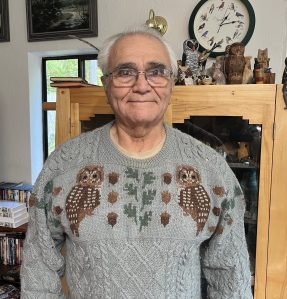
FLORA LICHTMAN: I’m curious for your thoughts on this. I think this is– it’s emotional for people. It’s really hard to imagine killing hundreds of thousands of owls, that being the best idea we have. You are wearing an owl sweater right now. You’ve dedicated your life to owls. Do you have complicated feelings about this?
ROCKY GUTIERREZ: Of course I do. I think every single biologist that’s involved with this is not happy that this is the only viable alternative. But realistically, it is the only viable alternative. People love owls, at least in this country they do. And they elicit a strong emotive response from people. Therefore, there’s a strong emotional reaction, as you said, to this choice to kill these owls.
However, even in your introduction, one of the premises that’s misleading that is commonly used by opponents of this act is that the 450,000 barred owls are going to be killed, and that’s just not true. What the Fish and Wildlife Service did in creating a strategy is to create a series of alternatives, the worst case of which would be 450,000 owls.
However, that will never be achieved because their preferred strategy will result in something like 5,000 owls a year over 30 years, which is about 150,000 owls. So it’s really quite different when you actually root down into their plan and determine what actually that they wish to happen and what is potentially possible.
FLORA LICHTMAN: The 450,000 is the cap, but they actually are aiming for fewer, many fewer.
ROCKY GUTIERREZ: Yes, but the important point is that barred owls will persist under any alternative of this strategy. So they’re not trying to cause the barred owl to go extinct or disappear from the Pacific Northwest, because that’s probably impossible at this point in time.
FLORA LICHTMAN: Because there are just so many.
ROCKY GUTIERREZ: Yes, because there’s so many. However, they can keep them out of certain areas, for example, out of Marin County, where there’s isolated habitat of spotted owls. And it’ll be easy to keep them out of Marin County. And you notice I used the word easy because scientists have proven that it is exceptionally easy when the density of barred owls is low to keep them under control and having minimal impact on spotted owls.
FLORA LICHTMAN: Hmm. I mean, do we have a sense of what would be impactful for spotted owls? We’re talking about these huge numbers, but if you got rid of barred owls in a few key places or you were culling populations by many fewer, would that have an impact on the owls, on the spotted owls?
ROCKY GUTIERREZ: Well, of course, any removal of the barred owls is going to have some impact. The problem that people have recognized, scientists have recognized, is that the density in certain areas is so high that they invade quickly from the surrounding area. This is why they want to have specially designated areas where all barred owls are removed so that the spotted owls in certain areas are protected from colonization by locally surrounding barred owls.
And when you do that, you can, in fact– well, we think you can maintain these not only spotted owl populations, but other populations of small owls and other species that are impacted.
FLORA LICHTMAN: That brings up another question, which is is this barred owl plan the best way to save spotted owls, or is it just the way that we can imagine doing it because actually conserving forests is not going to happen?
ROCKY GUTIERREZ: Yeah. Well, one of the things about this plan is that there are various alternatives considered, and they are based on a huge amount of information that have been gathered over four decades on the spotted owl. So we know that there virtually is no viable alternative. Animal welfare groups and others will say, well, just need to protect the habitat. Stop logging. But that’s not the answer. It doesn’t make any difference how much habitat you protect. It will not prevent the barred owl from invading those habitats, because they use all the habitats the spotted owls use, and they use other habitats that spotted owls don’t use.
So there is really no alternative. And this is not a conclusion that was derived from haphazard information or short-term information. We probably have more information on the requirements of spotted owls than virtually any other endangered species in the world. So this is a plan that’s based on really, the only viable alternative that we can perceive as scientists.
FLORA LICHTMAN: Wow. I mean, we know that culling wild animals isn’t new. We do this with deer. We do this with coyotes. We also that there can be unintended consequences of these kind of management plans. How do you think about that piece of it, ecosystem meddling piece?
ROCKY GUTIERREZ: Yeah, that’s interesting. And of course, this is one of the attacks of animal welfare groups is that they accuse scientists, or the Fish and Wildlife Service, for that matter, of playing God. But humans have been manipulating their environment since the dawn of humanity, or at least they’ve been trying to. And this is no different.
In the case of the barred owl, and other species in modern society, we control all kinds of things. We control cormorants because they impact fisheries and fishing. We control brown headed cowbirds because they impact endangered kirtland’s warblers. And the list goes on and on and on. So this is nothing new. It’s just that the idea of an owl is so close to the interests of people, including all of us who study owls, that it really strikes a strong emotional response from us.
FLORA LICHTMAN: Yeah. Yeah, it’s sort of a different beast because people love owls.
ROCKY GUTIERREZ: Right.
FLORA LICHTMAN: We have to take a break, but don’t go away because we are not going to let Rocky fly out of this conversation without telling us some cool spotted owl facts. And maybe we’ll even get him to do his best spotted owl impression. Stay with us.
I can’t let you go. You cannot leave Science Friday without telling us some amazing owl facts because they are so charismatic and interesting. Just tell me a little bit about the spotted owl and why you love them.
ROCKY GUTIERREZ: Well, all owls are interesting, and they have been of interest to humans for 40,000 years, since they first started drawing pictures of critters on cave walls. And I think they’re of interest to people and to me, in general, because they do something that we cannot do, and that is they can see in very limited light conditions at night. They have a mysterious lifestyle because of their mostly nocturnal behavior. Some are diurnal, but most are nocturnal.
And so they conjure up these really emotive conditions in our soul that makes at least me want to study them, to see them, even to go out sometimes at night just listening for them hooting in the distance– not to disturb them, but just to listen to them. And because we know that something is out there in the dark doing something that we can’t do. And I think that’s one of the real fun things about owls, why I think they attract so many people and have such interest in them. Because they can do this that we can’t do.
FLORA LICHTMAN: They have a superpower.
ROCKY GUTIERREZ: Yeah.
FLORA LICHTMAN: Or at least a power we don’t have.
ROCKY GUTIERREZ: Yeah.
FLORA LICHTMAN: Last one. You’re wearing an owl sweater today.
ROCKY GUTIERREZ: Yes.
FLORA LICHTMAN: I know your wife knits you owl sweaters. Do you have a spotted owl sweater?
ROCKY GUTIERREZ: I do have a spotted owl sweater. It was the very first one she made for me many years ago, and it’s still my favorite. But today, I’m wearing a long whiskered owlet sweater, which is a diminutive, a little tiny owl that lives in the high Andes of Peru in a cloud forest, in a tiny elfin cloud forest. And they sound like insects when they call.
[TRILL]
Strange little things.
FLORA LICHTMAN: Before we let you go, will you do a spotted owl call for us?
ROCKY GUTIERREZ: Sure. So a spotted owl call is usually a series of four note hoots.
[HOOTING]
So it’s one, one-two, one. And that’s the male. And the females have a higher pitched voice, and they sound like this.
[HOOTING]
But they make all kinds of other sounds. And when they get really agitated, they go,
[RAPID HOOTING]
FLORA LICHTMAN: That’s Dr. Rocky Gutierrez impersonating a spotted owl. He’s an owl ecologist and Professor Emeritus at the University of Minnesota. Rocky, thank you for joining us today.
ROCKY GUTIERREZ: Thank you very much. Bye bye.
FLORA LICHTMAN: And you can see a picture of Rocky’s owl sweaters at sciencefriday.com/spottedowl. Hey, one last thing before we wrap up. If you are in the middle of holiday shopping for the young science lovers in your life, we have a guide for this year’s best science books for kids on our website, sciencefriday.com/books.
We’ve got suggestions about butterflies and black holes and dinosaurs, hurricanes and more. Check it out at sciencefriday.com/books.
[MUSIC PLAYING]
Thank you so much for listening. This segment was produced by Kathleen Davis, and we’ll see you tomorrow.
Copyright © 2025 Science Friday Initiative. All rights reserved. Science Friday transcripts are produced on a tight deadline by 3Play Media. Fidelity to the original aired/published audio or video file might vary, and text might be updated or amended in the future. For the authoritative record of Science Friday’s programming, please visit the original aired/published recording. For terms of use and more information, visit our policies pages at http://www.sciencefriday.com/about/policies/
Meet the Producers and Host
About Kathleen Davis
Kathleen Davis is a producer and fill-in host at Science Friday, which means she spends her weeks researching, writing, editing, and sometimes talking into a microphone. She’s always eager to talk about freshwater lakes and Coney Island diners.
About Flora Lichtman
Flora Lichtman is a host of Science Friday. In a previous life, she lived on a research ship where apertivi were served on the top deck, hoisted there via pulley by the ship’s chef.