How Rocks Help Us Discover Lost Stories Of Earth
To author Anjana Khatwa, rocks are “storykeepers of time.” She blends science and spirituality to explore the origin story of our world.
The following is an excerpt from The Whispers of Rock: The Stories That Stone Tells about Our World and Our Lives by Anjana Khatwa.
When you purchase products through the Bookshop.org link on this page, Science Friday earns a small commission which helps support our journalism.
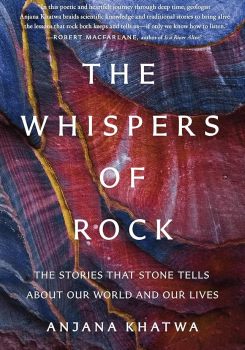
The Whispers of Rock: The Stories That Stone Tells about Our World and Our Lives
My love for rock began as a child when I walked over solidified lava flows in south-east Kenya. Back then, I did not understand the nature of the landscape or how the rock had come to be there; I only knew that I wanted to learn more about its story. This touchpoint experience sparked a fire deep inside me and I set out to teach myself how to listen to the whispers of rocks. Through pattern, colour and form, they told me of ancient worlds where mountains were born and volcanoes had erupted, where raging rivers flowed and the gentle wind had moved a sand grain. They whispered to me to look at how all this work had laid the foundations for the world around us. For life itself.
The more I listened, the more I felt a connection with these storykeepers of time. This is what sets me apart from other nature lovers because, as a rock whisperer, these entities speak to me in a way that no other part of the natural world does.
Each rock I meet teaches me about myself. Some speak to me about resilience and fortitude—how I have the power to stand in my own space and meet the challenges that life throws at me. Others speak of empathy and humility so that I might behave in a way that treats nature as my own kin. Whatever the whispers of rock might reveal to me, I am enriched by their knowledge and wisdom.
My rise from an enthusiastic teenager to becoming a professional earth scientist was fraught with difficulty. My passion for the geological world meant that I became an amusing oddity within my traditional Indian community. While the rest of my cousins chose sensible careers, I was the odd girl who studied rocks. At family events, I could always guarantee at least one awkward conversation or look of bemusement from a relative who made the unfortunate mistake of talking to me. ‘What are you studying at university?’ they would ask. ‘Earth science,’ I would reply and then go on to talk excitedly about some fascinating aspect of geology. Hurriedly, they would offer a hasty invitation to tea and, with a rustle of their sari, they were gone. The situation was not much different at home. I was proud of my expanding rock collection, which covered the windowsill in my bedroom. My mother would wring her hands in despair, ‘When will you give up this fascination for rock?’ she asked, her face pained as she eyed the cobwebs and dust on them. My response was always the same. These rocks that I had collected on family holidays and field trips were important to me, and I loved them like an eclectic group of old friends who always had a story to tell me.
I was also an outlier in the professional spaces where I existed. Decades of being the only brown body in the room took an immense toll on me. Like flowing water wearing away the rough edges of a boulder, I found myself moulded into a different person by the whiteness of the environments I worked in. My cultural heritage and spirituality tied to my Hindu upbringing became a secondary and lesser identity to my scientific self—a sacrifice I made to survive and succeed in my pursuit of becoming a rock whisperer. Assimilation had brought me status in the groups I moved between, but it also left me with a heavy burden of personal discomfort, unease and loneliness.
Lost and confused, I went in desperate search of my dharti—a Hindi word which describes the grounding of oneself through soil, rock and land. ‘Did you find it?’ enquires the piece of granite nestled in my hand, its angular edges reflecting the sharpness of its question. I feel its own sense of displacement in this landscape – brought from a quarry far away and placed in a land with a different story. I sought solace in rocks, and they brought forth new relationships with other kindred souls that began to revive my damaged spirit. Through embracing a sense of humility and empathy for the natural world, I could harmonise my scientific and spiritual selves into one true being. ‘All of nature is governed by cycles of creation and destruction. Progression is what drives our lives and indeed your own,’ these rocks seemed to urge; ‘in time your spirit will evolve and be renewed just as we are.’ Gradually, this wisdom seeped into the fractures that had broken my soul, slowly crystallising in my heart and mind the changes I needed to make. ‘What did you become?’ whispers the granite, sparkling with curiosity in my hand. Hook up at my family waiting in the distance, a blend of the choices that now represent my life. I achieved what you could not, I reply. I broke through the barriers that held me back and became what I was destined to be.
However, this approach, which relies on objectively observing, describing and measuring natural geological phenomena, can create distance between yourself and nature. To bridge this gap, appreciating and understanding spiritual approaches towards nature (even if you are not spiritual yourself) can provide a guiding sense of purpose, meaning and responsibility.
For some, this alliance of science and spiritualities will cause a sense of discomfort and consternation—a feeling that I understand and relate to. I was once asked after a talk whether my spirituality conflicted with my position as a scientist. I paused momentarily, unsure how to respond, conscious of the expectant silence that waited for my answer. I answered first as a scientist: that I am driven to search for factually based evidence that helps me answer questions that I ask about the world around me. Like so many of the scientists I interviewed for this book, 1 too find comfort in spaces where I can logically order, measure and evaluate how rock has come to exist. But I am also human, craving a deeper, more visceral connection beyond the science, which builds on my sense of empathy and love for the natural world. After the talk, a member of the audience came up to me, thanking me for my courage in expressing my positionality. The word ‘courage’ made me thoughtful as I think many in my field are fearful of their scientific credibility becoming eroded if they begin to accommodate other approaches, especially those that view the world through a more cultural or spiritual lens.
I think it is possible to coexist in this space of duality. If we look towards other seminal movements in scientific thought, such as the Gaia hypothesis developed by James Lovelock, it transformed the way we think of life on Earth. The Gaia hypothesis proposed that not only did species compete, they also cooperated to create the most favourable conditions for life to create a self-regulating system. Inspired by the spirituality of the environmental movement, Lovelock called his theory Gaia after the mythical Greek goddess who personified the Earth. In a similar vein, through embracing different ways of knowing the world, we stand to gain a more ethical and empathetic viewpoint on our relationship with rock. The profound shift from engaging with rock not just as an economic resource or as the backdrop to our existence, but as a keeper of our stories, memories and experiences, can guide our lives just as it has done for people across the world.
Through embracing our role as custodians rather than ‘owners and observers’, our relationship with the natural world transitions towards one of equity, consideration and – above all – love. From this position, with empathy and humility, we open ourselves to understand and value that different sources of knowledge have the power to entirely reframe our relationship with rock, and indeed nature itself. For to touch a rock and hear its whispers is to feel the privilege of a time and space that now only exists in our heart and mind.
Excerpted from THE WHISPERS OF ROCK: The Stories That Stone Tells About Our World and Our Lives by Anjana Khatwa. Copyright © 2025. Available from Basic Books.
Dr. Anjana Khatwa is a geologist and author of The Whispers of Rock: The Stories That Stone Tells about Our World and Our Lives.