Subscribe to Science Friday
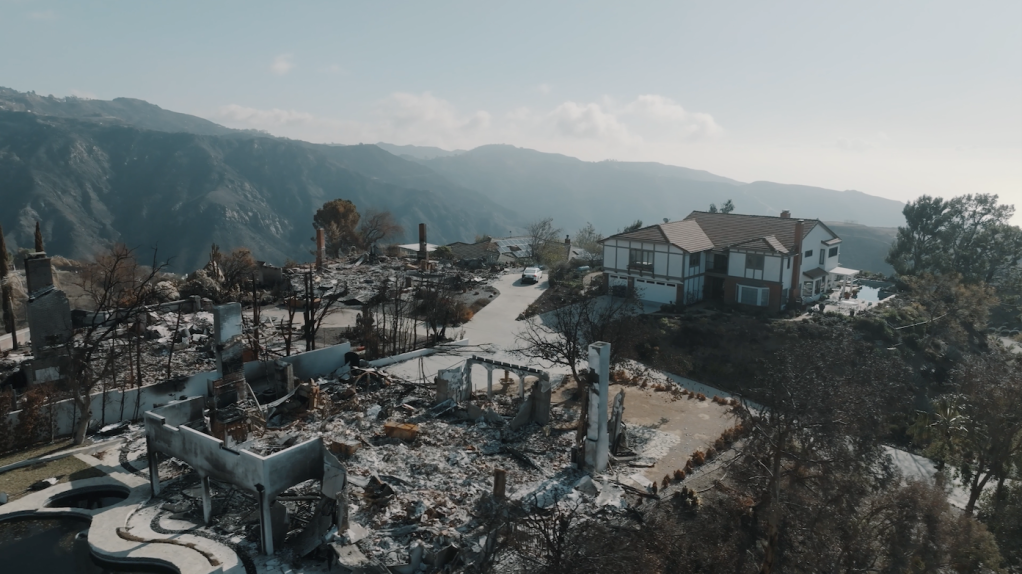
A year ago this week, the Eaton and Palisades fires broke out in Los Angeles, and ultimately became one of the most destructive urban fire events in recent history. Today we’ll hear about a community brigade that is taking firefighting into its own hands through a technique called “home hardening.”
Journalist Adriana Cargill, host of the new podcast “The Palisades Fire: A Sandcastle Special” from PRX, embedded with this group to understand what the future of firefighting could look like. She and Jack Cohen, a former research scientist with the USDA Forest Service, join Host Flora Lichtman to explain the science behind how people can prevent their own homes from burning.
Further Reading
- Learn more about the L.A. County Fire Department Community Brigade.
Donate To Science Friday
Invest in quality science journalism by making a donation to Science Friday.
Segment Guests
Adriana Cargill
Adriana Cargill is a multimedia journalist and host of the podcast “The Palisades Fire: A Sandcastles Special.” She is based in Los Angeles, California.
Jack Cohen
Dr. Jack Cohen is a former research physical scientist with the USDA Forest Service, based in Missoula, Montana.
Segment Transcript
FLORA LICHTMAN: I’m Flora Lichtman, and you’re listening to Science Friday. A year ago this week, two fires broke out in Los Angeles that became one of the most destructive urban wildfires in recent history. Today, we’ll hear about a Community Brigade that is taking firefighting into their own hands through a technique called home hardening. Here to tell us more is journalist, Adriana Cargill host of the new podcast, The Palisades Fire, from PRX and Wavemaker Media. She embedded with this group to understand what the future of firefighting could look like.
And we have Dr. Jack Cohen, former research physical scientist with the USDA Forest Service who helped pioneer the science of home hardening. I want to welcome you both to Science Friday.
ADRIANA CARGILL: Thanks for having me.
JACK COHEN: Thank you very much.
FLORA LICHTMAN: Adriana, your new series focuses on this LA-based group called the Community Brigade. Introduce us to them. Who are they? Why did they form?
ADRIANA CARGILL: Yeah so the Santa Monica Mountains and the Malibu area, where they’re from, is an area that has had wildfires for thousands of years. The Native Americans that lived there, the early European settlers, they all learned to live with fire. And there’s this tradition in those mountains of people staying and defending when there are major wildfires.
Now, this particular group, which I follow over six years in my previous podcast called Sandcastles podcast, they really galvanized during the 2018 Wolsey Fire. There was a group of them led by Keegan Gibbs, who, when that fire broke out, it was actually the same day as the campfire and another fire in Ventura. And so with three major wildfires burning in the State of California, emergency first responders were stretched incredibly thin.
And so when there weren’t a lot of emergency response support in their area, they stepped in, and they made it up as they went. A lot of them, including Keegan Gibbs, lost their family home or their neighbor or their family member, and they really, in the fire’s aftermath, they were like, how do we prevent this from happening again?
So over the last six years, they’ve been creating and evolving this idea. And in 2023, they partnered with the LA County Fire Department and officially launched the program.
FLORA LICHTMAN: And what is their approach. What are they doing exactly?
ADRIANA CARGILL: Yeah. So there’s other brigades in other places in the world. What they’re doing is totally different. I haven’t seen anything like it. They teach community members about home hardening, which I’m sure we’ll get into later, but can really reduce home loss during wildfires.
And then during an incident, they really focus on evacuations. When we have these massive fires, there just aren’t enough emergency first responders. So they’re really stepping up. And in the communities that they’re from, they’re trying to make sure that everybody gets out safely. And then in the post-fire period, which can be a couple of weeks to months, they’re really doing anything that the fire department would do but doesn’t have enough guys to do.
So that would be repopulation efforts. That would be helping homeowners sift through ashes in what was their houses, that would be coordinating donations. It’s all sorts of things.
FLORA LICHTMAN: Jack, you talked with leaders of this Community Brigade about home hardening. What science did you share with them?
JACK COHEN: So the research that I had done for decades was, first, to find out what was going on during the community destruction. So what was the relationship between an extreme wildfire fire that was not under control and community houses burning.
As it turns out, I was in Southern California for about 10 years as a research scientist, and what I was seeing was that, in many cases, houses were igniting and burning without the wildfire even making an approach to the community. It was all through the burning embers lofted out of the wildfire.
FLORA LICHTMAN: So you don’t even need to have the fire at your doorstep.
JACK COHEN: Correct.
FLORA LICHTMAN: The embers from the fire can travel and light homes on fire.
JACK COHEN: Yes.
FLORA LICHTMAN: What are things that people can do to make it more difficult for a fire to ignite their home?
JACK COHEN: So the wildfire actually doesn’t burn like a tsunami of superheated gases through the community. The ignitions are determined right at the house, mostly by burning embers. Well, what that does is it gives us an opportunity to readily change the ignition potential of the homes by not having rain gutters full of leaf debris and dead material right up next to the house.
And if, for example, in the relatively famous pictures after the campfire and paradise destruction, total destruction of homes was surrounded by unconsumed tree canopies. So what that says is that we have a choice over the ignitability, the ignition potential of the home, doing the little things– the dead material that’s on and right next to our house, the ember’s ability to penetrate into the flammable interiors of the house.
So those kind of preparatory little things can make all the difference where the wildfire isn’t actually making contact with the structure and even where you have continuous vegetation up next to the structure to keep it from igniting the house. So it’s not like we have to go through the entire landscape and change the vegetation.
So what that means is, we have a choice to keep our houses from burning by doing the preparation without necessarily controlling the uncontrollable extreme wildfire.
FLORA LICHTMAN: Adriana, let’s talk about rebuilding efforts after last year’s fires at LA. Does California’s fire code require any of this home hardening? Do insurance companies?
ADRIANA CARGILL: Yeah. So as you can imagine, that’s a complicated question. I believe as of January 2026, for rebuilds, 500 have begun, and for reference, more than 16,000 structures were lost, and about 80% of fire survivors still remain displaced. I think just those numbers tell you how slow the process is.
And LA mayor, Karen Bass, expedited the permitting process in the months following the fire, particularly for people who want to rebuild very similar to what they had before. Those rebuilds and all rebuilds have to follow current fire codes, but those codes mostly address building materials so that the houses use fire-resistant materials.
As far as landscaping and the home ignition zone, which is a lot of what Jack, Dr. Cohen’s work focuses on, it gets a little bit murkier. There was a California statewide bill, the Zone 0 Law that passed in 2020. And just as a reminder, that was now coming up on six years ago. But it has yet to be effectively implemented.
JACK COHEN: So one of the huge problems that we have with regard to fire is that we’ve got a long culture of fire protection taking responsibility for protecting us. And now, we’re facing situations where the approach of emergency response doesn’t work.
FLORA LICHTMAN: Because there’s not enough trucks. There’s not enough water. There’s not enough people.
JACK COHEN: Exactly. And so this reminds me of the former chief of LA County Fire during the Wolsey post-fire. He was in a public meeting, and they were ready to hang him. And his comment was, well, we only had 700 engines to protect 50,000 houses.
So that’s the exposure. 50,000 houses exposed across a wide area there, it’s an absolute impossibility. It’s not about not enough water. It’s about highly vulnerable communities. Right now, fire protection is completely unable to deal with these very specific situations.
FLORA LICHTMAN: This preventative medicine is what we’re talking about–
JACK COHEN: Yeah, absolutely.
FLORA LICHTMAN: –for fire. I mean, one of the questions this story raises for me is, whose responsibility should it be to prevent fires? I mean, I think we think of it as a service our government provides. The way that this community brigade is thinking about it, it shifts the responsibility to communities, to individuals. How do you all think about this question?
ADRIANA CARGILL: I think about this as not either/or, but a yes/and. I think this needs to be an all-hands-on-deck situation. Almost always in conversations, it’s a top down institutional approach. It’s about changing zoning. It’s about more budget to hire more firefighters, build more reservoirs, create more legislation.
Just like the Zone 0 Law I was talking about, it’s always this institutional change, which anyone who’s been paying attention to this for the last decade or so, this type of change is incredibly slow. And at the same time, we’re seeing wildfires are occurring more often, they’re more intense, and they’re more destructive than they’ve ever been.
I mean, I think at least for anyone living in California, it feels like every couple years, you hear. Now, it’s the new most destructive fire, the new, most deadly fire. And this problem seems to be accelerating where the pace of institutional change isn’t really meeting it.
And so I think what the Community Brigade approach is about is what about change from the bottom up? What about community-level change? What about grassroots change? What about including residents in this conversation?
So it’s the fire department, it’s the forestry, it’s land management, it’s all this stuff and the residents. And in terms of specifically your question about responsibility, something that Keegan and many people in the Community Brigade talk about is this hero-saving victim paradigm. It’s this idea that if my house catches fire, the fire department is going to come and save me.
Which, if it’s a structure fire on any old day, that is the case. But if there are 16,000 structures on fire on two opposite ends of the city at the same time in 60-mile-an-hour winds, it’s just mathematically impossible. And so what can residents do to help firefighters, to help the city, to help themselves not lose everything in these massive wildfires?
JACK COHEN: So during presentations that I’ve given to fire chiefs meetings, they asked me, well, what should we tell the public? And I look at them and I say, tell them we can’t be effective without you, the homeowners. One of the key elements of this is that we can only code so much. We can’t deal with all of those things that increase the ignition potential of our house– like firewood, like debris in our gutters, like debris in the carport, like having charcoal briquettes and lighter fluid next to our barbecue on the deck.
Those kinds of things can’t be coded gone. They have to be recognized as a problem by the homeowner. And so the only way we can get ignition-resistant function is with the homeowner engaged, which is counter largely to the message that’s been given for decades, we will protect you. We’re the fire department. We’ll have an engine in every driveway.
Well, that’s not reality. And so we have to engage the public in order for our fire protection to be effective.
FLORA LICHTMAN: I think that’s the right place to leave it. Adriana, Jack, thank you for taking the time to talk today.
JACK COHEN: You bet.
ADRIANA CARGILL: Thank you.
FLORA LICHTMAN: Dr. Jack Cohen is a retired USDA Forest Service researcher, and Adriana Cargill is host and producer of the new limited series podcast, the Palisades Fire, out now. This episode was produced by D. Peterschmidt. I’m Flora Lichtman. See you next time.
Copyright © 2026 Science Friday Initiative. All rights reserved. Science Friday transcripts are produced on a tight deadline by 3Play Media. Fidelity to the original aired/published audio or video file might vary, and text might be updated or amended in the future. For the authoritative record of Science Friday’s programming, please visit the original aired/published recording. For terms of use and more information, visit our policies pages at http://www.sciencefriday.com/about/policies/
[MUSIC PLAYING]
Meet the Producers and Host
About Flora Lichtman
Flora Lichtman is a host of Science Friday. In a previous life, she lived on a research ship where apertivi were served on the top deck, hoisted there via pulley by the ship’s chef.
About Dee Peterschmidt
Dee Peterschmidt is Science Friday’s audio production manager, hosted the podcast Universe of Art, and composes music for Science Friday’s podcasts. Their D&D character is a clumsy bard named Chip Chap Chopman.