The Long Push To Blame Systemic Problems On Individuals
“It’s on You” chronicles how corporations and behavioral economists pushed for huge, systemic problems to be fixed by personal choices.
The following is an excerpt from It’s on You: How Corporations and Behavioral Scientists Have Convinced Us That We’re to Blame for Society’s Deepest Problems by Nick Chater and George Loewenstein.
When you purchase products through the Bookshop.org link on this page, Science Friday earns a small commission which helps support our journalism.
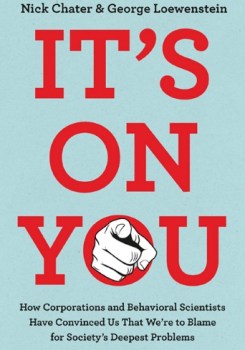
It's on You: How Corporations and Behavioral Scientists Have Convinced Us That We're to Blame for Society's Deepest Problems
An actor in a Native American costume paddles a birch bark canoe through a river clogged with floating trash. He pulls his boat ashore and walks toward a bustling freeway where a driver hurls a crumpled paper bag out a car window. As he turns toward the camera, a single teardrop is visible on his painted cheek. The advertisement concludes with a powerful message: “People start pollution. People can stop it.”
Baby boomers in the US might recognize this as the famous “crying Indian” public service announcement, produced by a group called Keep America Beautiful, which first aired on Earth Day in 1971. Beyond the irony that the Native American was actually an actor of Italian descent, the ad conveniently neglects to mention that both it and Keep America Beautiful were sponsored by beverage and packaging corporations such as the American Can Corporation and the Owens-Illinois Glass Company.
For decades, these companies broadcast the message that “people start pollution”—essentially shifting blame for a massive problem they created onto the public—while energetically fighting against any regulatory measure that would meaningfully reduce pollution, such as so-called bottle bills (laws requiring that people can get a deposit back when they return packaging). The “crying Indian” ad was finally retired in 2023, not because it was revealed to be a front for big business, but because it stereotyped Native Americans.
Yet the same tactic is still in wide use—and not only when it comes to pollution.
It may seem natural for us to feel a measure of personal responsibility for the many problems that plague society; or, if we ourselves don’t feel personally responsible for them, to at least blame them on the actions of other individuals. We see an epidemic of obesity, for instance, and we focus on people’s choices about their diet and exercise. We dread not having enough money for retirement and fault ourselves and others like us for failing to put more aside. We see the threat of climate change, and we focus on the type of car we drive or the way we power and heat our home. But in these cases and many more, we have been led astray by the equivalent of a “crying Indian,” misled into believing that individuals created these problems, and that individuals can fix them.
In this book, we examine many daunting challenges that face our societies and troubled planet: from climate change to gun violence, from obesity to the opioid epidemic, from the crippling cost of health insurance in the US to global income inequality, from a spike in American traffic fatalities to a crisis in pensions and retirement savings. In every case we believe the only way to fix these problems is with a systemic approach, by changing the rules of the game: introducing regulations and taxes, removing perverse incentives, adding checks and balances, remaking infrastructure and redesigning institutions.
Yet over and over again, we will see how vested interests that have created the current situation—and benefit from it enormously—find ways of reframing the debate, whether it’s the National Rifle Association telling us that “guns don’t kill people; people kill people” or the oil giant BP cynically marketing the concept of the “individual carbon footprint” as it fights any and all measures to curb emissions caused by fossil fuels.
It’s not only the occupants of the C-Suite (the CEO, CFO, etc.) and lobbyists in the halls of Congress who have distracted us from the real causes of the problems we face by focusing our attention on the flaws and failings of individuals. Over the last few decades, many psychologists and behavioral economists—including the psychologist and the behavioral economist who wrote this book—have also been focused on the shortcomings of individuals. We and many of our colleagues in the behavioral sciences have spent our careers running experiments and documenting the many “imperfections” of human judgment and decision-making… With this intense focus on individual irrationality, it is perhaps unsurprising that a widely held view has come to dominate policy discussions—that many of society’s, and the world’s, problems stem from individual failings. We call this perspective on our social and environmental problems the i-frame (individual frame).
Standing in stark contrast to the i-frame perspective is the idea that social problems arise because there is something wrong with the system of complex and interlocking rules that govern our lives. According to the s-frame (system frame) perspective, the outcomes we end up with depend on the rules of the game, not on the conduct of individual players. So when we see social problems that are either relatively new or have gotten much worse in recent years—whether it’s obesity, income inequality, plastic waste, or gun violence—we should cast a critical eye on the playing field. What has changed about how the game is played? What new rules have been instituted (or, more likely, removed)—and at whose behest? What could be done to level the playing field? The mantra of the s-frame is change the game, not the players. And changing the game will usually involve the traditional levers of government: regulations, laws, taxes, incentives, and more.
The i-frame perspective, we will see in this book, has some undeniably appealing features. It focuses on specific choices made by identifiable individuals; it adopts, as it were, a “person’s-eye” view on social problems. When we see the world through the i-frame, diagnosing social problems by focusing on individual behavior, we tend to try to solve those problems by helping individuals make better choices: eat more healthily, exercise more, use less energy, recycle, avoid harmful addictions, put more money aside for a comfortable retirement, and so on. Self-help books, diet programs, fitness instructors, financial advisers, and life coaches stress how each of us can take control of our lives to be healthier, wealthier, and happier. Many religious traditions likewise focus, in diverse ways, on enjoining us to be better people and to lead better lives. Billions upon billions of better individual choices, the logic goes, will lead to a better world. All of this makes the i-frame perspective intuitively seductive: Individuals and their struggles are easy to relate to and empathize with. You can’t relate to, or empathize with, a system.
With the i-frame perspective in the foreground, governments have attempted to create interventions that will help people make better choices, whether better for the specific individual (e.g., concerning health or savings), or better for the common good (e.g., concerning the environment). One such approach is what are known as “nudges,” a term that came to prominence after the publication of the 2008 book Nudge by the legal scholar Cass R. Sunstein and behavioral economist Richard Thaler. Nudging involves carefully arranging the choice options people face (rather grandly, the “choice architecture”) so that the quirks of human nature pull us toward doing the right thing and away from doing the wrong thing. A typical example would be to make sure that the “default” option—which kicks in if we do nothing—is mostly the “right” option, so that the lazy and inattentive are automatically “opted in” to get healthier food options, put more money aside for retirement, or receive their electricity from “green” providers.
If i-frame interventions were as successful as many people seem to believe, then perhaps systemic change, with all its inherent risks, would be unnecessary. Perhaps we could solve climate change by encouraging each individual to reduce their carbon footprint, ensure retirement security by inducing people to save more, eliminate obesity by figuring out clever interventions to promote dieting and exercise. Alas, a mountain of evidence shows that the impact of i-frame interventions—the nudges we have been told are so beneficial—has been disappointing, often showing small or even null results. Worse, knowledge of the existence of nudges has been found to “crowd out” support for more-effective conventional system-changing policies. By promising cheap and quick solutions to policy problems, the enormous publicity surrounding nudges convinces people that more fundamental policy change is unneeded or at least not a top priority.
The book is divided into two parts. In Part One, we document how a strategy of misdirection—a diversion from the s-frame to the i-frame—has been applied methodically by powerful corporate interests across a wide variety of issues, from climate change to the obesity crisis, from poverty in retirement to the growth of inequality, and more. We describe different aspects of psychology that make this diabolical strategy work so well. We explain how well-intentioned researchers—including ourselves for more years than we care to remember—can get swept up in i-frame thinking and devote their time and attention to proposing misguided and ineffective solutions to problems. In Part Two, we try to make sense of how we got into the situation of rampant dysfunction documented in Part One. We recount how the transition from the Great Society vision of government gave way to an antigovernment perspective—funded by powerful corporate interests and exemplified by the “Chicago school” of neoclassical economics—which culminated in the election of Ronald Reagan as president in 1980. The resulting “i-frame ideology” eschews all reforms and regulations and champions individual self-reliance and responsibility. A government-mandated cure, we’re told, will always be worse than the disease.
We then document how the new discipline of behavioral economics, which emerged in the early 1980s as a reaction to the assumptions and policy positions of the Chicago school, ended up proposing equally individualistic solutions to public problems in lockstep with those advocated by the Chicago school—effectively sleepwalking into the enemy’s ranks.
S-frame change is essential, but it is no panacea. Yes, systemic solutions are the only way to make progress on a host of problems, but systems can and do go horribly wrong, leading to monstrous regimes, collective delusions, and human destruction and suffering on a vast scale, as history amply illustrates. In fact, seeing exactly how such systems have gone horribly wrong in the past only underlines the power of the s-frame—and the importance of getting it right.
Excerpted from It’s On You: How Corporations and Behavioral Scientists Have Convinced Us that We’re to Blame for Society’s Deepest Problems by Nick Chater and George Loewenstein, copyright ©2026 by Nick Chater and George Loewenstein. Used with permission of Basic Venture, a division of Hachette Book Group, Inc.
Dr. Nick Chater is a professor of behavioural science at Warwick University and coauthor of It’s on You: How Corporations and Behavioral Scientists Have Convinced Us That We’re to Blame for Society’s Deepest Problems.
George Loewenstein is the Herbert A. Simon University Professor of Economics and Psychology at Carnegie Mellon University.