How the financial industry has curbed drug development
“Pharma Monopoly” shows how the financial industry’s influence over pharmaceutical decision-making means fewer new drugs and higher prices.
The following is an excerpt from “Pharma Monopoly: The Battle for the Future of Medicines” by Tahir Amin and Rohit Malpani.
When you purchase products through the Bookshop.org link on this page, Science Friday earns a small commission which helps support our journalism.
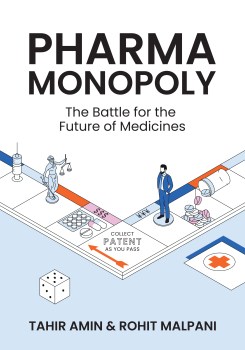
Pharma Monopoly: The Battle for the Future of Medicines
Short-Term Gains, Long-Term Pains
Some of the oldest and now most powerful pharmaceutical companies, such as Merck, Eli Lilly, and Pfizer, started out as family and small businesses. It was not until the 1940s that they would become publicly traded companies to sell shares and raise capital. Only then did shareholders gain influence over the decision-making of pharmaceutical company CEOs.
Shareholder governance has itself shifted from individual to institutional investors, such as asset management groups, banks, insurance groups, investment management funds, pension funds, and venture capital. In 2019, the largest shareholders in US pharmaceutical companies that were in the top 15 companies worldwide were the institutional investors Vanguard Group, Blackrock, State Street, and Capital Research.39 Vanguard and Blackrock were also present as one of the three main shareholders in all eight of the top US pharmaceutical companies that were in the list: Pfizer, Merck, J&J, AbbVie, Gilead, Amgen, BMS, and Eli Lilly. A 2022 survey of the 15 biggest European pharmaceutical companies painted a similar picture, with asset management firms and hedge funds such as Fisher Asset Management, Arrow Street Capital, and Coatue Management being some of the largest shareholders.40 With institutional investors being the dominant shareholders and CEOs who have grown up in a business culture dominated by the “Friedman doctrine,” it is inevitable that the largest shareholders and industry executives are guiding the business decisions of pharmaceutical companies to achieve goals set by the financial sector.
An illustration of the consequences of financialization on the decision-making of today’s pharmaceutical company investors and executives can be found in a 2021 report released by the US House Committee on Oversight and Reform.41 The Oversight Committee launched a multi-year investigation into pharmaceutical pricing and business practices, which included analyzing the financial data of the world’s 14 largest drug companies. Its report evaluated how much investors and executives of drug companies spent on enriching themselves as compared to the amount they invested in the R&D of new treatments. Between 2016 and 2020, these companies spent over $577 billion on stock buybacks and dividends that benefited investors and executives. This amounted to $56 billion more than they spent on R&D. If the same rate of spending on buybacks and dividends were to be applied for the period 2020–9, these companies are projected to spend over $1 trillion. A similarly egregious picture was revealed in relation to the compensation packages received by the executives of the 14 companies. Over $3.2 billion in aggregate compensation was paid to them over a five-year period. It was also found that price increases for some brand-name drugs were tied to executives meeting their annual bonus targets.
Equally concerning were the Oversight Committee’s findings that one of the companies investigated, AbbVie, spent a large portion of research expenditure for its top-selling drug Humira on “anticompetitive R&D” aimed at suppressing competition and finding ways to maintain high prices instead of developing new treatments.42 As already discussed in Chapter 5, much of AbbVie’s “innovation” was dedicated to building patent thickets to thwart competition for another seven years and earn over $100 billion in additional revenue. Between 2014 and 2018 alone, the company would spend a total of $15.3 billion on stock buybacks while patients were left paying higher prices.43
The consequences of financialization in the pharmaceutical sector are many. Companies are focused on the short term. Many progressive economists criticizing the financialized practices of pharmaceutical companies argue that they need to go back to spending more on “real innovation” and less on enriching shareholders and executives. Such critiques, while well meaning, fall into the neoliberal trap around the language of innovation and patents discussed in Chapter 5. If anything, the language of innovation provides the perfect cover for financialization. The two go hand in hand. Instead of making long-term investments in inventing new knowledge for breakthrough drugs, pharmaceutical companies use the language of innovation to focus on lifecycle management strategies of tweaking existing drugs to extend monopolies and maximize revenue. In fact, data shows that, because of financialization, companies from different sectors now direct more of their investment to incremental innovation and patenting than expending resources on radical innovation – in other words, invention.44
Alongside pharmaceutical companies spending resources on lawyers who “legally innovate” to extend revenues from blockbuster drugs, financialization has also encouraged the industry to partner with investment bankers to oversee a wave of consolidation in the sector, which has resulted in less competition as fewer large pharmaceutical companies now dominate the marketplace. Between 1995 and 2015, the 60 leading pharmaceutical companies merged into 10. This has had a negative impact on the development of new medicines, with industry generating fewer new compounds compared to pre-merger levels. Merged drug companies also spent proportionally less on research than their non-merged competitors.45
Any inventive activity in recent years has come from smaller companies: 63% of all new compounds in 2018 came from smaller biopharma firms, compared with just 31% in 2009.46 But larger firms use their massive financial war chests gained through earlier blockbusters to acquire these smaller companies for princely sums and then apply their well-honed playbook of patent thickets and excessive pricing to keep earning mega-profits. What is more concerning is that some studies have shown that R&D within the merged entity, which is typically a smaller biotechnology company, declines substantially.47 Not only do these mergers reduce competition in the marketplace, they also can kill the places where any real invention for new drugs emerges.
Notes
39 Joan Busfield, “Documenting the financialisation of the pharmaceutical industry,” Social Science & Medicine, 258, 2020: art. 113096.
40 Ramish Cheema, “15 biggest European pharmaceutical companies,” Yahoo Finance, November 23, 2022.
41 Committee on Oversight and Reform, Drug Pricing Investigation, Industry Spending on Buybacks, Dividends and Executive Compensation, Staff Report, July 2021.
42 Ibid., p. ix.
43 Ned Pagliarulo, “AbbVie shows allure of pharma stock buybacks,” Biopharma Dive, December 14, 2018.
44 Young Soo Lee, Han Sung Kim, and Seo Hwan Joo, “Financialization and innovation short-termism in OECD countries,” Review of Radical Political Economics, 52, 2, 2019: 1–28.
45 Robin Feldman, “Drug companies keep merging. Why that’s bad for consumers and innovation,” The Washington Post, April 6, 2021.
46 Ibid.
47 Justus Haucap and Joel Stiebale, “Research: innovation suffers when drug companies merge,” Harvard Business Review, August 3, 2016.
Excerpted from “Pharma Monopoly: The Battle for the Future of Medicines” by Tahir Amin and Rohit Malpani, with permission from Polity Books, 2026, www.politybooks.com.

Tahir Amin is a founder and CEO of the Initiative for Medicines, Access & Knowledge (I-MAK), and co-author of “Pharma Monopoly: The Battle for the Future of Medicines.”
Rohit Malpani is an independent consultant and former director of policy for the Médecins Sans Frontières Access Campaign. He is a co-author of “Pharma Monopoly: The Battle for the Future of Medicines”