‘Big Math’ is here, and humans can shape its potential
Machine-powered math can take on huge problems with millions of unknowns. That can be concerning—but also holds enormous potential for good.
The following is an excerpt from “Big Math: The Hidden Codes That Run Our World” by Steven Strogatz and Alex Townsend.
When you purchase products through the Bookshop.org link on this page, Science Friday earns a small commission which helps support our journalism.
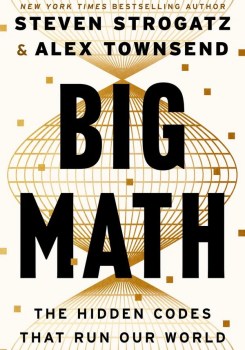
Big Math: The Hidden Codes That Run Our World
Regina Barzilay had just turned forty-three. Nobody in her family had ever had breast cancer or any kind of cancer at all, and she had no risk factors that she knew of. She assumed, as so many do, that she was safe. Only later would she learn that more than 80 percent of women diagnosed with breast cancer have no family history of the disease.
“I couldn’t believe it,” she said when we spoke with her in the fall of 2025. “They did biopsies, the whole shebang.” The disbelief stretched from her diagnosis in April 2014 through a grim march of procedures—two lumpectomies, chemotherapy, radiation—to December, when her treatment finally ended. “I lost all my hair and stuff,” she said casually, but there was nothing casual about it. Regina was divorced at the time. Her son was seven years old. As an immigrant, she had no family nearby. “If something happened to me,” she said softly, “what’s gonna happen to him?”
Before all this, she had spent years as a leading expert in computational linguistics, devising methods to translate ancient languages, especially in the most difficult cases where no Rosetta stone was available. Now, as she battled cancer, her own body felt like one of those inscrutable texts.
After her treatment ended and she returned full-time to MIT, where she was a computer science professor, she felt a kind of frantic energy. She couldn’t sit still and do nothing, knowing that many other women were going through the same ordeal that she had. She went from doctor to doctor in the hospital where she’d been treated, offering help with their data. “You don’t need to give me funding,” she told them. “I’m a full professor at MIT. Can I do something for you?” They all smiled and said they were doing fine. “Nobody was interested,” she said. “At all.”
She could not accept that answer. And the more she sat with it, the more outraged she became. With understandable frustration, Regina told us what she had learned during treatment at one of the best hospitals in the world. “The lack of any computer science was really unbelievable,” she said. She had asked her doctors a simple question: “What happens to people like me here?” Meaning, How do patients with my diagnosis tend to do at this hospital? No one knew.
“They cannot answer you this question,” she said. “I’m not talking about machine learning. I’m talking about basic data analysis.” The records existed. The information existed. But there was no way to connect them. “We perfected the technology for recommending movies and buying stuff online,” she said, laughing at the absurdity of how data science was used—and not used—in 2014. “But the people who really can benefit from it were not getting what they deserve.”
That mounting indignation and the compassion behind it led Regina Barzilay to a question that would change her life and reshape her field. Given that most breast cancers grow slowly, she thought, and given that for many women after age forty, mammograms are done year after year, the warning signs must be there long before a radiologist sees anything. “So,” she asked, “can we look at the earlier images, and instead of diagnosing what is big enough to see now…can we recognize what was already happening before?”
With collaborators in radiology and computer science, Barzilay began gathering data on a scale no one could ever hope to review directly: a quarter of a million screening mammograms, each paired with information about what had happened to the patient in the years that followed. She and her team trained an AI model to learn from these images, to see patterns too subtle for any human to pick up: tiny shifts in texture and density that, when analyzed across vast populations, formed the earliest signatures of malignancy.
They called the system Mirai, from the Japanese word for “future.” Mirai could look at a single mammogram and estimate a woman’s risk of breast cancer up to five years in advance. The model was tested in hospitals across the United States, Sweden, Taiwan, and beyond. In study after study, its predictions proved more accurate than the methods physicians had relied on for decades. Math and computation had teamed up to create a new early-warning system for one of the most feared diseases on earth.
Mirai began as one woman’s search for answers but grew into a tool that learned from more medical experience than any doctor could absorb in ten lifetimes. This is just one story of many from the world we’re living in today. When math scales up with the help of computers, everything changes.
For the past few decades, math has been up to something. Quietly at first, and now thunderously, it’s shaking the foundations of how we work, how we play, how we learn, how we shop and travel and communicate, even how we heal.
In a nutshell, math is going big.
After centuries of exploring problems small enough to fit inside a human mind, mathematicians are now embracing immensity: big, messy problems with billions of unknowns. This modern, computer-assisted style of math is spurring breakthroughs that are letting us decipher massive datasets, unravel giant networks, and simulate complex systems. It’s triggering upheavals in every field of human endeavor, from science and medicine to business and artificial intelligence.
Unfortunately, these breakthroughs tend to be obscured by jargon and the sheer sophistication of the ideas behind them. And because they’re occurring in so many different fields at once—without a unifying name to tie them together—they’re all too easy to miss. It’s the classic problem of not being able to see the forest for the trees. Here, the trees have head-scratching names like deep learning, compressed sensing, and linear algebra. The forest, we suggest, should be christened Big Math.
Imagine every photo on your phone, every movie you stream, and every online search you make. Big Math operates under the hood of these everyday miracles. You know it as
Beyond your screen, Big Math helps many of today’s most successful businesses turn immensity into profit. In Amazon’s cavernous warehouses, millions of items are shelved at random but found in seconds, thanks to deft probabilistic reasoning and logistical optimization. Facebook uses network theory to connect billions of people through a vast web of likes, shares, and friends. OpenAI’s ChatGPT—powered by trillions of parameters—answers questions, plans vacations, and suggests the perfect gift for your mother-in-law. And Nvidia’s graphics chips, originally built for video games, run quadrillions of calculations every second, driving the machine-learning revolution. It’s enough to take your breath away. This is Big Data and Big Tech, to be sure, but behind the curtain, Big Math is running it all.
Big Math is just as vital in modern science and engineering. It forecasts tomorrow’s weather and pinpoints where a hurricane will strike. It estimates how much a skyscraper will sway in the wind and shines a light on the insidious practice of gerrymandering in American politics. It even reaches the deepest level of reality. Big Math lies at the heart of quantum mechanics, helping physicists understand atoms and subatomic particles, with spin-offs to microelectronics, lasers, and a new kind of computing—quantum computing—looming on the horizon. The stakes here are unimaginably high: If large-scale quantum computing becomes a reality, it will break many of the encryption algorithms that protect financial transactions, medical records, and state secrets. Without quantum-resistant defenses, today’s digital infrastructure will be vulnerable as never before.
Although Big Math is a modern invention, its roots go surprisingly deep. Precursors appear in an ancient Chinese puzzle book dating to a century before the birth of Christ. A millennium later, the same signs surface in ninth-century Baghdad, when Muḥammad ibn Mūsā al-Khwārizmī explains how to split complex inheritances according to Islamic law, easily and systematically, using linear equations. And another thousand years after that, the great jazz singer Ella Fitzgerald briefly enters the story as a fifteen-year-old girl confined in a harsh reform school in upstate New York—the unlikely birthplace of social network theory.
If the roots of Big Math run so deep, why is it reaching full flower only now? The answer has to do with scale. The human mind is remarkable, but it is not built to handle truly enormous systems.
Take social networks. The evolutionary anthropologist Robin Dunbar famously proposed that a person can maintain only about one hundred fifty meaningful relationships. If we use this Dunbar number as a benchmark, a circle of ten work colleagues feels comfortably manageable. But a platform like Facebook has nearly three billion active users and Instagram has more than two billion, and that level of connectivity is unimaginably vast by human standards.
In geometry, what’s too big for us might start at four dimensions, since we three-dimensional creatures find anything higher than that notoriously hard to picture. We’re also not great at keeping track of many moving objects; research in visual cognition shows that people can typically track only four or five items at once. And our short-term memory can hold around seven items, a far cry from the billions or trillions discussed in Big Math problems.
Given our cognitive limits, there’s no way we could do Big Math on our own. What made it possible was the invention of the modern computer.
At first, computers served the military. As the name suggests, computers were built to compute—to crunch the numbers needed to break codes, aim artillery, and simulate atomic blasts. After World War II, computers found new homes in civilian life, powering everything from airline schedules to telecommunications. Ever since, Big Math and computers have enjoyed a mutually beneficial partnership: Big Math provides the brains, and computers provide the muscle.
Long before computers existed, mathematicians came up with a handful of magnificent ideas—like matrices, networks, Markov chains, and optimization—that have since proved astonishingly scalable in a digital age. These core ideas of Big Math already had power before computers came along. But once they did, that power grew. With their help, we can now describe, map, navigate, optimize, compress, reconstruct, and predict immensity in ways never before possible.
At the beginning of our partnership with machines, we remained firmly in control, holding the reins. Computers were mere beasts of burden, doing arithmetic for us, cranking out calculations that were too long or tedious for us to handle. They didn’t think or feel, and they never complained; they simply followed instructions. Even when they arrived at answers we couldn’t reach on our own, we understood the paths they’d taken to get there. Their logic was our logic, just scaled up. With their help, we made extraordinary advances in all walks of life.
But at some point, the balance began to shift. Computers started making discoveries we couldn’t entirely follow. At first, they uncovered phenomena we’d never dreamed of. Then they began to learn from data in ways that unnerved us even more. These machine-made discoveries pointed toward something as inescapable as it was unsettling: Big Math was outgrowing its creator.
When Regina Barzilay developed her machine-learning model for predicting breast-cancer risk, she showed that a computer could detect trouble years before a tumor appears, often before any radiologist could spot it. The model sees something real, but no human can say exactly what it is.
Should the model’s opacity worry us? Barzilay doesn’t think so. As long as models are properly validated, she argues, we shouldn’t demand that they limit themselves to things humans currently understand—or even can understand. Understanding matters, but the urgency of saving lives matters more. When Barzilay extended her work to lung cancer, she and her colleagues named their model Sybil, after the ancient prophetess who could see farther than humans could explain.
Still, this new way of knowing raises other disconcerting questions. When computers detect patterns we can’t perceive, what does understanding even mean? When our tools learn from data in ways we can’t follow, how much should we trust them? And what do we owe ourselves when opacity is the price of power?
In the early chapters of this book, we’ll meet the tools of Big Math. They’re the hidden codes that run our world, and they pervade our day-to-day lives. Yet lately, as Big Math extends its reach, it has begun to escape our grasp. Near the end of the book, we turn to the questions posed by this trade-off between power and understanding. What do the most advanced forms of Big Math mean for mathematics itself, for each of us individually, and for the world we all share?
These aren’t just academic concerns. They’re central to how we live today. The challenge for all of us, then, is to harness Big Math and learn to ride it well. This book is meant to help, to show what its tools can do and where they fall short, so we can all take part in the choices ahead.
As you can already tell, this isn’t your typical math book. It’s more a conversation than a lecture, one that invites you to pull up a chair and lean in. We’ve written it for everyone, and we mean that. If your math is rusty, that’s fine. And if you wouldn’t normally be caught dead reading a math book, all the better!
But this isn’t just about making math feel cozy or accessible. There’s a reason we’re having this conversation now. The world is being reshaped by a handful of powerful mathematical ideas. This book is your way in. It’s for anyone who wants to have a sense of how the world works—and the confidence to feel at home in it.
This mission is personal for us. We’re both math professors at Cornell University. Steven is nearing the end of his career, soon to be put out to pasture, while Alex is just hitting his stride. We both love teaching and learning and exchanging ideas with our students, our colleagues, and each other.
Every Wednesday, we meet for lunch at Risley Dining Hall on Cornell’s campus. Picture something straight out of a Harry Potter movie: You walk into a Gothic castle and enter a grand dining hall with a hammer-beam ceiling and dark wooden trusses. There’s a large organ with pipes going up to the ceiling and portraits of long-departed eminences glowering down from the walls. Sunlight pours in from towering windows at the far end, illuminating Alex as he goes back for another helping of coconut chia pudding while Steven yields to one last chocolate chip cookie.
The two of us usually spend a few minutes catching up about our kids and our lives or gossiping about academic politics, but before long we’re diving right back into what has fascinated us for the past two years: the idea of telling the story of Big Math.
We’re both drawn to big, complex problems in math, science, engineering, society, and even the arts. In other words, we’re applied mathematicians, interested in how math connects to the real world. Steven uses nonlinear dynamics and network theory to study how order emerges from chaos in biology, physics, and the social sciences. Alex is enamored of linear algebra, partial differential equations, and approximation theory. With the help of computers, he applies those areas of math to fluid dynamics, data compression, and, lately, AI for science and engineering.
It has been so much fun getting to know each other and exploring the world of Big Math together. Those lunches became our proving ground where we tested ideas, poked holes in them, and slowly teased them into the shape of this book. Some days, we worried that human insight was slipping away from our field forever. Other days, we thought it was just changing character. Most days, we marveled at how lucky we were to spend our lives learning—even as the machines were starting to learn faster than we ever could.
In the pages ahead, we’ve tried to give you the experience of sitting in on one of these lunches. But don’t worry: At this table, you don’t need a PhD in mathematics to follow the conversation. We’ll tell the story of Big Math through anecdotes, analogies, a little history, and intuitive explanations, all leavened with real-world examples. For your part, you just need a bit of curiosity—and a willingness to be amazed. The ideas we’ll explore have moved out of the classroom and into the control rooms of the digital world. Understanding them gives you a kind of vision, a mathematical sixth sense, for what’s happening now and what’s coming next.
Whether you’re a student, concerned citizen, business leader, or just a casual reader of the news, there are a handful of mathematical ideas you’ll meet here that will equip you to make sense of our rapidly changing world and adapt to it. Some of the ideas will be familiar from school. Others are more obscure, known only to insiders. These more sophisticated ideas come from fields like matrix theory and linear algebra. Calculus and differential equations. Numerical analysis. High-dimensional geometry. Probability theory. Quantum mechanics and information theory. Machine learning and AI. Data science and statistics. It might sound like a lot, but what’s astonishing is how few ideas make up the core. Together they form a minimal tool kit, a Swiss Army knife for our time.
Whoever you are, don’t wait. Big Math isn’t some rarefied abstraction. It’s woven into your everyday life, and it’s shaping your future. This is your map to our brave new world.
Excerpted from BIG MATH by Steven Strogatz and Alex Townsend. Copyright © 2026 by Steven Strogatz and Alex Townsend. Used with permission of Little, Brown and Company. New York, NY. All rights reserved.
Dr. Steven Strogatz is a professor of mathematics at Cornell University.