A Tyrannosaurus rex mom is built for tearing flesh—and blending in
In “Tyrant Lizard Queen,” a T. rex mother passes her unique build, from powerful jaw to tiny arms, on to her newly hatched offspring.
The following is an excerpt from “Tyrant Lizard Queen:The Love, Life, and Terror of Earth’s Greatest Carnivore” by Riley Black.
When you purchase products through the Bookshop.org link on this page, Science Friday earns a small commission which helps support our journalism.
Tyrant Lizard Queen: The Love, Life, and Terror of Earth’s Greatest Carnivore
The hatchling’s mother is magnificent. At thirty-two feet long and seven tons, she’s a large T. rex but still stretching a few more inches and growing sturdier by a few more pounds as each generous wet season offers more prey. She captures and dismembers her meals with a truly impressive head, her jaws capable of crushing bone in a snap and her banana-size teeth suited to puncturing through the toughest hides. All of this pulverizing power requires immense jaw muscles, which have, through generations and generations of her ancestors, caused the sides of tyrannosaur skulls to broaden and flare out to the sides. The musculature has required so much accommodation that the sideways-pointing eye sockets early tyrannosaur species started out with eventually shifted forward to give the carnivore overlapping visual fields. Not only can the hatchling’s mother accurately gauge distances with those softball-size eyes of hers, but she’s certainly given a fright to more than a few herbivores who suddenly noticed that something in the forest was looking directly at them.
The tyrannosaur skull has become such an evolutionary focal point that other aspects of tyrannosaur bodies have shifted to accommodate it. The tyrannosaur’s arms are the most obvious trade-off. Despite the fact that almost every other part of a T. rex body is big, bulky, and robust, her tiny forelimbs are almost imperceptible against her sides. The appendages aren’t long enough for her even to scratch her own face, and each ends with two fingers tipped with claws—a thumb and first finger. The arms are completely useless for hunting or grappling with struggling prey. While still muscular, they are too small and out of the way for T. rex to even see them.
The beauty of the tyrannosaur is not only in her exceptionally powerful frame, however. Her scales are shaded for concealment while still bearing unique markings that distinguish her from every other T. rex padding around the floodplain. She wears a natural camouflage as finely honed by adaptation as that of any prey species. The lighter cream running from the underside of her chin past her belly gives way to rust-shaded scales above, dotted with horizontally elongated spots of pale brown. The spots dot her impressive head, too, a circle around each eye and smaller specks here and there in her own unique pattern. The smattering of lighter markings against the rich brown look a bit like bird and pterosaur droppings, almost as if she were just a funny-shaped tree. Together, the spot pattern and counter shaded colors help her blend into the groves of dawn redwoods and ginkgo trees she so often uses for cover, the spots further breaking up her outline so that a grazing three-horned Torosaurus might mistake her for just another shady patch of forest. It’s terrifying how easily such a large animal can hide in plain sight. And, of course, fine wisps accent her saurian attire. A soft breeze on this spring morning riffles the sparse coating of filamentous feathers along her neck, back, and flanks, the fluff growing denser toward the tip of her tail in what on good days could be called a fan but is presently a bit of a clump of dirty plumage. It’s hard work looking after a nest.
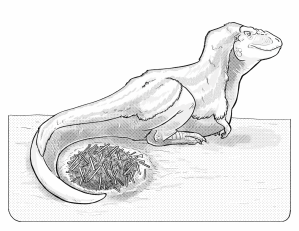
The hatchling’s mother shifts to sit, folding her legs beneath her and resting her weight on the thick boot of her paired pubic bones. The wide crescents of bone meet there to create a sturdy stump she can rest her weight on and still allow her to get up quickly if she needs to. She is keeping close watch over the clutch of eggs wobbling and shifting in the rotting vegetation she scraped together months before. Even though each of the seven babies is still working its way out of its egg, introductions are already being made. Offspring and mother can smell each other, each infant tyrannosaur beginning to associate the stinky aroma with this great creature they are inextricably drawn toward. With another determined kick our hatchling hits the eggshell so hard that a large piece pops off and she tumbles toward the new window, rolling so that her feet are sticking out below her through the hole as she wiggles her little body inside the remaining shell. Too awkward to stand just yet, she tumbles over to her side and jerkily lashes out with both legs. Each flex of her taloned toes pulls and rips more of the shell until she slides her whole body out of the fractured pod, eyes blinking as she adjusts to a vast, bright world.
Covered in slick embryonic fluids, leftover slime from the egg’s interior bubbling in her tiny jaws, she rests on her side and cranes her neck about to see the expanse she’s stumbled into.
The hatchling is not a tiny copy of her mother. She almost looks like another species altogether. She’s adorable, and not merely by tyrannosaur standards. The baby’s snout is short and shallow, making a wedge shape in front of the eyes, which take up most of her head. Her body is far more slender and birdlike than that of her mother, although her two-fingered arms seem disproportionately large compared to the rest of her. The same goes for her legs, thick trunks that seem almost ridiculously muscular, the engines that will carry her over the landscape, hold down prey, and, perhaps, dig out her own nest one day. She almost looks like a throwback to early tyrannosaurs of 80 million years before, when they were small snappers with long arms. It’ll take years for her to grow into her powerful and magnificent adult looks. She’s fuzzier than her mother, too, reddish-brown filaments closely packed from head to tail. She needs the coat to keep her tiny body warm, especially at night. In time, she’ll develop her own concealing spots just like those on her mother, but for the moment she has a more speckled look to better hide her among the drops of guano and detritus around the nest. Even though she’s about the size of a raven, already larger than many of the small creatures skittering around these damp wood-lands, she’s still tiny enough to barely be a mouthful for other species here. Before she can eat them, she will have to avoid being eaten.
From the book TYRANT LIZARD QUEEN by Riley Black, copyright (c) 2026 by Riley Black. Published with the permission of St. Martin’s Press, an imprint of the St. Martin’sPublishing Group.

Riley Black is a science writer and the author of several books, including “When the Earth Was Green,” “The Last Days of the Dinosaurs,” and “Tyrant Lizard Queen.”