Subscribe to Science Friday
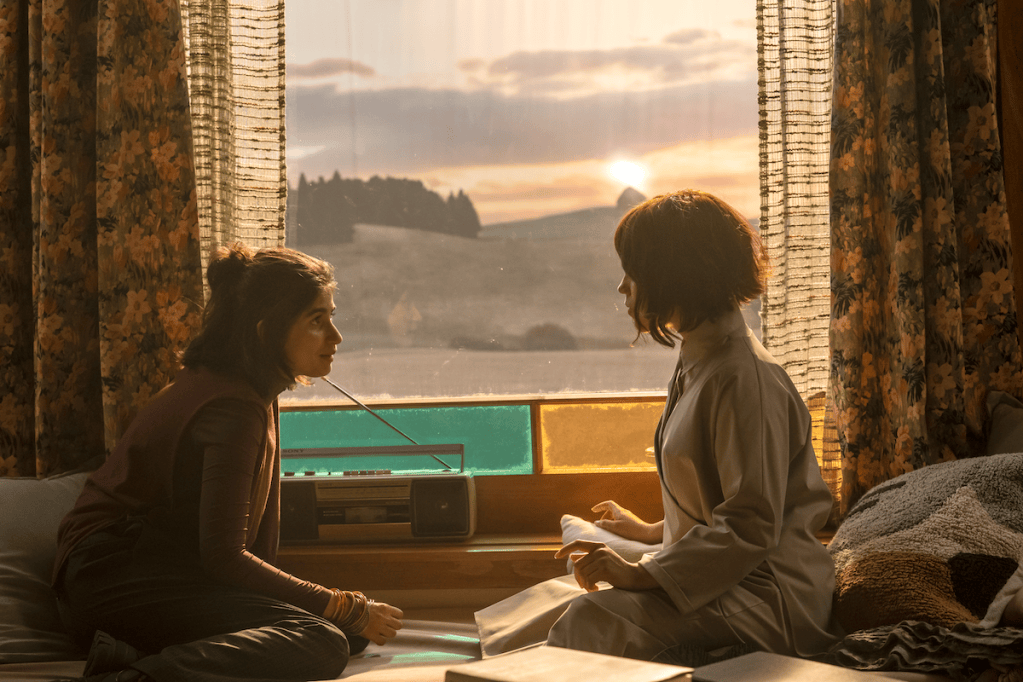
The movie “Klara and the Sun,” in theaters now, is based on the 2021 novel of the same name by Kazuo Ishiguro. The story is set in the future and is narrated by Klara, a robotic “Artificial Friend,” whose job is to be a companion to a sick teenage girl.
In the 5 years since the release of the novel, the AI landscape has changed profoundly. Flora talks to novelist Kazuo Ishiguro about the rapid evolution of artificial intelligence, the intersection of art and science, and his hopes—and fears—for the future of this tech.
More from the interview
When I read “Klara and the Sun” shortly after its publication in 2021, its premise felt purely fictional. This is a world in which Artificial Friends are old news: Klara, deemed defective by her empathetic nature, is an outdated model whose technology has been surpassed by newer, sleeker AFs.
The artificial intelligence landscape of 2021 feels quaint compared to now, as the film adaptation of “Klara” is being released. AI assistants like Claude and Google Gemini have been integrated into internet life, whether you want them or not. And AI safety has become the tech talking point of the year, set against the fact that AI is not empathetic to the nuances of human nature and life.
Kazuo Ishiguro, author of “Klara and the Sun,” says the AI debate has him thinking a lot about truth—as it relates to the scientific method, but also what we feel to be true in our hearts.
AI’s emotional weight
Ishiguro says he started thinking about the spectrum of truth in earnest during the COVID-19 pandemic, when it felt like there was a standoff between science and how people were feeling.
“We were so tuned into the scientific community, wanting answers from them,” he says. “And on the other hand, we seemed to drift right to the other end of the scale about what you might loosely call ‘emotional truth.’ We wanted to believe what we wanted to believe.”
In some cases, that led to people turning to conspiracy theories about vaccines and public health officials. When people felt so strongly about something, it became truth, whether science agreed or not.
Now, Ishiguro says he sees that playing out with AI.
“Just having the presence of AI in the world seems to arouse very strong emotions, not just toward AI itself or science itself, but it seems to be doing things to our relationships with each other,” he says. In previous generations, what people thought of as fundamental truths, like religion, affected how people related to each other. It could be the basis, or the end, of a relationship, he points out.
“I think a lot of our older, fundamental beliefs are being challenged by things like AI,” he says. “And I think inevitably, perhaps almost incrementally without realizing it, we might start to relate to each other in a different way.”
Scientific truth and emotional truth
It’s hard to imagine that a Nobel laureate could feel imposter syndrome. But Ishiguro says he feels like he’s been misidentified as an oracle due to the topics he’s had the foresight to write about.
“I’m watching this rapid progress of science and technology from a seat way back in the auditorium,” he says, adding that there are certain dangers to putting too much emphasis on the opinions of an author. “Having said that, it’s also equally dangerous to just leave it to the experts, because this is something that impacts people at every level.”
Kazuo says emotional truth—what we feel to be true in our heart—can be just as important as scientific truth, especially when we’re talking about a technology that can fundamentally change the human experience.
While there’s a long history of debate over scientific truth, with peer review and the scientific method, there’s no such structure for debating emotional truth. In arguing emotional truth, it’s one person’s opinion versus another’s.
“With science, there is a more or less agreed way of actually having your arguments, even if there isn’t a clear-cut conclusion to them,” he says. “With emotional truth, it’s much messier.”
But there’s also a risk to putting too much power into emotional truth. Kazuo told us that one of his biggest concerns about AI is that it will get to a point where it can produce art, like a film or novel, that provokes an emotional reaction from people.
“When an AI program can do that, it seems to me that it’s in a very good position to be used politically,” he says. “When you have an AI system that can really understand how best to emotionally manipulate people … and get them to do things, I think that would be a very dangerous use of AI.”
Managing the weight of judging scientific truth and emotional truth will not be easy, and Ishiguro says we’ll need a lot of public debate, not just limited to experts, as we move forward with AI.
— Kathleen Davis, Producer
Donate To Science Friday
Invest in quality science journalism by making a donation to Science Friday.
Segment Guests
Kazuo Ishiguro
Kazuo Ishiguro is a novelist and Nobel laureate, based in London, England.
Segment Transcript
FLORA LICHTMAN: Hey, it’s Flora and you’re listening to Science Friday. The movie Klara and the Sun comes out in theaters today. It’s based on the 2021 novel of the same name by Kazuo Ishiguro. The story is set in the future and is narrated by Klara, a robotic artificial friend whose job is to be a companion to a sick teenage girl.
Novelist Kazuo Ishiguro has spent his career writing about the human condition, often in relation to changing technology and scientific capabilities. His other novels include Never Let Me Go and Remains of the Day. He won the Nobel Prize for Literature in 2017.
Kazuo I’m so grateful that you’re joining us. I have been reading your work my whole adult life, and it really has given me so much. So thank you for making time to come on Science Friday.
KAZUO ISHIGURO: Thank you. It’s terrific to be here.
FLORA LICHTMAN: There’s a lot of science in your books. Not just robotics or AI, but gene editing and memory. I’d love to start with just hearing a little bit about your personal relationship with science.
KAZUO ISHIGURO: Well, it’s not a great one, actually. My father was a scientist. And that’s partly why a Japanese family was living in Britain. My father was working for the British government as a research scientist. And he was a kind of an inventor. He was trying to create a machine that could predict tidal waves and so on.
The machine that he created is now in the science museum in London. Because it is such an interesting piece of innovation that sits right between the analog era and the digital one. So this is all happening more or less at home because he worked at home a lot. He would go to his laboratory.
But one of my great regrets is that I didn’t pay very much attention to what he was doing. The trouble in– certainly in Britain, I don’t how it is in America– is that there is almost like a cultural divide between science and arts. And I kind of felt I was an artistic person, and I was interested in music and books and things.
And so I gave myself license to completely ignore what my father was doing. And I wish now that I had paid much more attention as I get older. I mean, I feel there’s this kind of huge gap, not just in my knowledge, but in the way I think, that wouldn’t be there if I trained myself to think more in that kind of scientific way.
FLORA LICHTMAN: When did you reacquaint yourself with science?
KAZUO ISHIGURO: Oh, I never properly reacquainted myself with science. But I have some scientist friends or people who work in the tech world, and talking to them is very illuminating. And one of the interesting surprises for me is that the two worlds aren’t that different. I always imagined that things are much more clean cut in science. People reach conclusions and consensus. And that was it. And then they moved on to do the next thing.
When I get to know people in science, they’re having rows and disagreements, just like people in the cultural world. There’s fierce rivalries and accusations being thrown around all the time. And in a way, it is comforting that science doesn’t progress in this clean cut way, that it has the mess of human debate and questioning about it.
I mean, it’s an inquiry, and people seem to acknowledge in the world of science, just as much as in other worlds, that reasoning can be motivated. Just because it’s scientific reasoning, it doesn’t mean to say it’s not motivated. And so I’m kind of reassured in a funny kind of way by the messiness of the scientific world.
FLORA LICHTMAN: I just had a conversation with a scientist yesterday and he said, there’s this popular misconception about science that it is about answers, when in fact science is really about questions.
KAZUO ISHIGURO: I’m sure that’s true. But I mean, there’s no point in asking a question if you’re not looking for an answer.
FLORA LICHTMAN: That’s true too.
KAZUO ISHIGURO: So in the end, yes, we all aspire towards answers.
But it’s been interesting for me, particularly in recent years. At times there seems to have been a kind of a standoff, if you like, between the kind of truth that people like me, or filmmakers like Taika Waititi– who made the movie of Klara and the Sun– there’s kind of a truth that we’re reaching for when we do our work. Which I think it’s different in kind to the kind of truth that scientists are arguing about and trying to reach.
And in recent years, I feel that the competition between these two ideas of truth seems to be more visible. And particularly during the pandemic, where all of us, just at every level, we are so hungry for answers to questions from the world of science. We wanted to which vaccines were going to work or whether we’re going to have a vaccine. What’s happening with this virus? Is it going to get worse?
We were so tuned in to the scientific community, wanting answers from them. And on the other hand, we seem to drift right to the other end of the scale about what you might loosely call emotional truth. We wanted to believe what we wanted to believe. We had conspiracy theories. Maybe vaccines were part of a conspiracy theory, it wasn’t just about the virus.
I mean, it just seemed to be in the air, that people felt that if they felt something in a strong enough way, that was the truth in some kind of way. And now we’re living in this time of people debating about AI, and to a lesser extent, gene editing. But I see that same conflict. People want to believe what they want to believe.
And just having the presence of AI in the world seems to arouse very strong emotions. Not just toward AI itself or science itself, but it seems to be doing things to our relationships with each other in the family. How we look at each other, how we feel about each other, even what we the fundamental things we assume about ourselves.
FLORA LICHTMAN: Is that happening for you with AI? Are you looking at yourself differently, or your family differently?
KAZUO ISHIGURO: It’s hard to say. I mean, we’d like to think there are certain kind of feelings and emotions that are eternal or universal to all human civilizations. We all care about our children. We have a certain bond amongst family members. We look for spouses or partners, and we have this thing called love. We fear death.
I mean, some things we’ve always assumed are eternal, almost. Part of our human condition, but they’ve always taken place within quite powerful contexts, I would say. So in a more religious age, what you believed about God and what happened after death, that had a big impact on the way you related to people.
Sometimes you could break off a relationship with somebody you loved because it went against some kind of belief system that you lived within. And I think we are now moving into an age when a lot of our older fundamental beliefs are being challenged by things like AI. And I think inevitably, perhaps almost incrementally, without realizing it, I think we may start to relate to each other in a different way.
And so, when I was writing Klara and the Sun, and I think very much in the movie, we were looking at family relations and emotions like love. I mean, this story isn’t about– it’s not trying to predict where we might go if the technology and the science gets out of control. It’s not necessarily suggesting that AI or gene editing is a menace, although it definitely acknowledges the darker side of those things.
But in our story, we focus on what happens to human beings and their assumptions about what another human being is. And can you make sense of an emotion that you label as love. If the possibility is raised that you can find out almost everything, excavate every kind of piece of information about the person, the object of your love, and maybe even transfer it or preserve it somewhere so that you can transfer it.
I mean, if somebody is just a bundle of impulses and emotions that you can more or less predict, maybe you relate to them in a different way. You can’t think of them as people with souls. There’s a Joni Mitchell song when she suggests that love is touching souls. Well, in the modern era, it’s harder to think of such a romantic idea.
FLORA LICHTMAN: Well you push back on that in the book, because doesn’t a character say, you can explore a room, but there’s rooms within rooms within rooms. Am I remembering right?
KAZUO ISHIGURO: Oh, no, that’s very good. Yes, I was relying on you to push back. I was just playing devil’s advocate.
[THEY LAUGH]
No, I mean, in our story, both in the book and the film, we don’t have any clear conclusion. And, yes, in the book, there is a passage in which somebody suggests that actually, however brilliant Klara the robot is, however, superintelligent and however well-equipped she seems to be at observing and learning another human being, and everything about them and the way they think and the way they feel.
It’s more like entering a house with many rooms, and when you enter each of those rooms, you’ll find more rooms and there’ll be more rooms. And that maybe is what the human heart is like. And it will be very difficult for any machine or any system however able, to ever get to the bottom of what a human heart is. There’s something forever unfathomable about the human heart. But then Klara says– this machine says, well, I think maybe I’m up to it. I’ll try very hard.
FLORA LICHTMAN: We’ll see about that. We have to take a break. And when we come back, we’ll talk about how much has changed in AI in the five years since Kazuo Ishiguro wrote Klara and the Sun. And how he thinks fiction can help us make sense of a changing world. Don’t go away.
[INTERSTITIAL MUSIC]
Klara and the Sun was set in the future. I remember when I read it. I remember very distinctly where I was. You know it’s a good book when you remember where you were when you were reading it. And I remember thinking, oh, this is really distant future. It doesn’t feel that way so much now. I’m curious, for you, has the pace of change of AI surprised you?
KAZUO ISHIGURO: Well, yes and no. It has kind of surprised me because when I started to write this book, people weren’t really talking about AI. To some extent I’m surprised people aren’t talking about gene editing more. Both in terms of the enormous benefits that it’s bringing in terms of health care, and other things about food and control of disease.
But also, I think it does pose enormous threats and questions about how we organize our society. If it becomes possible to produce superior children, people who are just objectively superior, not just, you’re thinking that my son is nicer than somebody else’s child or something. These are very challenging thoughts.
What’s happened in the last four or five years is that AI has come to dominate people’s consciousness. I’m still not convinced that we’re asking exactly the right questions about AI. I can understand that certain groups of people feel their particular livelihoods are threatened, so they suddenly start to make a lot of noise. And that’s as it should be.
But I still think there are some big questions about AI that that’s not to the fore.
FLORA LICHTMAN: Well, what are the questions we should be asking about AI?
KAZUO ISHIGURO: Well, I always feel uncomfortable when I get asked that because you’ve got to understand, Flora, the Nobel Prize is given to many very clever people, but I’m not one of them.
FLORA LICHTMAN: Do people treat you– just as a side question– do people treat you like an oracle?
KAZUO ISHIGURO: I was given a Nobel Prize for making up these kind of slightly strange stories. I’m watching this whole thing that we’ve been discussing about, about the rapid progress of science and technology in these fields. I’m watching from a seat way, way back in the auditorium. There are certain dangers to asking people like me questions like that because there’s a danger that we start focusing on the wrong emphases about these things.
Because I don’t really know what’s going on. Having said that, it’s also equally dangerous to just leave it to the experts, because this is something that impacts people at every day level. And once again, I come back to our story, Klara and the Sun. It takes place in a domestic setting. It’s about one particular family and what happens when you introduce a superintelligent AI robot into that life.
We can’t just leave it to experts to pronounce and control the parameters of the debate. We have to all participate in this. Everyone has to say, look, we’re worried about this, or reassure me about this, or how do we protect that. At the moment, there aren’t many obvious platforms, it seems to me, where we can actually, democratically in the most general sense of the word, have that debate.
FLORA LICHTMAN: I think this comes back to what you said earlier about emotional truth versus scientific truth. And obviously we love scientific truth on Science Friday. But I also think emotional truth is important. I’m going to go out on a limb there. I think that’s important too. And that is why I’m interested in your point of view on AI from wherever you are in the auditorium, because I think it might help us understand what seems to be a profound thing happening right now.
KAZUO ISHIGURO: Yes, I think emotional truth is very important. That’s how I used to justify what I did. If you sit on a stage with a bunch of Nobel Prize winning scientists and then you have to go up and get your Nobel Prize and you start wondering, why am I here with these guys?
Do I have anything like what they have? And you cling to this idea, oh, maybe I’m getting it for emotional truth, rather than this kind of stuff. But the trouble with emotional truth is that it’s harder to debate in a disciplined way. I mean, in science, there seems to be something that has been developed over centuries, scientific discourse with experiment, peer review.
There is a more or less agreed way of actually having your arguments, even if there isn’t a clear cut conclusion to them. With emotional truth, it’s much messier. People are just saying, but that’s my emotional truth. Well, too bad, I feel this. And so we try to have kind of a critical dimension in the cultural world, it seems to me.
We try to say, look, that is just emotional manipulation, because it lacks some kind of emotional truth. It might make you laugh and cry. It might be very transporting. But there is something about it that is not true. We don’t have a clear system like you have in the world of science.
And so it can be very dangerous. And someone who can wield emotional truth very powerfully can manipulate electorates and nations for their own ends. And so it becomes a very real thing, and it becomes a very dangerous thing when it’s not regulated. When we don’t have a context, as you do in science, a kind of disciplined context, to actually evaluate claims of emotional truth.
FLORA LICHTMAN: That’s such a fascinating idea, and I can’t think of the antidote.
KAZUO ISHIGURO: All right, having said all that, with its massive qualification. You asked me, what are the other questions about AI?
What I worry about about AI. I worry about the prejudices and biases that will disappear within black boxes in AI. And we will feel compelled to come to certain judgements. Some of those judgments, it could range from people being denied a loan, to people being sent to jail or even executed. And we won’t quite know why.
We’re depending on the conclusion reached according to things inside a black box. And I’m very aware that throughout history we had things like slavery, which was supposed to be perfectly OK. And until very recently, and still in many parts of the world, a gay person is thought to be someone who should be put in jail, or worse.
So I’m sure if you start to build black boxes now, it’s going to be full of the equivalents, today’s equivalents of those things. Except it’s going to be much harder for us to go back and unpack those things as we did with things like racism and homophobia, and indeed, things like slavery.
But we know that human society changes. And by and large, I believe progress is for the good. But I think that’s going to be very difficult, once we leave all the decisions to things deep inside a black box that we can’t even analyze.
And I told you the other thing that in my cultural world. It interests me. And it also frightens me. And it touches on what we said before about emotional truth. If you get to a point where an AI can actually produce, say, a novel, or maybe a movie, that makes people laugh and cry and really transports them.
Quite aside from the question about whether that’s taking work away from real human beings. When an AI program can do that, it seems to me it’s in a very good position to be used politically. And when you have an AI system that can really understand how best to emotionally manipulate people.
Through their emotions, get them to do things and really target particular demographics and basically identify exactly the thing that will get people worked up and compel them to do what you wish them to do. I think that would be a very dangerous use of AI.
FLORA LICHTMAN: You’ll have to come back and talk to us for your next book. Will you?
KAZUO ISHIGURO: Yeah, but I have to warn you, my next book has no intellectual content whatsoever. I mean, it’s coming out in March, and I’ve written it purely as an entertainment thing.
FLORA LICHTMAN: Look, what I’m hearing is that it’s another way of exploring emotional truth. And we’re interested in all kinds of truth on Science Friday, so.
KAZUO ISHIGURO: Well, I’m really pleased to hear that you’re interested in emotional truth on Science Friday. I have to say I think it’s really important that there are– I said earlier that we seem to lack platforms where we can debate these things, so that we don’t just leave things to the experts. But I think it’s terrific that there are shows like yours and stations like yours where everyone can go to. This is where we connect.
There is a slightly Citadel-like feeling about elite science that people feel, we’re not allowed in and people talk in strange jargon and we’re not qualified even to step through the doors. So I think it’s wonderful and really important what you’re offering us now.
FLORA LICHTMAN: Well, that makes my day. So thank you very much. Kazuo Ishiguro is a novelist and Nobel laureate based in London, and the film adaptation of his book Klara and the Sun comes out in theaters today. Thank you so much for joining us today. This was really my pleasure.
KAZUO ISHIGURO: Thank you, Flora, it’s been fantastic talking to you.
FLORA LICHTMAN: This episode was produced by Kathleen Davis, and special thanks to our friends at NPR studio in London. Thanks also to you for listening. I’m Flora Lichtman.
Copyright © 2026 Science Friday Initiative. All rights reserved. Science Friday transcripts are produced on a tight deadline by 3Play Media. Fidelity to the original aired/published audio or video file might vary, and text might be updated or amended in the future. For the authoritative record of Science Friday’s programming, please visit the original aired/published recording. For terms of use and more information, visit our policies pages at http://www.sciencefriday.com/about/policies/
Meet the Producers and Host
About Flora Lichtman
Flora Lichtman is a host of Science Friday. In a previous life, she lived on a research ship where apertivi were served on the top deck, hoisted there via pulley by the ship’s chef.
About Kathleen Davis
Kathleen Davis is a producer and fill-in host at Science Friday, which means she spends her weeks researching, writing, editing, and sometimes talking into a microphone. She’s always eager to talk about freshwater lakes and Coney Island diners.