Subscribe to Science Friday
Movies may be a largely visual medium, but sound plays a huge role in setting tone, creating new worlds, and fleshing out characters. Sound designer Erik Aadahl has brought some of Hollywood’s iconic creatures to life with sound, like the Transformers, 2014’s Godzilla, and Rocky the alien from “Project Hail Mary.” He joins Flora to talk about the science of sound design, and how he uses his background in biology to look for sounds in the animal kingdom.
Further Reading
- ‘Project Hail Mary’ brings a new kind of alien to the big screen
- Transformers Sound Designer Erik Aadahl on Breaking In and Creating the Sounds of Transformers via YouTube
- Sign up for our “Science Goes to the Movie” newsletter
Donate To Science Friday
Invest in quality science journalism by making a donation to Science Friday.
Segment Guests
Erik Aadahl
Erik Aadahl is a sound designer and editor at E² in Los Angeles, California.
Segment Transcript
[THEME MUSIC] FLORA LICHTMAN: Hey, I’m Flora Lichtman, and you’re listening to Science Friday. A few weeks ago on the show, we talked about the sci-fi space exploration movie Project Hail Mary. And I was particularly obsessed with the sounds that the alien in the movie, Rocky, was making.
[OTHERWORLDLY NOISES]
Their distinctive, and they’re funny, and Rocky talks a lot. And so I asked Andy Weir, who wrote the book Project Hail Mary and who’s a producer on the movie, if the sound designers actually made a real language for Rocky, if it was internally consistent. And here’s what Andy said.
ANDY WEIR: I don’t think so. I mean–
FLORA LICHTMAN: Aw, I’m so disappointed.
I didn’t get the answer I wanted. But then, almost like in a movie, we got this very surprising message on our listener line.
ERIK AADAHL: Hello, Science Friday. This is Erik Aadahl calling from Los Angeles, California. I’m a longtime listener, and I recently enjoyed your interview with Andy Weir and Dr. Wong about the science of Project Hail Mary. A question came up about the sound design of Rocky’s alien language. And as the sound designer of Project Hail Mary, I’m in a unique position to answer. I love your show. Keep up the good work.
FLORA LICHTMAN: Erik is not just the sound designer behind Project Hail Mary. He also did sound on 2014’s Godzilla, Transformers, and A Quiet Place. And he’s here to tell us all about the art and science of making movie monster roars and more.
Erik Aadahl, thank you for being here.
ERIK AADAHL: It’s a pleasure to be here.
FLORA LICHTMAN: I’m genuinely so happy you called us. This is the center of my nerdiness. It seems like the best job. Is this the best job?
ERIK AADAHL: Well, I don’t have too many frames of reference. But, yeah, I would say it is one of the best jobs I can imagine.
FLORA LICHTMAN: Are you that person at the restaurant who’s always listening? Are you like, shh, guys, I hear an interesting teacup clink, and I must capture it? Are your ears always on?
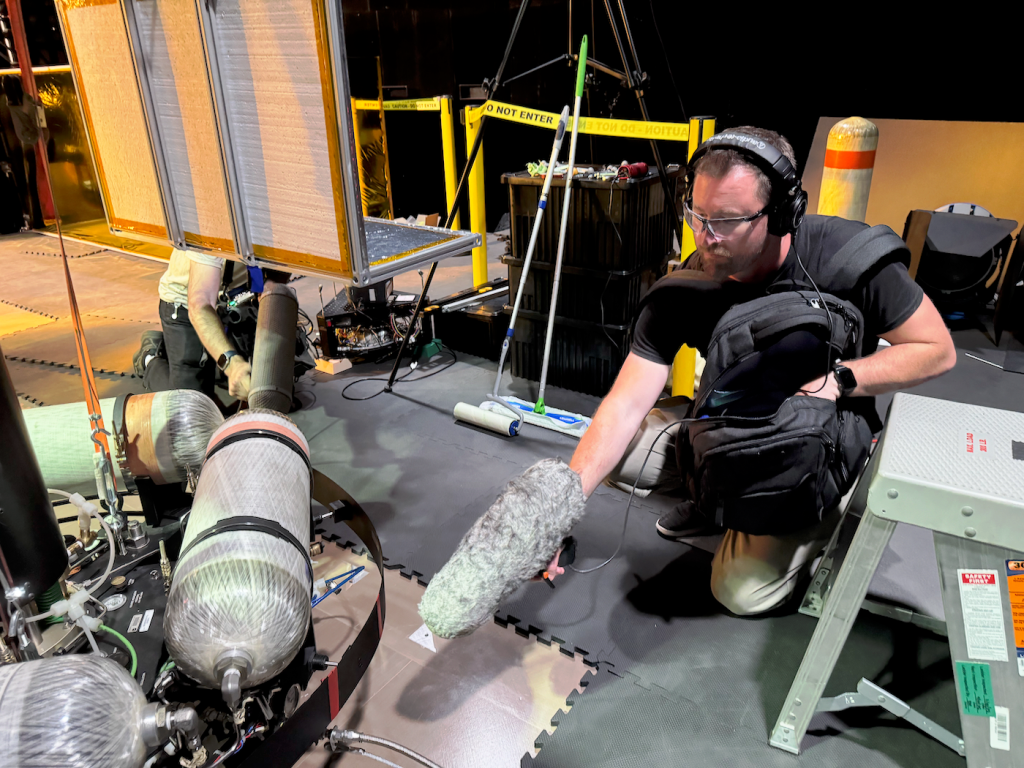
ERIK AADAHL: Yes, my ears are always on, though at restaurants I’m usually trying to filter out all of the noise. But when I’m just going about my daily life, if I open a door, and it creaks in a weird way, I think, OK, got to go grab my rig, record that.
If there’s an exotic bird that shows up in my yard, got to get the rig, record that. One of the nice benefits of my job is it does open up your awareness to experience. And so I try to always be aware of what is happening sonically around me, and then maybe worry later about how I might be able to use that in a movie.
FLORA LICHTMAN: Well, let’s talk about one of your movies, Project Hail Mary. We have to talk about the alien Rocky’s voice. As I said, this is a thing I’m obsessed with. So for people who haven’t seen it, here is Rocky saying his name in his native tongue.
[OTHERWORLDLY SOUNDS]
That’s beautiful.
ERIK AADAHL: Yeah, and that scene, that’s one of my most enjoyable little moments, because Rocky’s saying his Eridian name for the first time to Dr. Grace. And then Dr. Grace asks him, well, what’s my name? What’s your name for Grace? And it’s just like a burp.
So Rocky has a much more elaborate version of himself. And the way that was directed by Chris Miller and Phil Lord was they asked for something that was sort of beautiful and proud. And you could imagine he’s saying, I am Rocky from the boulder, rough-textured hills of X, Y, Z. It’s a long kind of epithet. But, yeah, that was a fun moment where he could open up with his expressiveness.
FLORA LICHTMAN: Can we hear it one more time?
[OTHERWORLDLY NOISES]
OK, clearly multilayered. What sounds are in there making up that voice?
ERIK AADAHL: So let’s go from the lower frequencies to the higher frequencies. So the base note there is a didgeridoo. And that’s creating kind of our base notes. And so that’s what we performed for that. And when you get into the more gurgly layer, there’s some humpback whale.
[HUMPBACK WHALE CALL]
There’s also some avian species. And one of my– there’s a class of birds, thrushes, that have just the most beautiful song. And that sound that we just heard for Rocky’s name has a solitaire bird.
[BIRD CALL]
And we slowed it down by a couple of octaves to get it into a more musical register that works better for the human ear. And that’s the kind of melodic center of Rocky’s name for himself.
FLORA LICHTMAN: Were there any other ingredients that you used in his vocalizations?
ERIK AADAHL: For most of his communication, when he’s calm, we used an ocarina.
FLORA LICHTMAN: What is that? Can you play it?
ERIK AADAHL: It’s a simple wind instrument, and it sounds kind of like this.
[IMITATES OCARINA]
And that can be pitched. We record at high resolutions, 192 kilohertz, which is way above human hearing range, and we can slow it down without losing any fidelity into a nice five-, six-octave range. He does get a little bit impatient and more agitated or annoyed with Dr. Grace.
And for that, we used a contralto clarinet, which has a nice a little bit more– it sounds like an animal, but–
FLORA LICHTMAN: A little more edge.
ERIK AADAHL: A little more edge to it, a little rasp to it.
[CONTRALTO CLARINET SOUNDS]
It’s funny. With certain sounds, you can close your eyes, and you can put a label to it, like, oh, that sound sounds annoyed, or that sound sounds content.
FLORA LICHTMAN: That clarinet is annoyed.
ERIK AADAHL: It’s a little pissy.
[LAUGHTER]
FLORA LICHTMAN: It’s amazing. I mean, it’s almost like you have to be a wildlife biologist and also a musician of many instruments to do this job.
ERIK AADAHL: I am a musician, and I did double major in biology and cinema in college.
FLORA LICHTMAN: It really does show. I mean, how does the recipe come together? When you’re putting together Rocky’s sort of language or vocalizations, are you like, oh, man, I need a pinch of humpback whale to really complete this? Is it like cooking, or is it something different?
ERIK AADAHL: Yeah, it’s a little bit like cooking. It’s a little bit like knitting. And I think of it a little bit like painting, colors being frequencies. And you try to be very specific with what sound frequencies you use because, like painting, it can very quickly become muddy.
The ideal is simplicity. If you can be simple and bold, that’s the ideal. So first, we wanted to just figure out what is his voice. The voice conveys the soul and the spirit.
And then, once that was figured out, then we got into the nitty-gritty of his Eridian language, which we wanted to be accurate with. We wanted the word for sleep in this section to be consistent with sleep later. But there might be a different context, and so it might be performed a little bit more intensely, or a little bit more calmly or quickly or slower, depending on the context.
FLORA LICHTMAN: Oh my gosh, so the language is actually consistent throughout.
ERIK AADAHL: The language is consistent.
FLORA LICHTMAN: Correction.
ERIK AADAHL: Yeah, yeah. There’s about 250 scripted words for Rocky. So the sleuths out there who want to go do some forensic sound examinations can probably spend a year trying to parse all that out.
FLORA LICHTMAN: Well, like you said, the sound brings Rocky to life. And it’s a huge part of the movie.
ERIK AADAHL: I think, to me, it’s half of the cinematic experience. We use our eyes, and we use our ears. And in a way, our ears can manipulate emotion more powerfully, in a more subliminal way.
FLORA LICHTMAN: You think so?
ERIK AADAHL: I think so. I mean, well, just the way sound works on our brains is it goes through our medulla oblongata first before it hits the auditory cortex. And that’s where you get things like pitch and localization and sound level, power intensity. That’s all prethought.
A brilliant filmmaker once said that sound kind of comes in through the back door and images come in through the front door. And in a way, that gives us a lot of power over how to express emotion and evoke emotion in an audience. So yeah.
FLORA LICHTMAN: We have to take a break. But when we come back, we have to talk about another iconic movie creature vocalization that you hooked up.
[ROAR]
If you know, you know.
[THEME MUSIC]
Let’s talk about Godzilla.
ERIK AADAHL: OK.
FLORA LICHTMAN: So let’s go back to 1954. This is the original Godzilla roar.
[GODZILLA ROAR]
ERIK AADAHL: Classic.
FLORA LICHTMAN: Iconic, yeah. Eric, you were tasked with making an updated Godzilla roar for the 2014 movie. Because that’s an iconic movie and an iconic sound, did it feel like a lot of pressure?
ERIK AADAHL: Well, yeah, there’s pressure to it, because it’s a piece of cinema history. And it’s so iconic that you can play that sound anywhere around the world, and people close their eyes, and they know that’s Godzilla.
So we definitely needed to pay homage to that. And the director, Gareth Edwards, he was like, you know, we can’t really use that 1954 recording. When you put that in a theater, it sounds kind of old. It’s a little vintagey.
FLORA LICHTMAN: A little dusty, yeah.
ERIK AADAHL: A little dusty. How do we do that with the technology we have 70 years later? And so that led into four months of experimenting.
FLORA LICHTMAN: Wow.
ERIK AADAHL: And I wanted a sound that just felt like an anthem that I could fill the theater with and Dolby Atmos, and just– my barometer is always, am I getting goosebumps or not? And if I don’t, I’m like, OK, I need to keep experimenting, keep trying stuff.
And sometimes it’s very serendipitous how this works. There’s happy accidents that weren’t intentional. And for something, different, I was recording a lot of different sounds using dry ice.
So you’ve got basically frozen carbon dioxide gas. It’s very cold. And you can use it against different metals. Usually metals are the most interesting things to apply to dry ice.
And on the Foley stage, we had this 6-foot-long cylinder. It was a piece of air conditioning ducting. And– just put that on top of this block of dry ice, and it started resonating. And because the dry ice is cooling the metal, the metal is now condensing and vibrating in doing so. And that vibration starts to push air. And it just started doing this wail.
[WAIL]
And I thought, OK, wait, there we are. That I can use as the central ingredient for the new roar. And hopefully, it translated.
FLORA LICHTMAN: Let’s hear it.
[GODZILLA ROAR]
ERIK AADAHL: And it’s funny. The inhale before he does the roar is– that’s an elephant blowing through his trunk. And it was Michael Jackson’s former elephant, Bo, and her partner, Susie, who are now living on a refuge in Lancaster, California.
And the way you get elephants to trumpet– they trumpet when they’re happy– is to let them go to the pond. And so they were basically stampeding when they did that. And so the trick is to mic them in a way where you’re not hearing tree branches snapping and get a nice clean trumpeting sound or– raspy trunk sounds.
FLORA LICHTMAN: Where you’re just like, hi, hello, elephant sanctuary. I must come mic your elephants?
ERIK AADAHL: Yeah, yeah, one of our assistants reached out, and they were totally into it, so.
FLORA LICHTMAN: OK, before we go, I want to play a game with our listeners. We’re going to play a sound from the Terrence Malick movie The Tree of Life. And this particular sound is the sound of the universe expanding, which also sounds like a hard assignment, just as an aside. And, OK, everybody listening, I want you to think about what this sound could be.
[LOW RUMBLE]
Is it a ghost, Erik?
ERIK AADAHL: I have not been able to record a ghost yet. But, yeah, so the entire reel 2 of The Tree of Life is kind of a 20-minute us witnessing evolution of the universe from the very beginnings, from the Big Bang through creation of stars and planets and the evolution of life on Earth through different periods.
And obviously, in space, we’re working with a vacuum. So using sound in space there was more to create a feeling. It wasn’t necessarily intended to be literal. It was more to evoke kind of vastness and mystery and maybe loneliness.
And Terrence Malick had kind of asked us to just go with your instincts and we’ll see. And I did not tell him what it was. He asked me. And I’ve learned this over many years. It’s not always a good idea to tell a director what the sound is, because sound is– it’s a very abstract art. You’re often using something that has nothing to do with what you’re witnessing visually on screen. And that’s part of the malleability of sound and the expressiveness of sound is you can be very abstract with it.
And he said, well, OK, don’t tell me until we’re done. But I’m going to name it. And he named that the sound of eternal silence. So that’s what–
FLORA LICHTMAN: Perfect.
ERIK AADAHL: It’s perfect, right? I mean, sometimes, you need a poet to apply words to sounds, because sounds can be very hard to describe. So I thought that was very poetic. And when we were done, I told him what it was. And that was me breathing into a microphone.
[LAUGHTER]
FLORA LICHTMAN: Sometimes the answer is right in front of you, or in you.
ERIK AADAHL: Literally.
FLORA LICHTMAN: Thank you for what you do, Erik.
ERIK AADAHL: Well, thank you for listening.
FLORA LICHTMAN: Erik Aadahl, the sound editor and designer behind many of your favorite movies, and apparently a Science Friday listener. This episode was produced by Kathleen Davis. And if you liked the sound of this podcast, or maybe something didn’t sound right, or maybe you too are a sound designer behind some of our favorite movies, call us and let us know– 877-4-SCIFRI, 877-4-SCIFRI. We’ll catch you next time. I’m Flora Lichtman.
[THEME MUSIC]
Copyright © 2026 Science Friday Initiative. All rights reserved. Science Friday transcripts are produced on a tight deadline by 3Play Media. Fidelity to the original aired/published audio or video file might vary, and text might be updated or amended in the future. For the authoritative record of Science Friday’s programming, please visit the original aired/published recording. For terms of use and more information, visit our policies pages at http://www.sciencefriday.com/about/policies/
Meet the Producers and Host
About Kathleen Davis
Kathleen Davis is a producer and fill-in host at Science Friday, which means she spends her weeks researching, writing, editing, and sometimes talking into a microphone. She’s always eager to talk about freshwater lakes and Coney Island diners.
About Flora Lichtman
Flora Lichtman is a host of Science Friday. In a previous life, she lived on a research ship where apertivi were served on the top deck, hoisted there via pulley by the ship’s chef.