How Caesar’s civil war led to a devastating loss of knowledge
In “The Museum of Lost Things,” a beheading and a late-night visitor lead to the devastating fire at the Library of Alexandria.
The following is an excerpt from “The Museum of Lost Things: True Tales of Fabled Treasures, Legendary Cities, and Mythical Creatures That Vanished From History” by Sam Kean.
When you purchase products through the Bookshop.org link on this page, Science Friday earns a small commission which helps support our journalism.
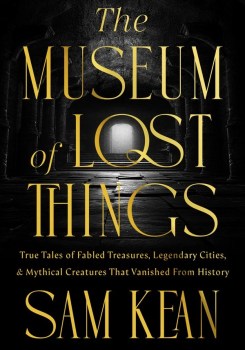
The Museum of Lost Things: True Tales of Fabled Treasures, Legendary Cities, and Mythical Creatures That Vanished From History
Julius Caesar walked right into a holy hell of a mess in Alexandria.
This cosmopolitan city served as the seat of government for Egypt’s 13-year-old pharaoh, Ptolemy XIII, a descendant of the Ptolemy mentioned in the Rosetta Stone. In 48 b.c., his kingdom was beset with controversy. According to his late father’s will, Ptolemy was supposed to rule Egypt jointly with his 21-year-old sister Cleopatra. But Ptolemy’s advisers—a scheming general named Achillas, a conniving eunuch named Pothinus, and a devious rhetorician named Theodotus—had convinced the teen to seize the kingdom for himself and banish Cleopatra to the desert.
The trio of advisers then did something even more audacious. In 48 b.c., Julius Caesar was fighting a heated civil war against a rival, Pompey. After losing a battle in Greece, Pompey fled to Egypt seeking refuge—a request that put Ptolemy’s advisers in a bind. Taking Pompey in would make an enemy of Caesar, who seemed likely to win the war. Then again, if Caesar lost, refusing Pompey would make an enemy of him. So, cleverly if cold-bloodedly, the trio met Pompey on his warship in Alexandria’s harbor and lured him onto a dinghy. There, the general Achillas stabbed him. As his comrade Theodotus said, “A dead man cannot bite.”
Caesar arrived in pursuit of Pompey four days later, at which point the advisers presented him with Pompey’s decapitated head as a gift. Caesar shed a few crocodile tears—he had to show some respect for a fellow Roman citizen—then rowed ashore with his troops and took up residence in the royal palace.
This proved unwise. Egypt was touchy about its independence, and seeing the most powerful man in Rome strutting around the palace worried the Egyptian people. Did Caesar have designs on their kingdom? Caesar tried to appease them, receiving local dignitaries and going sightseeing; he no doubt took in the famous lighthouse near the harbor, one of the Seven Wonders of the Ancient World. But he couldn’t defuse the tension. Riots broke out, and the mobs killed several soldiers
Things grew even more tense when Cleopatra showed up. One night, she and a trusted guard slipped into Alexandria’s harbor on a rowboat. Once ashore, the guard wrapped her in a bedroll, hoisted her over his shoulder, and gained entrance to the palace by pretending to be a traveling salesman.* Famously, he unfurled the roll at Caesar’s feet, and Cleopatra popped out.
Caesar, 56, was smitten by her good looks and saucy wit. Exactly as she’d calculated, they became lovers. Moreover, he agreed to help her reconcile with her brother and regain her kingdom. To paraphrase historian Irene Vallejo, she came, he came, she conquered.
Ptolemy’s advisers were of course alarmed to see Caesar canoodling with the boy’s rival to the throne. Caesar, in his postcoital daze, didn’t realize the danger he was in and even threw a banquet to celebrate the reunion of Cleopatra and Ptolemy. During the feast, however, Caesar’s barber wandered off and overheard the eunuch and general plotting about murdering the Romans. Acting quickly, Caesar ordered his guards to storm in and seize the advisers. Achillas and Theodotus escaped, but Caesar executed the eunuch Pothinus. Achillas then began amassing troops outside the city, and when Caesar sent two messengers out to negotiate, Achillas killed one and drove the other off. War was now inevitable.
Caesar hastily summoned reinforcements from abroad to aid his 3,800 soldiers, but the troops wouldn’t arrive for weeks. In the meantime, the Egyptian general attacked with 22,000 men. The fighting that followed was fierce. At one point, in a pitched battle in the harbor, Caesar had to leap off his ship and swim for his life, even disrobing in the water to keep from drowning. The people of Alexandria fished his clothes out and paraded them around as trophies.
Caesar’s troops held on until the reinforcements came a few weeks later, but the newly arrived Roman galleys found themselves stuck outside the city. Alexandria’s harbor was C-shaped—a circular bay with a narrow mouth—and dozens of Egyptian ships were blocking the entrance. To remove this obstacle, Caesar had his troops sneak up and hurl torches at the ships. The canvas sails and pitch-soaked planks quickly ignited.
While the inferno blazed, Caesar’s men rushed across a causeway to an island, allowing them to link up with the reinforcements. And while it wasn’t easy, Caesar outfoxed the Egyptians over the next few months, defeating Ptolemy’s forces and restoring Cleopatra to the throne.
However dramatic, the battle for Alexandria might have been a mere footnote in Caesar’s career if not for one thing. The fire on the ships in the harbor grew so massive that embers began drifting ashore on the wind. Some of the warehouses there caught fire, and stores of highly combustible grain went up, sending sparks jumping between the buildings “like meteors as they cut furrows across the heavens,” said one witness. And according to some ancient sources, the ensuing inferno destroyed the greatest concentration of wisdom in history: the legendary Library of Alexandria.
Excerpted from “The Museum of Lost Things: True Tales of Fabled Treasures, Legendary Cities, and Mythical Creatures That Vanished From History,” from National Geographic Partners, LLC. Copyright © 2026 Sam Kean

Sam Kean is the author of eight books, including “The Museum of Lost Things.” He is based in Washington, D.C.