Before its catastrophic end, Pompeii was full of life
In “The Lost Voices of Pompeii,” ordinary people live their lives and seek to be remembered in the turbulent years before Mt. Vesuvius erupts.
The following is an excerpt from “The Lost Voices of Pompeii: Life and Death on Pompeii’s Final Day” by Dr. Jess Venner.
When you purchase products through the Bookshop.org link on this page, Science Friday earns a small commission which helps support our journalism.
The Lost Voices of Pompeii: Life and Death on Pompeii’s Final Day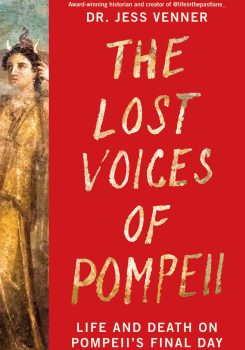
Buy the Book
Today, Pompeii is known for how it ended rather than how it lived. When we think of Pompeii, we picture the crumbling walls, the worn stone streets and the plaster casts of bodies frozen mid-motion. The circumstance of its destruction and preservation has caused this ancient Roman city to become a monument to disaster.
In 79 ce, Pompeii was a city full of life, a sunbaked, chaotic home to around 20,000 people. Children chased one another down alleyways, bakers shouted orders, dogs barked at passers-by, dice rattled on inn tables, and the smell of bread and wines hung in the air. Families and lovers, traders and tavern-keepers, slaves and politicians filled its streets, sharing meals, falling in and out of love, arguing with neighbors, grieving, working, and celebrating.
And yet, beneath the commonplace rhythms of everyday life, the population of Pompeii shared something with the greatest heroes of myth and empire: a desire to be remembered. The Greeks called it kleos, glory earned through actions, while the Romans called it fama, a name that lived on after death in the memories of those left behind. From the lowest slave to the most powerful politician, the fear of oblivion after death was widespread, and people everywhere sought to leave their mark, whether in stone, plaster, paint or architecture, as a bold and lasting declaration of, “I was here. I was part of this city’s history.”
It makes perfect sense because, in the ancient world, the only certainty was uncertainty. A harvest could fail, a mother could die in childbirth, the gods might turn their backs, or the ground beneath your feet could split open without warning. As is still the case, the poorest and most marginalized people in society often suffered first and worst, but disaster did not discriminate. It had the power to terrify both the rich and the poor and the ability to level privilege with poverty, exposing the fragility that bound them all. Seventeen years before the eruption that sealed Pompeii’s fate, one specific event made this plainly clear.
On 5 February 62 (or 63) ce, a powerful earthquake shook Campania, causing widespread destruction and marking the beginning of nearly two decades of tremors that would continue right up to the eruption. Hearing of the chaos in Campania, Seneca the Younger, the Roman philosopher and statesman, wrote to his friend Lucilius, telling him of the news:
We have just had news, my esteemed Lucilius, that Pompeii, the famous city in Campania, had been laid low by an earthquake, which shook all the surrounding districts as well. The city lies on a beautiful bay, running far back from the open sea, and is surrounded by two converging shores, on the one side that of Surrentum and Stabiae, on the other that of Herculaneum…It caused great destruction in Campania, which had never been safe from this danger but which had time and again got off with a fright…They also say that a flock of six hundred sheep was kill and statues were split open, and some people were deranged and afterwards wandered about unable to help themselves.
Today, we understand this quake as the start of Mount Vesuvius awakening from a long slumber. But to the people of Pompeii, the danger was not at all obvious. A handful of writers had voiced their concerns, but, to a largely illiterate population, these warnings went unheard. Strabo, the Greek geographer of the late Republic who travelled widely across the Mediterranean and recorded its landscapes, remarked on Vesuvius’ summit, describing it as barren and fire-scorched. Vitruvius, the Roman architect of the first century bce whose treatise On Architecture remains our most important source on Roman building, noted the local pumice and compared it to that found near Mount Etna, which they knew to be a volcano. But these were isolated observations, and for most residents the tremors were an unsettling, but ultimately familiar, part of life in Campania.
Also, a famine appears to have occurred post-41 ce, and in 59 ce, a huge riot broke out between Pompeian fans and visiting Nucerian fans at the amphitheater in Pompeii, resulting in the town being punished by the Senate with a ten-year ban on holding gladiatorial games and the dispersal of all unofficial occupational groups. So, food shortages and civic unrest added to the pressure; by 79 ce, Pompeii was a city under strain. Nevertheless, the hardy Pompeians refused to fold in the face of failure. In the seventeen years that followed the earthquake, homes were extended, further commercial gardens took root, specialized trades flourished, and new workshops popped up across the city. It was a time of extraordinary energy, when fear and hope seemed to coexist and prosperity was in the air.
As the city evolved and the Empire stretched far and wide, the people of Pompeii clung tightly to the values of honor and legacy.
For the elite, power and public memory were defenses against the unknowable void of the afterlife. By inscribing their names on statues, temples, and dedicatory plaques, and anchoring their presence and their legacy in the physical world, they hoped their lineage—and with it, the broader Roman identity—might endure.
Even those excluded from formal political power found ways to leave their mark. People from all social strata built thriving businesses, and freedmen, former slaves who had been granted their freedom, raised children who would go on to enjoy the political rights denied to their fathers. Freedmen also joined religious organizations such as the Augustales, a priestly college devoted to the cult of Augustus, which offered a rare avenue toward visibility and honor. More still left their mark in subtler ways.
Graffiti, sometimes carefully painted in red by hired hands, at other times hastily scratched into plaster with a stylus pen, blanketed Pompeii’s shops, houses, temples, brothels and bathhouses. Around 10,000 examples have been recorded to date, capturing everything from names and boasts to insults, advertisements, rumors, and shopping lists. However trivial they may have seemed at the time, each one offers a rare and intimate glimpse into lives that might otherwise have vanished.
The eruption of Vesuvius, one of the deadliest in history, consumed the city in less than twenty-four hours, silencing its streets and sealing its hopes, fears, and ambitions beneath six meters of volcanic material. On that day, the people of Pompeii achieved the immortality they had long sought, but not in a way they could ever have imagined. Though it may feel unsettling to peer so closely into lives that ended so abruptly, their longing for remembrance is a thought I try to hold onto, whether I’m standing before a plaster cast or reading a name scratched into a wall.
However, there’s a difference between remembering a city and truly knowing its people. While visitors admire the brothels, giggle at phallic carvings, and wander through grand atrium houses, they often struggle to connect with the lives behind them. It is easy to forget that Pompeii was a living, breathing place, full of people with families, dreams, and anxieties who, just like us, experienced sickness, heartache, joy, wonder, jealousy, and everything in between. Their lives were every bit as complex as ours, though their stories are too often eclipsed by the drama of their death, or by the better-known names of Roman history. If we are to truly understand these people, to know them as more than footnotes to tragedy, we must return to their beginning and trace how Pompeii came to be in order to discover how its people shaped, and were shaped by, the city they left behind.
***
Pompeii lies at the heart of the fertile region the Romans once called Campania Felix, or “Lucky Campania.” In fact, Strabo writes that the land was so fruitful it could yield up to four harvests per year. For centuries, Mount Vesuvius had watched silently over this landscape, its forested slopes and rich volcanic soil nourishing orchards, vineyards and olive groves. To those who lived in its shadow, the mountain was a giver of life: a steady, unshakable presence that shaped the land and sustained the economy.
In a fresco from the House of the Centenary, Vesuvius is depicted as a lush green giant, its slopes heavy with trellised vines and fruit trees. Beside it stands Bacchus, the Roman god of wine, lavishly robed in grapes and crowned in vines, the personification of the mountain’s bounty and the blessings it bestowed. Painted some time before the eruption, this is the earliest known painting of Vesuvius, and it offers a wonderfully vivid glimpse into how the people of Pompeii viewed their landscape: not as a looming threat, but as a source of life.
By the time this fresco was painted some time after 55 ce, Pompeii was already an ancient city, its identity shaped by centuries of change. Its streets and structures had been shaped by successive waves of settlement, each one layering new customs, languages, and beliefs onto the last. Greeks, Oscans, Etruscans, Samnites, and finally Romans all left their mark, not only on the city’s architecture and layout, but on its daily routines, rituals, religions, social structures, and tongues spoken in its streets. Their legacies were not always visible on the surface, but they ran deep into the bones of the city, the population of 79 CE undoubtedly aware of the cultural tapestry that made up their home.
The Oscans, an Italic people of southern Italy, were among the first to settle in the area of Pompeii. In the eighth or seventh century bce they founded five hamlets along the River Sarno. It is thought that Pompeii took its name from the Oscan word for “five,” though some prefer the later legend that gave the credit to Hercules. It was said that as he returned from a victory in Spain, he drove his cattle in triumph through Campania in a pompē, a procession that supposedly gave Pompeii its name (and nearby Herculaneum his own). The Greeks had arrived in Campania around the same time, having been drawn by the sweep of the Bay of Naples and its fertile soil. While they never established Pompeii as a Greek city in the way they did Cumae or Neapolis, their imprint on the region was unmistakable, and their influence in art, religion, and culture would ripple through Campania for centuries.
The Etruscans also leant their influence to Pompeii. Expanding south from their homeland of Etruria (modern-day Tuscany), they too were drawn to Campania by its rich land and trade routes from as early as the ninth century bce. By the seventh and sixth centuries bce, the Etruscans had established cities and a connected trade network, bringing with them technologies, long-distance commerce, and cultural sophistication, which helped to reshape the early settlement of Pompeii into something larger and better connected. Their dominance in Campania, however, was short-lived. After their naval defeat by the Greeks at Cumae in 474 bce, Etruscan power in the region became almost invisible by the late fifth century, though their influence lingered in Pompeii in its fortifications, religion, and trade practices.
It is almost directly after the expulsion of the Etruscans that we see changes in settlement patterns, the titles of magistrates and the language in Pompeii because, by the late fifth century, new forces were pressing into the fertile plains of Campania. The Oscan-speaking Samnites, a people from the rugged central Apennines, descended into the region and gradually took control of Pompeii and other Campanian cities. Drawing inspiration from their close contact with the Greek cities of the Bay, they adopted Hellenistic styles and ideas to express their new power.
Across Italy, the Samnites had fought bitterly against Rome in the three major Samnite Wars (343–290 bce), but Pompeii itself stayed largely outside these conflicts. Instead, after its victory over the Samnites, Rome asserted its dominance over Campania, and Pompeii was forced to become a socius, or subordinate ally of Rome. This meant that Pompeii was bound to provide troops and resources to Rome despite being denied the rights of citizenship. Despite that unequal status, the city prospered. Agriculture flourished in the volcanic soils, and trade in oil and wine flowed through its port, bringing wealth and new connections. Between 300 and 180 bce, the number of people living inside the city walls grew, as insulae (city blocks) were laid out in previously undeveloped areas likely used for agriculture.
By the second century bce, Pompeii under Samnite control was thriving and beginning to take on a distinctly Hellenistic character in its infrastructure. Its transformation was accelerated with the construction of major public buildings such as the Temple of Jupiter, the Large Theatre and the Basilica, while the Stabian Baths were expanded and remodeled.
But this prosperity existed alongside constant threat. Pirates prowled the Mediterranean, attacking coastal towns like Pompeii and disrupting sea trade, while, closer to home, unrest among Italic peoples pushed tensions across the peninsula to breaking point. Around 216 bce, refugees displaced by Hannibal from the nearby city of Nuceria are thought to have settled in Pompeii, expanding the area east of the Via Stabiana, one of the city’s major thoroughfares, and adding further to the city’s population and diversity. By this time, Rome’s power was spreading quickly across the Mediterranean. Yet Pompeii, fiercely independent, held fast to its own identity, even as Roman ways crept ever deeper into daily life.
Our earliest reference for the date of the Vesuvian eruption comes from Pliny the Younger’s letter to the historian Tacitus, written some two decades after the event. In it, he describes how his uncle, Pliny the Elder, observed an unusual cloud rising above Mount Vesuvius on 24 August 79 ce. Pliny’s observation has gone on to shape centuries of scholarship, and in December 2024, the director of the Archaeological Park of Pompeii, Gabriel Zuchtriegel, confirmed that the official date of the eruption would remain the one first recorded by Pliny the Younger. There are, however, several reasons why I remain unconvinced by this date.
It is worth keeping in mind that this was a private letter, written years after the event, and passed down to us only as a result of manuscript copies preserved by monastic scribes during the Middle Ages. The earliest surviving copy of Pliny’s letters dates back to the sixth century. Medieval scribes copied out full texts in grueling copying sessions, and as such were exhausted and overworked, and therefore prone to human error.
The margin for error is not insignificant, and there is material evidence for a different date: a charcoal graffito found in a house undergoing renovation in Pompeii in Region V in 2018. Given the context of the house, the charcoal note was likely left by a builder or decorator. Charcoal is a temporary medium, and it seems improbable that such a note would remain untouched on a blank wall for an entire year, in view of the number of properties undergoing rapid change post-62. It is therefore far more plausible that this was written shortly before the eruption.
As an archaeobotanist, I work with ancient plant remains, and the seasonal indicators preserved in Pompeii also point to an eruption in the autumn. Pomegranates, which ripen between late September and November, were found carbonized in large quantities at Villa B, Oplontis, a working villa just outside Pompeii. Archaeologists have also found evidence of other fruits and nuts typically harvested from September or October onwards, such as figs, fresh chestnuts, walnuts and wine grapes. While some argue that climate change might have altered harvest times, and these items could be preserved (which they often were), the ancient texts and ongoing agricultural practices in the region today suggest consistency in seasonal rhythms.
Then there are the coins. In the 1970s, a hoard discovered in the House of the Golden Bracelet included two coins bearing IMP XV and the image of the Emperor Titus. We know from inscriptions elsewhere that the Emperor Titus had already received his fourteenth acclamation on 7 or 8 September 79 ce, meaning that his fifteenth acclamation (IMP XV) would have come at a later date. However, it was later found that the coin actually read IMP XIIII COS VII, marking his fourteenth acclamation, which equates to a minting date of between July and August 79 CE. While this neither proves nor disproves either an August or October date, it is unlikely that these two coins would have gone into circulation in Pompeii within this short space of time.
Another small but curious detail lies in clothing and furniture. Several victims were found wearing cloaks and heavier garments, and braziers had been left in use in rooms and corridors. This stands out as unusual, given the average temperature for southern Italy in August. It is possible the victims were wearing heavy clothing to protect themselves from the falling dust and pumice, and while people might have grabbed what they could in haste, the use of heating equipment, such as braziers, at the time of the eruption suggests cooler weather.
From the manuscript transmission, the agricultural evidence, the coin hoard, the clothing, and domestic heating, as well as the charcoal graffito, I find the case for a later eruption date more persuasive than the traditional one. While no single piece of evidence is definitive, taken together they suggest the eruption likely occurred after 24 August 79 CE.
***
Although we know the names of many individuals who lived in Pompeii before the eruption, we cannot be sure of what happened to them. Not a single confirmed survivor has ever been identified. Population estimates for Pompeii vary, but the most accepted range is between 15,000 and 20,000, leaning toward the upper end with enslaved people included. As of a few years ago, around 1,050 bodies had been recovered from the two-thirds of the city that have so far been excavated, and more are still being found. Extrapolating this for the whole town gives an estimated death toll of around 1,600 to 1,700, suggesting a mortality rate of somewhere between 9 and 11 per cent. While these numbers remind us of the scale of the tragedy, they do not capture the lives behind them.
Excerpted from “The Lost Voices of Pompeii: Life and Death on Pompeii’s Final Day” by Dr. Jess Venner. Copyright © 2026 by Dr. Jess Venner. Published by HarperCollins Publishers. All rights reserved. Reprinted with permission.

Dr. Jess Venner is an archaeobotanist at the University of Oxford and author of “The Lost Voices of Pompeii.”