Learning to trust the night sky, one star at a time
In “The Wild Dark,” a young Craig Childs finds himself alone in a dark wilderness. As the Milky Way comes into focus, fear turns to wonder.
The following is an excerpt from “The Wild Dark: Finding the Night Sky in the Age of Light” by Craig Childs used by permission of Torrey House Press, torreyhouse.org.
When you purchase products through the Bookshop.org link on this page, Science Friday earns a small commission which helps support our journalism.
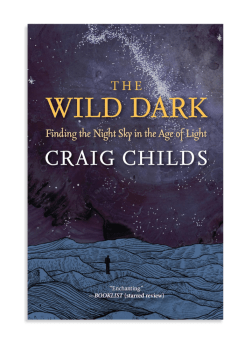
The Wild Dark: Finding the Night Sky in the Age of Light
Night comes slowly. Dusk shakes out its soft, furry tail, and stars appear. The first you’ll see is probably not a star but a planet, and you’d want to know what’s being wished upon, if it’s a dying blue giant several hundred light-years away or a red, dusty ball of rock one orbit out from our own. After the first one or two planets, the next needle pricks will be true stars, their abundance depending on the phase and brightness of the moon and the haze of ambient light. In the rowdy glamour of Las Vegas, if you look closely, three or four will scratch the surface. A little darker and you get hundreds of stars, Betelgeuse hanging between casinos like the red eye of a cyclops in a cave seven hundred light-years deep, or the glimmering blue-white binary of Sirius eight and a half light-years away. A little darker and you get hundreds of stars, and darker than that, thousands. Under full night conditions, a total of nine thousand stars are known to be visible to the unaided eye from around the entire Earth, a few thousand in a single scan from wherever you happen to be.
Do you remember being stopped cold by a brilliant night, seeing more of the heavens than you could rightly address? Was it in a wilderness where the Milky Way is so bright it cast a shadow? A back deck or a porch, rocking chair, dirt road you’re rambling along late in the evening, your face turning up to take it all in? It’s becoming rarer you might have noticed. When was the last time?
My first time was foisted on me. I must have been five or six and it was somewhere in Colorado because we lived in Denver back then. An hour or two by car out of the city had some wild places and still does today, dirt roads and empty country with no lights. My mom’s boyfriend drove a white Dodge pickup and we took it up to the mountains to camp. He was a meaty, kindhearted hockey player from Saskatoon who hauled a full-size mattress in the bed of his truck, and when we got to where we were going, he pulled it out with his big hands and threw it down with a mighty thwump. The ground was covered in needles fallen from ponderosa pines, amber and slick. As light faded, trunks of trees stepped farther and farther back and vanished. My mom had brought blankets, a lot of them, and she tucked me in so she and her sweetie could slip away to do whatever adults did, hand in hand in moonless dark. I lay frozen on the mattress, terrified. Perhaps I squeaked a complaint, but I probably stayed quiet, frozen, hearing nothing, not even crickets in chilly mountain air. Under the blankets, I could barely move.
I can’t say whether I’ve had more or less trauma than most. My early years were fine and loving as I recall, but at that moment on the mattress panic was loud, my heart beating in my ears. The dark seemed malevolent, or worse, it felt like nothing at all, no mom out there, no boyfriend, no pickup. I’d fallen from the well and brightly lit world with my eyes darting for anything to grasp. I landed on what was most obvious, a black ring of pines holding a circle above me, a window onto a color I still search to name, sapphires on silk. The Milky Way flowed like an event, a splash of paint a hundred thousand light-years across. I knew nothing of light-years, and if I knew of stars it was from nursery rhymes. I’d seen them before, but not to my memory and not eye to eye, not in a way I recognized.
As I looked into the thick of the sky, the weight of the blankets seemed to lift, and a monster was no longer seated on my chest. I won’t pretend to remember in detail what I thought that night, but I was acutely aware for the first time of visual infinity, and it was not empty as one might fear. It was chock-full, so busy my eye didn’t know where to settle. If I could have reached a hand out from under my blankets—and maybe I did—I would have waved a five-fingered blackness against the sky. I no longer felt alone. How could I? What should have been a complete void was not. My heart settled, breathing slowed. The celestial sphere seemed to sing me off the ledge.
This is how I came to trust the night sky. It’s where I still turn when my heart races in the dark and I have to get up from bed and walk outside bare-shouldered, standing with arms folded across my chest as the color of lilac rains down on my skin.
Not everyone feels this way. A friend gets the willies from seeing too many stars at once. Adverse, irrational reactions to seeing outer space are termed cosmophobia or astrophobia. Space dread. I don’t find this an unreasonable response, not if you consider we live on a planet as blood-pumping gut sacks with eyes sophisticated enough to see the cosmos.
Sitting around a campfire in Utah under a Bortle 1 sky—a rating for the darkest sky a person can encounter from the face of the Earth—my friend told me he looks up and can’t help thinking about the nothingness of forever. “Call me weird,” he said, “but it kind of freaks me out.” I sympathize with the feeling. A shiver goes down my spine seeing a sky like this. Most people on Earth live in regions of substantial light pollution, and space is something only seen on TV. Witnessing an unfettered night sky for the first time doesn’t always elicit delight; confusion is more like it. What are we seeing? Has this been up there the whole time? When confusion doesn’t go away, it eventually becomes awe.
Having the entire visible universe up there can be daunting, but my astrophobic friend certainly wouldn’t want it not to be there. We deserve a glimpse, and to decide for ourselves.
Seeing stars is a birthright, one of the major features of living on Earth, and the last islands of visibility are shrinking, their edges eaten away by human-made light. Satellite observations and recordings from the ground show a surge in illumination over the last few decades that has diminished the celestial view worldwide and is gradually making us night-blind.
Besides the useful Bortle scale, I measure sky quality by calling an urban view a domesticated sky. A feral sky would be past the suburbs, at least twenty miles outside city limits where urban stargazers take their telescopes. Wild has no human lights, no atmospheric glare from glowing filaments or diodes. You don’t have to have a telescope, the entire sky becomes one. It’s what I saw when I was a kid, my first eyeful of a full-dark night, which was not dark at all. This is old growth darkness where the trees of heaven grow all over each other, spangled in countless blossoms.
If I were a Johnny Appleseed of dark nights, I’d plant dazzling skies as I wander the land, tin pot for a hat, sleeping on the ground with no roof to block the view. The seeds are already in place, stars waiting to appear, nourished whenever the light fades out. I’d tend to these otherworldly forests by looking up and making eye contact. A night sky is not an absence of light, it is the presence of the universe. It is there to be seen. I’ll take refuge beneath an overgrown, untamed cosmos where the ground shimmers even when there’s no moon. I’ll draw blankets of light-years over myself, in no hurry to fall asleep, eyes wide and sparkling with stars.
Excerpted from “The Wild Dark: Finding the Night Sky in the Age of Light” by Craig Childs used by permission of Torrey House Press, torreyhouse.org.
Craig Childs is the author of :Wild Dark. Finding the Night Sky in the Age of Light.”