Tiny wasps emerge from a caterpillar, and reveal a hidden world
In “Hidden Creatures,” a young entomologist discovers the miraculous world of parasites when cocoons sprout from a caterpillar.
The following is an excerpt from “Hidden Creatures: Luscious Leeches, Bashful Botflies, and the Wondrous, History-Shaping World of Parasites” by Dino Martins.
When you purchase products through the Bookshop.org link on this page, Science Friday earns a small commission which helps support our journalism.
Hidden Creatures: Luscious Leeches, Bashful Botflies, and the Wondrous, History-Shaping World of Parasites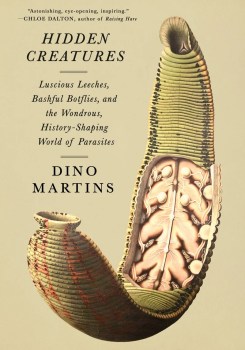
Buy the Book
A benediction of light woven betwixt lanceolate leaves seeps down. The earth repays the gift with an essence distilled from root hairs fingering their way through soil, termites tending hyphal masses of fruiting fungi, millipedes munching on matter, and blades of grasses evaporating dew. I look up into the shimmering, the drooping leaves shiver, and so do I, delighted by the sheer thriving of life around me. This tree is one of my favorite places.
A place of peace. A place of sanctuary. My Pepper Tree. Over a century old, it had been planted here at the edge of the fields, and I sometimes sit and imagine the moment that its life began. I think of all the birds, insects, and stories that the tree has known. Perhaps if I listen really, really closely, she will share some of them with me. Speckled among the foliage are tiny round fruits, pinkish or ivory, with flaking skin that when crushed released a spicy scent. I roll them between my fingers to reveal the wrinkled seeds within. The tree has three trunks—gnarled and bent, curving sideways—that reach up, with branches that spread and droop, forming an enchanted bower.
I climb up into the branches and stay as still as possible. In this stillness, the earth speaks to me. Birds and insects draw closer. The white-eyed slaty flycatchers, bright-eyed and cheerful, perch and dive around me. Below a robin-chat rummages through the leaf litter, occasionally finding a treat, warbling a melody in gratitude. Butterflies, white and green, orange and black, speckled yellow and brown, dance about, teasing me and lifting my heart.
The months pass, and the time of rain is with us. For several weeks, afternoon storms put paid to my tree-dreaming. Then one day the rains ease off. I return to my sanctuary. A line of ants, shiny and black, make their way up the trunk. I place my arm in their path. After a disheveled minute, they resume their pilgrimage. Life goes on. Then something magical is revealed. In the stillness, a tiny, constant rasping becomes evident. A soft dusting of pellets rains down. I sit up. It takes a minute; then I spot one, then another, then a dozen. Caterpillars munching away!
The caterpillars are nestled within the leaves of a creeper, which has clambered into the tree. They sit along the midribs, nibbling their way through the heart-shaped leaves, starting with edges, then working their way toward the center. I reach out and grab one of the caterpillars. Its body is taut, smooth, almost muscular, and it struggles as I pull it away from its breakfast. As large as my outspread hand, it sits on my palm, waving its head from side to side, then hunching up. I marvel at its glowing green skin and its patterns of yellow, purple, and silver spots. I gather up a dozen of the largest caterpillars I can find. I take these back home and tend them over the next few weeks. Watching them scoffing leaves, seeing them grow larger and fatter, provides me with a deep peace and purpose.
One day they all stop feeding. Normally elongated and wriggly, they become more squat, oval-shaped. The next morning, something happens. Their speckled skin peels back, shriveling like a wet swim-suit, to reveal a sleek, perfectly formed pupa. These are pale orange at first, then darken to a deep reddish-brown. Inscribed onto their surfaces I can just make out the shape of where the eyes, wings, and other features of the adult moths are, transforming within their sarcophagi. Eleven caterpillars have transformed, but one remains, trembling ever so slightly. I keep an eye on it. Another day passes. The next morning, something horrifying and fascinating comes to pass.
I open the box to peer in, and the last caterpillar’s body is riddled withsomething or someone squirming beneath its skin. I recoil in horror, then overcome with curiosity, look closer, and can just make out tiny maggots moving within its flesh. The next day white, oblong cocoons have erupted from its skin. Several dozen of these white, alien structures are dotted over the caterpillar. The caterpillar is still alive, racked by the occasional spasm, and waving its head about.
I transfer the caterpillar into a glass jar and take it to school with me. Friends and teachers look in horror, and one cries out, “Aiii! Ni shetani!” (It’s a devil!) Suggestions are made that I should burn the beast, lest the same fate befall us for handling it. I protectively clasp the jar closer to my chest. One of the teachers suggests that we just wait and see what happens. And she refers me to a textbook in the library. There isn’t much detail, but I glean that these might be some kind of insect living within the body of the caterpillar. And what happens next is truly gobsmacking. I yell out, interrupting the afternoon geography class. Teacher beckons me to the front of the room. “What do you have in that bag, Dino?” she asks, peering down at me.
“I hope it’s not a chameleon!” she says, taking a step back.
(An incident the previous term saw a chameleon escape from my desk and caused mayhem.)
“No, madam, it is not a chameleon,” I reassure her.
I place the jar on her desk. Grimacing at first, she can see how excited I am and allows the rest of the class to gather round. We watch some magic unfold. From the tip of each white oval emerge antennae, then legs, and soon squirming out are tiny black-and-yellow-striped wasps. Through all this the caterpillar is still alive, and I can see its sides moving softly as it breathes through the tiny spiracles along its flanks. The wasps crawl about, soon taking flight and colliding with the glass, then walking about with their antennae flicking avidly. “Those insects were living inside its body?” asks one of my classmates. I nod in response. The teacher then invites me to explain to the class—and I narrate the saga, from the finding of the caterpillars to their pupation, to the failure of the last one, this one, to transform properly. There are lots more questions: “What happens next? Can the wasps enter people’s bodies? Will the caterpillar survive?”
We return to our desks, and after class, during the break, word spreads around the school and other students come to look at the “monster caterpillar beast.” Later that evening, I take another look inside the jar. Most of the wasps have emerged. Then I notice something puzzling. Among the wasps, who are sleek and blackwith long antennae, is another even tinier, iridescent creature: another kind of wasp! I separate out the wasps, keeping them in a jar to observe later. I ferry them back to school the next day. I’m once again referred to the library. We find a book about insects, with lots of natural history drawings and photos. And there, wow, is a photo of a caterpillar covered with cocoons, just like the one we have! I read and learn about parasitic insects, who can lay their eggs inside the bodies of other creatures, and about other kinds of parasites: fleas, lice, ticks, worms. Still puzzling over the tinier wasps that I’ve found, it dawns on me—these, too, are parasites, but not of the caterpillar directly. They are parasites of parasites. Hyperparasitoids. Wasps eating wasps within a caterpillar!
After this discovery, everything changes. I learn that one needs to look beneath the surface. One must see beyond what is obvious. That the world contains many, many layers of mystery and puzzles. That things are not always what they seem. That god and devil can be incarnated as one.
I return to the Pepper Tree.
I shimmy up the trunk and sit among the branches. I look out into the distance.
Fields and forests. Swifts and swallows tracing through the sky. Cattle withheads bowed low, grazing. A line of giraffes, walking far, far away.
Do all of them also have creatures living hidden within them?
My mind races.
A whole new universe is being revealed. My heart is singing.
Life within life within life within life. And a lifelong purpose, for me.
Unraveling mysteries.
Seeing the Unseen.
Excerpted from “Hidden Creatures” by Dino Martins. Copyright © 2026 by Dino J. Martins. Published by arrangement with Alfred A Knopf, an imprint of The Knopf Doubleday Group, a division of Penguin Random House LLC

Dr. Dino Martins is an entomologist and evolutionary biologist based in Malindi, Kenya. He’s the author of “Hidden Creatures: Luscious Leeches, Bashful Botflies, and the Wondrous, History-Shaping World of Parasites.”