Finding political identity in nature and community
In “A Voice Like Mine,” Deb Haaland finds connection through running, and reflects on how we all have a role in the politics of community.
The following is an excerpt from “A Voice Like Mine” by Deb Haaland.
When you purchase products through the Bookshop.org link on this page, Science Friday earns a small commission which helps support our journalism.
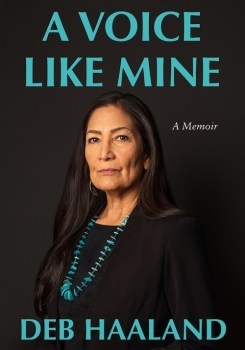
A Voice Like Mine
When I started running, each time was a trial. Since then, I have run hundreds of miles on paved roads and dirt trails. I love the crunch of gravel or the bounce of pine needles under my feet, inhaling deeply beneath grand redwood trees or powering up a service road to get to the top of some hill so I can take in the view. While running on the Anacostia Trail in Washington, DC, I have been blessed to see deer, bald eagles, and wild turkeys. At the same time, and each time I ran along the Anacostia River, I thought about what the region used to be, immense swampland, and how the ancestors lived and prospered there. It may be difficult for some folks to imagine, but the nation’s capital was home to communities of Indigenous Anacostan, Piscataway, and Pamunkey people fishing, hunting, and thriving.
In addition to running, I have crewed for others. Twice, I crewed on the 135-mile Badwater Ultramarathon, a footrace that begins in Death Valley, at the lowest elevation in the United States, and ends at the Portal Road on Mount Whitney, eight thousand feet above sea level. On both occasions, my runners reached the finish line after midnight, and I found myself enveloped by inky blackness beneath a sky full of stars. I am not often at a loss for words, but being surrounded by the darkest sky I have ever experienced challenged my thinking. No longer was I an inconsequential speck of earthly matter, but part of the universe. I believe that if everyone had such experiences, we would all feel an urgent devotion to our planet.
Running is an ancient tradition, and to me, it is not so much a hobby as an obligation. My ancestors sacrificed comfort, endured hardship, and survived in an immense desert so I could be here. I am grateful for my physical ability to run and for Creator’s gift of good health. I believe I must share this gift any way I can. My running days are not over; I hope to stay on the trails for many more years. I’ve always dreamed of running the Badwater Ultramarathon myself, and even though the days have passed into years and my obligations to serve my communities continue, perhaps I will train for that race someday. For now, I find daily joy in putting one foot in front of the other.
If you’ve read this book from the beginning, you can see that I am not like a lot of politicians. I do not come from people who were born into the political echelons of our country. I didn’t graduate from an Ivy League school. I didn’t even start college until I was twenty-eight. Neither of my parents graduated from college; they were humble public servants who devoted themselves to sustaining our communities and our country. Their sense of duty has been my North Star. And that’s the point, isn’t it? People with real, lived experience should have opportunities to serve. Elections should never be about the candidate, but about the people that candidate strives to represent.
After serving my state as a congresswoman and traveling thousands of miles to the farthest edges of our country as a cabinet secretary, there are still days when I marvel at the beauty of New Mexico. When the sun sets behind a mountain range, painting the sky in rich oranges and reds, or when I’m running in the foothills of the Sandia Mountains, I feel deeply grateful. That gratitude compels me to safeguard our culture and history, to protect what we have built over centuries, and to pass it on to future generations.
Everyone has something to offer. Whether you live in an Indian pueblo, a small town, or a big city, your voice matters in our politics. I think often of a woman I met in a remote Indian pueblo community here in New Mexico in 2012. There was no Native American community in New Mexico I did not visit that year, and one chilly October day, that young woman stood inside her house, and I on the front porch, with a screen door separating us, for no less than twenty minutes. As four children of varying ages came and went, looking up at me and listening to our conversation before returning to their play, the woman asked many questions about my candidate: Where did Obama stand on health care and the economy? Did he know that Indian tribes in New Mexico needed housing? Did he care about Head Start for her young children?
Twenty minutes is a lifetime to an organizer whose voter contact goals consistently increase as the campaign goes on, yet I knew I needed to stay, even to the detriment of the spreadsheet I’d turn in to my field director that night. Here was a young mother, maybe in her late twenties, who was making time to speak with a person she had never met because she wanted to know more about my candidate and how national politics would affect her life and the lives of her children. I was on her time.
Every election year, we ask people to get out and vote for candidates who share our values, sometimes without thinking hard enough about the lives those voters lead. As volunteers and organizers, perhaps we need to take a step back and think about them. How many jobs do they have, and how extensive are their responsibilities at home? Are they caring for children and parents in equal measure? What are their hopes and dreams? Their struggles? What would actually make their lives better? If we took the time to listen, perhaps we could begin uniting people toward a common purpose and changing our country into the place it was meant to be: a nation that values irreplaceable things such as health, community, equal justice, land, air, and water above all else.
Folks try to categorize us as establishment Democrats, liberal Democrats, progressives, blue dog, yellow dog, and every other “type” of Democrat you care to name. I am a Democrat because I believe in the values I was raised with: Commitment to my community. Helping those in need. Always being cognizant of how my actions impact others and the environment. Kindness. Putting the well-being of children ahead of my own. I believe I have an obligation to help elect candidates who share these values because I want a better world for the people I love.
It is up to me, and it is up to you, to return to the values handed down to us by previous generations and to lead by example. Practicing the politics of community means acknowledging that we are part of something bigger than ourselves. That can be the starting point.
Excerpted from A Voice Like Mine: A Memoir, from Henry Holt and Company. Copyright © 2026 by Debra Anne Haaland
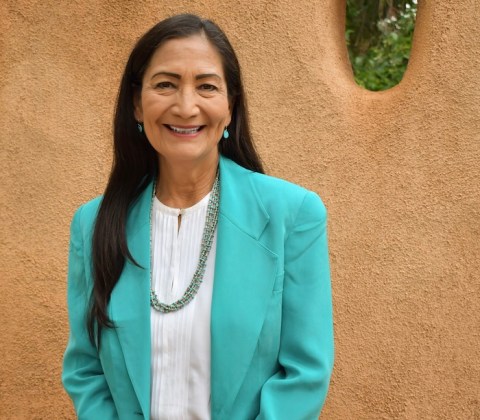
Deb Haaland served as Secretary of the Interior under President Biden. She is a member of Laguna Pueblo tribe and lives in Albuquerque, New Mexico.