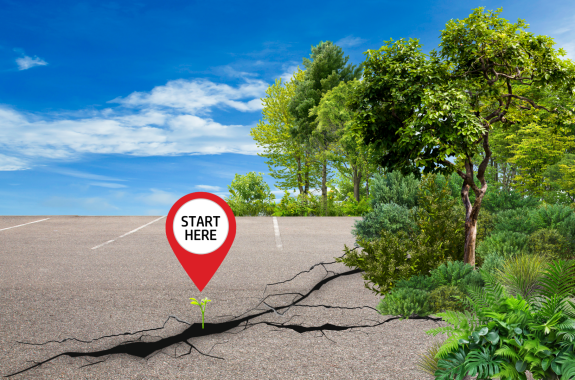
Akira Miyawaki was a Japanese botanist who studied how forests grow and how to restore them after damage. He focused on potential natural vegetation (PNV). This refers to the plants that would naturally grow without human interference. By studying native forests, Miyawaki realized that many tree-planting projects, like streets lined with trees that are all the same, lacked biodiversity and did not function as true ecosystems.
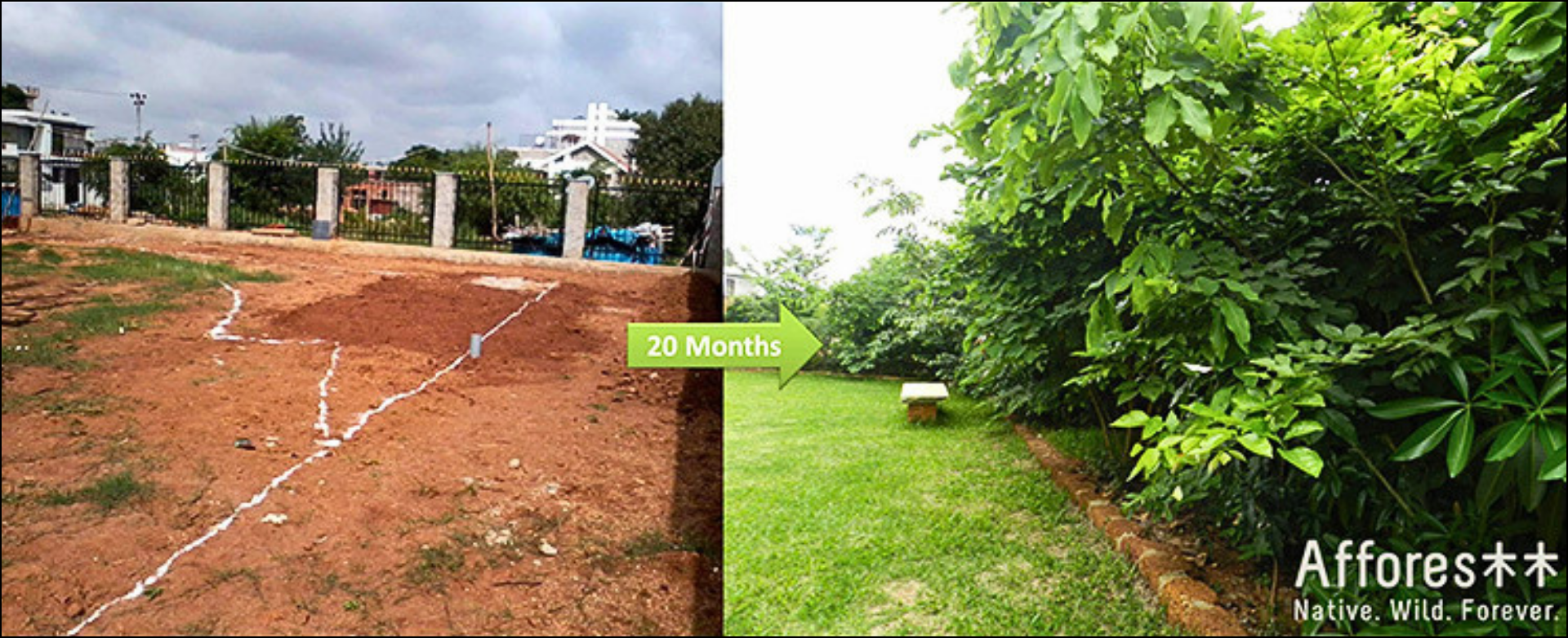
In the 1970s, Miyawaki developed a method of planting many native species close together in prepared soil to grow forests quickly and naturally. The Miyawaki method, a more than 50-year-old planting method from Japan, attempts to speed up forest growth by planting native species together in a deliberate way.
Into The Woods, From Chestnut Genetics To Tiny Forests
How the Miyawaki method speeds up forest growth
Building a complex ecosystem normally takes a long time. In natural conditions, a forest grows slowly using a process called ecological succession, taking decades or even centuries to grow.
In nature, forests grow slowly, beginning with pioneer species, plants that can withstand poor soil and full sunlight. Over time, these plants improve the soil by adding organic matter and retaining moisture. As a result, larger, longer-living trees can take root.
The Miyawaki method skips the early stages of this process. Instead of waiting for nature to build this ecosystem step-by-step, scientists and volunteers prepare the land so that a forest can grow and thrive almost immediately.
What makes a forest a forest?
At first glance, a forest may look like a clump of trees, but scientists define forests very differently. A forest is actually a complex and layered ecosystem, where many types of plants, animals, fungi, and trees all interact with one another.
In a forest, plants do not grow to the same height. Instead, they organize themselves into distinct layers that play an important role in the ecosystem.
- At the top is the overstory, or canopy, formed by the tallest trees whose branches create a roof over the forest. In North America, typical trees that dominate this layer are oaks, maples, and hickories.
- Next is the understory. This layer is made up of smaller trees that can tolerate less sunlight than the taller trees around them. These trees could grow into a canopy layer if a large tree falls and opens up a spot in the canopy.
- Then comes the floor layer. This layer is closer to the ground and is made up of shrubs and young saplings. Under those live herbaceous plants, like wildflowers, grasses, and ferns.
- Finally, we reach the subfloor layer, under the forest floor. This is where fungi, bacteria, and the roots of plants and trees form a complex network that moves nutrients and water through the soil. These hidden communities recycle organic matter and promote growth.
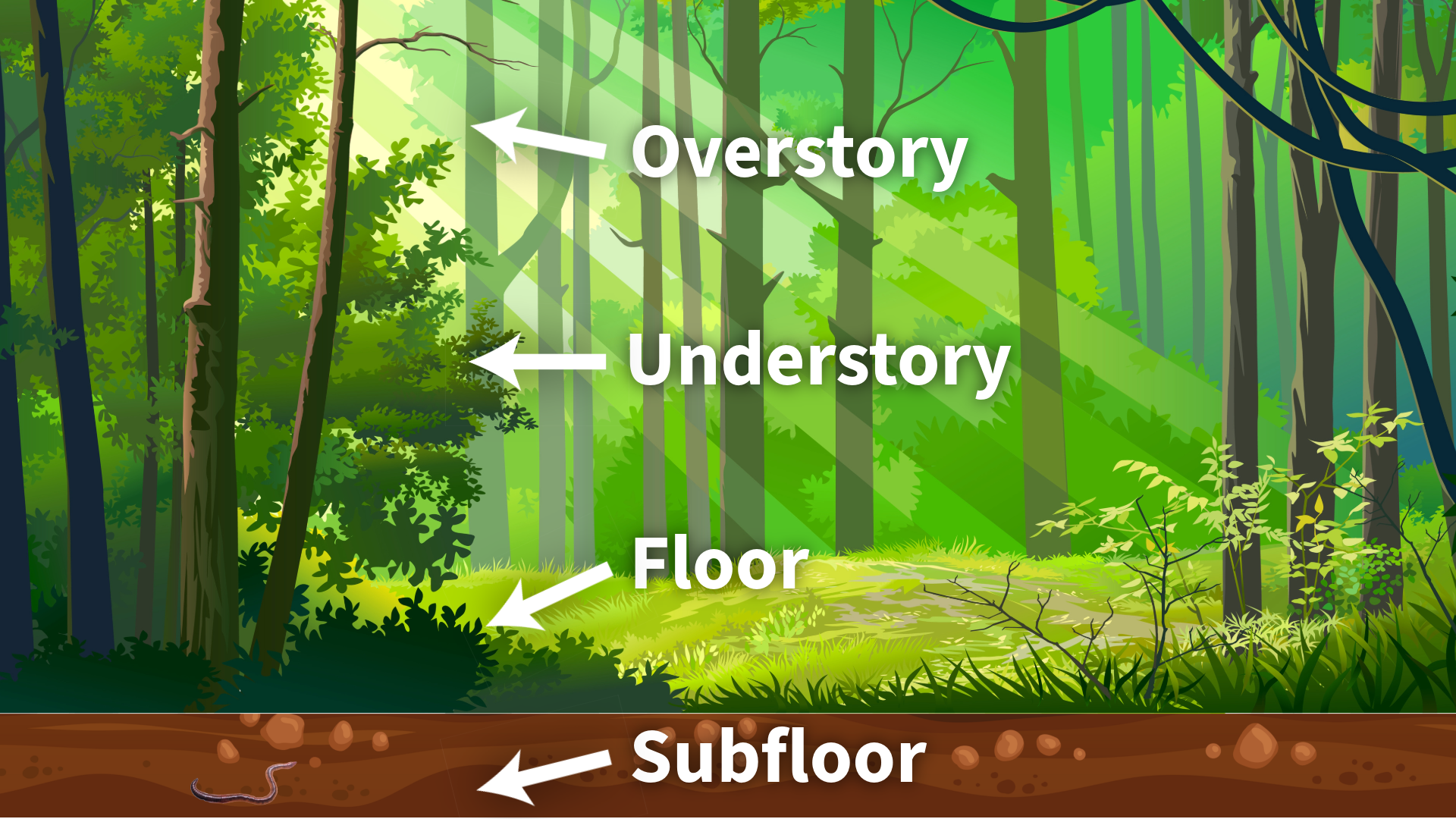
Together, these layers form different habitats, allowing a wide variety of species to live in the same place. Animals, insects, birds, and microorganisms all depend on the forest for food, shelter, and a breeding environment.
This is why scientists describe forests as ecosystems rather than just groups of trees. That complexity is what makes forests so beneficial to the environment. They store carbon in wood and soil, clean and cool the air, absorb rainwater, reduce erosion, and provide habitats for thousands of species.
When these natural systems disappear, landscapes can become unstable. One of the greatest ecological and agricultural disasters in the United States was partially caused by poor land management during a devastating drought. During the Dust Bowl of the 1930s, prairie lands lost the deep roots of grass that had held the soil in place, allowing winds to lift dry topsoil into massive dust storms across the Great Plains.
Design your own Miyawaki-style miniforest
Planting a Miyawaki-style miniforest is not as simple as digging some holes. It takes careful planning and design. Ecologists study ecosystems, native species, and how plants will grow together before they even think about planting anything.
Step 1: Plan the space
First, choose a site where you want to plant a miniforest. This could be a schoolyard, a parking lot, or a plot of land in a local park. (Make sure you have permission to plant on your selected site!) Keep in mind that the plants you choose might need sunlight up to eight hours a day.
Estimate the size of your space. A typical miniforest ranges from 1,000 to 10,000 square feet, but you will likely want to start small for your first project. A large classroom or a two-bedroom apartment is about 1,000 square feet. Even a small forest can sustain and support hundreds of plants!
If you want the space to be accessible to the public, consider incorporating a path.
Step 2: Research native plants
Research plants that are native to your area by visiting the following resources:
In addition to these sites, you can search for local extension offices to find lists of plants native to your area. A local extension office is a community resource connected to universities and the USDA that shares research-based information to help people with gardening, farming, health, and youth programs.
Once you figure out what species are native to your area, choose 8 to 12 different plants, including appropriate selections for the overstory, understory, and floor. You will want to research how tall and how quickly each plant in your garden will grow. Be sure to include plants that can support insects, birds, and other wildlife, too.
You may want to look at examples of miniforests from an area near you to get additional ideas.
Step 3: Design your layers
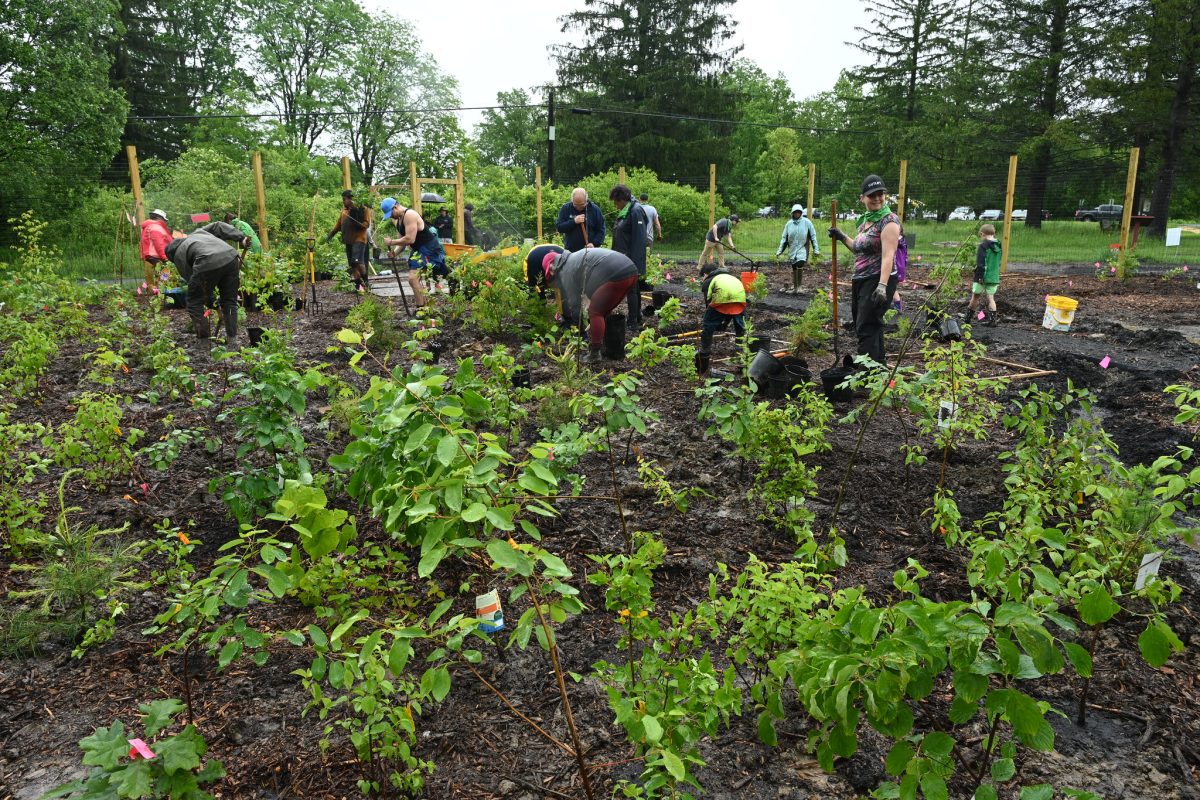
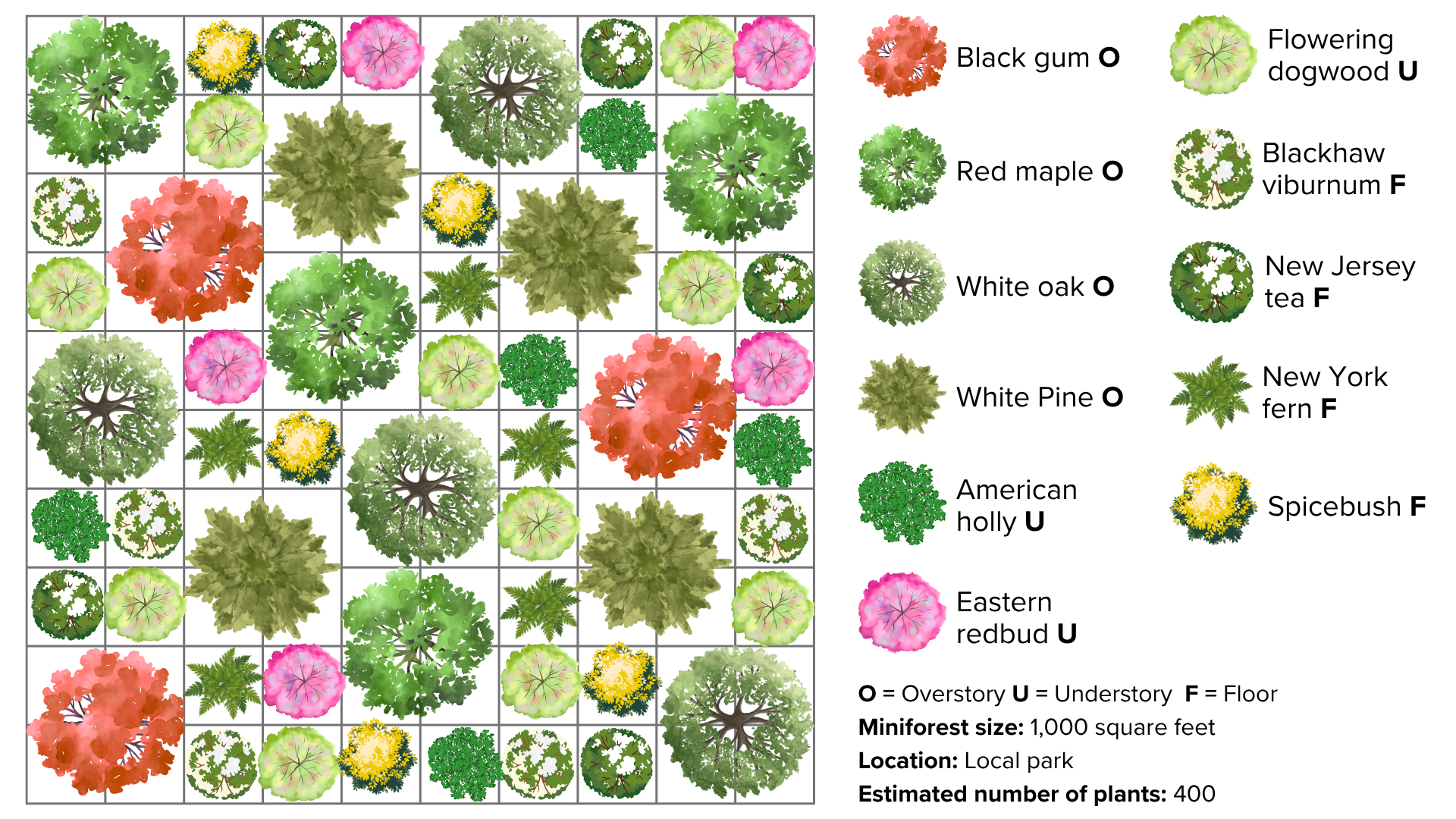
Miyawaki-style miniforests are planted much more densely than typical forests. Place plants close together, mix different species, and try to avoid large and empty spaces. Mix forest layers throughout your design. Avoid perfect rows—forests grow naturally and unevenly. Think about sunlight, water, and space needs of your plants as you design your miniforest.
Quick Math: A Miyawaki-style miniforest uses around 3 to 5 plants per square meter. A square meter is around 10 square feet. This means each plant needs only 2 to 3 square feet of space.
Let’s say the space you chose is 1,000 square feet. That’s around 100 square meters, which means your miniforest should include a total of 300 to 500 plants.
Miyawaki suggested a miniforest contain 70 to 80% combined overstory and understory plants (trees) and 20 to 30% floor plants (shrubs and herbaceous plants). For a 100 square meter miniforest (about 1,000 square feet), 70 to 80 square meters should be trees, and 20 to 30 square meters should be plants. That means, if you want to plan for an average of 4 plants per square meter, you will need 280 to 320 trees and 80 to 120 plants.
Use this printable workbook to sketch out your space and plan your miniforest. Examples of miniforest designs are also included at the end.
Step 4: Reflect on your design
Now it’s time to think like an ecologist. Ask yourself these questions:
- Why did you choose these plants?
- What are some ways the plants may support one another?
- What kind of animals and insects will your plants attract, and why?
- How will your forest improve the air, soil, and water in your area?
Share your miniforest plan with others and explain your choices. Compare your design with someone else’s and discuss what makes each forest unique.
Want to make your design a reality? Find out who you need to talk to in your area about planting a miniforest. If your city or town has an Environmental Commission, Parks and Recreation Commission, or Shade Tree Commission, these may be good places to start. You can also reach out to your mayor, town council, or Department of Public Works. Prepare your pitch, explaining why you want to build a miniforest, and bring your design so people can see what you want to create.
The Miniforest Movement Gains Ground In The U.S.
Can you grow a miniforest in a jar?
Not everyone has the space to plant a miniforest outside, but you can still model how a forest ecosystem works on a smaller scale.
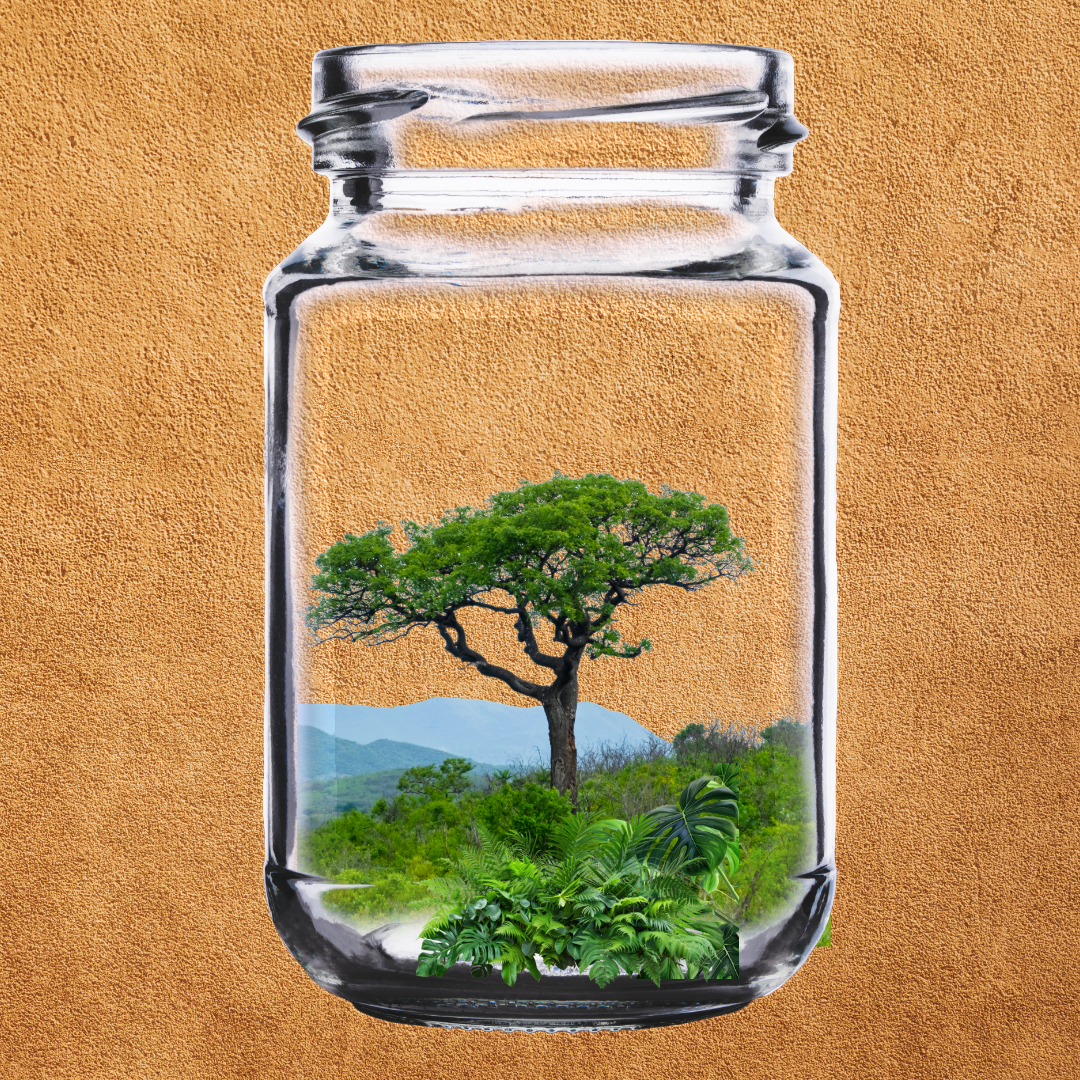
A terrarium is a self-contained environment where plants, soil, water, and air interact. While it won’t grow into a full forest, it can help you observe how ecosystems function, including plant growth, competition, and the movement of water.
If you want to create your own miniature ecosystem, check out these Science Friday educational resources to learn how to build and maintain a terrarium environment:
Lilliputian landscaping: creating a sustainable terrarium garden – In this activity, you’ll examine the different materials gardeners add to their soil, and discuss how these materials are important for plant growth. You’ll learn how to build a sustainable terrarium by adding a waterbed, mixing your own soil, and transplanting a small plant into your terrarium.
Learn how to cultivate moss in a terrarium – In this activity, you’ll learn about the biological needs of mosses, and you’ll grow and maintain your own moss terrarium. Through daily maintenance and observation, you’ll identify the necessary factors for the successful cultivation of moss.
Get inspired
- If you need some inspiration, check out the Somerville High School Forest in Boston, Massachusetts, which has planted 350 trees in a 1,400-square-foot space.
- Listen to “Into The Woods, From Chestnut Genetics To Tiny Forests” to learn about the miniforest movement in the United States.
Read “Mini-Forest Revolution: Using the Miyawaki Method to Rapidly Rewild the World” by Hannah Lewis. - Watch “Legend of the Forest: Akira Miyawaki, 87, Plants Trees with Children,” which shows how Miyawaki’s method, shaped by lessons from disasters such as Hiroshima and the 2011 tsunami, helps create dense, resilient forests that can protect ecosystems and communities.
- Watch engineer Shubhendu Sharma’s TED Talk, “An engineer’s vision for tiny forests, everywhere.”

NGSS Standards
- LS2.A: Interdependent Relationships in Ecosystems
– MS: Organisms and populations are dependent on their environmental interactions with both living and nonliving factors. In this activity, students explore how plants in different forest layers interact and support one another.
– HS: Ecosystems have carrying capacities and complex interactions. Students evaluate how biodiversity and plant density influence ecosystem function and stability. - LS2.C: Ecosystem Dynamics, Functioning, and Resilience
– MS: Ecosystems are dynamic in nature; their characteristics can vary over time. Students examine how forests develop through succession and how methods like the Miyawaki approach can accelerate this process.
– HS: Ecosystems can be influenced by environmental changes and human activity. Students analyze how restoration efforts, such as planting miniforests, can impact ecosystem resilience. - LS4.D: Biodiversity and Humans
– MS: Changes in biodiversity can influence ecosystem services that humans rely on. Students design forests using native species to support biodiversity and ecosystem health.
– HS: Humans depend on biodiversity for resources and ecosystem services. Students evaluate how increasing biodiversity through restoration can benefit communities and environments.
Get great educational resources for your classroom, home, and beyond to your inbox each month.
Credits:
Lesson by Cybele Tamulonis
Copyediting by Erica Williams
Developmental editing by Sandy Roberts
Digital production by Sandy Roberts
Educator's Toolbox
Meet the Writer
About Cybele Tamulonis
Cybele Tamulonis is a writer, apiarist, and entomology enthusiast.