Subscribe to Science Friday
In April, the crew of Artemis II got an unprecedented tour of the far side of the moon, and they brought back a proverbial shoebox full of pictures. Lunar scientist Kelsey Young stayed on Earth, and helped guide the astronauts through their photo shoots from Mission Control.
Young talks with Host Flora Lichtman about how the science team chose their shot list, how to lead distant astronauts in their scientific observations, and what researchers are learning from the images and in-the-moment descriptions captured by the Artemis II crew.
Donate To Science Friday
Invest in quality science journalism by making a donation to Science Friday.
Segment Guests
Kelsey Young
Dr. Kelsey Young is the Artemis science flight operations lead for NASA’s Science Mission Directorate.
Segment Transcript
FLORA LICHTMAN: Hey, it’s Flora, and you are listening to Science Friday. When astronauts are in orbit, most of the messages from Earth come from a person in a role called Capcom. They’re often an experienced astronaut serving as the capsule communicator. But sometimes, during the recent lunar flyby of Artemis II, the conversations from mission control came from another desk, one labeled Science.
If you tuned into the Livestream during the lunar flyby, like we did, obviously, you probably saw my next guest seated or sometimes excitedly standing at that desk in mission control. Doctor Kelsey Young is the Artemis science flight operations lead for NASA’s science mission directorate, and she headed up the lunar science observations and photography for the Artemis II mission.
Hey, Kelsey, thanks for coming on the show.
KELSEY YOUNG: Thanks for having me. You can’t see me, but I’m smiling ear to ear right now.
FLORA LICHTMAN: Have you come down to Earth yet?
FLORA LICHTMAN: I will be honest. I’m a big post-processor, so I don’t think I’ve quite gotten enough space from the experience to truly process things. But I can tell you that things have not died down. We’re working on processing all the data that we got from Artemis II, while also looking to the future and starting planning for Artemis III and IV.
FLORA LICHTMAN: Yeah, give me a sense of the scale of the data. Is it just images and how much do you still have to process?
KELSEY YOUNG: Oh my gosh, there is so much data, and I mean that in the best possible way. We do have four different types of data. We do have the crew images, of course. That’s by far the largest data set, as you might imagine.
We also have a few crew annotations. So they had the ability on their crew tablets to literally, with a stylus, annotate on pictures of the moon to say, I saw this here. And then there were photos and videos taken with the vehicle-mounted cameras outside of the crew cabin.
We also have crew audio files, which is a data set that is just rich with science return. We’re so excited now that we’ve started to dive into those. We also have–
FLORA LICHTMAN: Wait, like, voice memos, Kelsey? Like, what are they?
KELSEY YOUNG: Yeah, literally voice memos. And that was actually our highest priority data set for the mission for lunar science, because of the unique mission profile of having human beings looking at the moon, from the vantage point that they did have it, and actually giving their nuanced color observations, albedo observations, lighting observations, and all of those data are contained in those audio files.
FLORA LICHTMAN: Why are the verbal observations so important? I mean, do the astronauts’ perception of what they’re seeing tell us something different from just a raw image from a DSLR camera?
KELSEY YOUNG: So cameras are really amazing. They take pictures that are so incredibly valuable, scientifically. Human eyes are able to provide something on top of that, though. They have the ability, human eyes, to see, just in the literal blink of an eye, to really capture color nuance, that images, you might have to really understand what’s there to pull out.
And so an example of that would be, of course, Apollo 17 astronaut Jack Schmidt, describing the orange soil discovery on one of his spacewalks during the mission. And he saw this, you hear it in his voice, he’s like, orange soil. Oh my gosh. And he ultimately collected that sample because he saw that color nuance and took that sample back. And it ultimately, that sample helped us understand something about how recently volcanic activity existed on the moon, which was a new scientific discovery.
But when you look at the pictures from his suit-mounted camera, that orange does not pop out. So it’s not perception, it’s reality. And we worked with them to really hone their toolkit for how to give descriptions so that we could understand what they were seeing. It’s something that orbiting spacecraft are not able to provide, and it can help the next orbiting spacecraft by saying, hey, crew observed these things in these areas.
Hey, science community, is this a value? Want to go follow up?
FLORA LICHTMAN: When you went in, was there– did you have a shot list and how did you pick it?
KELSEY YOUNG: Oh, yeah. We had this tool that members of our team develop called the lunar targeting package. It starts with a list of targets on the lunar surface. So features on the lunar surface that was encompassing of all 360 degrees of the lunar surface. And so we have this really long list of over 150 targets that encompasses the entire moon.
So then we’re getting close to a launch window, here it is. April one is coming up. Now let’s do an initial pass. Let’s do an initial sort of down select. And the way we do that is we have 10 lunar science objectives for the mission based on what are the communities driving lunar science questions. And OK, what is the Artemis II mission profile uniquely able to contribute?
Because of course, we do have LRO. We do have other payloads, other instruments, other spacecraft. But what can Artemis II contribute?
FLORA LICHTMAN: Were there people on your team who were like, fighting for one target over another? Were people like, no, we must have this?
KELSEY YOUNG: Kind of. Yeah. So we had 10 objectives, as I said. And so we had kind of a group– we just have an amazing lunar science team. Oh, my gosh. I could talk about them for way more time than you have.
But for actual operations, we were kind of divided across two rooms in multiple shifts. And we did have roles on the team that were staffed by lunar scientists whose job it was to advocate for specific ones of those 10 lunar science objectives. We called them theme leads. And so somebody might be a theme lead for volcanic history, and someone else might be a theme lead for photometry or for color.
And they had to very respectfully and politely duke it out, to make sure that down select of lunar targets covered the entirety of our science objectives. We didn’t want to go too heavy into one objective at the expense of a couple others. So it really was about ensuring broad spread and covering all of our bases.
FLORA LICHTMAN: Were people giving you boxes of chocolates, Kelsey?
KELSEY YOUNG: Well, I was actually out of that process. That was our team that did that because I was on console, of course, in the front room. So I have two deputies on the team and one of them, Jacob Richardson, was the targeting lead. So it was him. And you’ll have to ask him if he got any boxes of chocolate.
FLORA LICHTMAN: So during the mission, you are hearing the descriptions of what the astronauts are seeing, but you’re not actually seeing the images in real time?
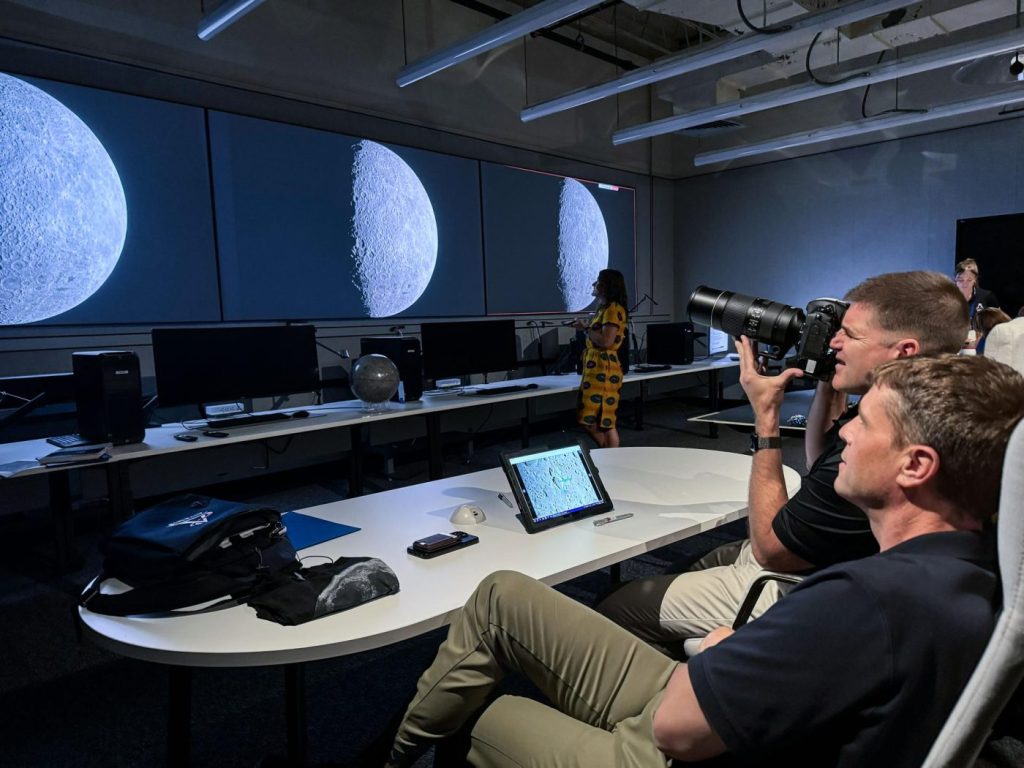
KELSEY YOUNG: We are not seeing the images. We were seeing what you guys saw watching at home, which was that live feed from the vehicle mounted GoPro cameras. We also created these high resolution visualizations of what the crew would be seeing. That is, of course, not reflective of the real moon that they were seeing, but we could at least say, OK, this is where they are in the flyby, this is the angle of the sun versus the spacecraft, to put ourselves a little bit in the minds of what the crew were seeing. And it helped us just stay in sync on which part of the flyby they were executing, when.
FLORA LICHTMAN: Was it like a tease, though. Were you like, I’d like to see it for myself.
KELSEY YOUNG: I mean, you guys heard it. How amazing are these four people and their ability to communicate what they were seeing?
FLORA LICHTMAN: They were really good. They were really good at that.
KELSEY YOUNG: I wish I could just watch a live stream, 24/7 of them describing the moon because it’d be so great.
FLORA LICHTMAN: There is a reality TV show possibility for that, I’m sure. One of the things that got a ton of attention, and I remember seeing it on social, were the impact flashes. And I might have been watching you, actually. Were you the one who was talking to the astronauts at this time when they saw them?
KELSEY YOUNG: I sure was.
FLORA LICHTMAN: OK, so I remember this very specifically because I saw your face light up like a light bulb. Your jaw drops and you’re like. You can just see this huge reaction from you. Why were you excited about that?
KELSEY YOUNG: Yep, that was me. That was, what you saw was a genuine human moment. And one of our 10 objectives that I keep talking about, it was impact flash investigations. Impact flashes, looking for impact flashes.
And what those are is literally very small particles impacting the lunar surface. And it literally creates like an extremely transient, really, really quick, very bright flash.
FLORA LICHTMAN: And when you say small particles, how small?
KELSEY YOUNG: Centimeters to inches.
FLORA LICHTMAN: No. Stop it.
KELSEY YOUNG: Yes.
FLORA LICHTMAN: Really?
KELSEY YOUNG: Well, in this case, they were, I mean, because we can back that out from the descriptions the crew gave, that you all heard. And you can have bigger impacts as well, but we think these were pretty small.
FLORA LICHTMAN: So obviously the likelihood, it seems like an odds thing, right? What’s the likelihood that that’s going to happen while astronauts have eyeballs on the moon? Is that why it was so cool to see it?
KELSEY YOUNG: Yes, you hit the nail exactly on the head, of my surprised face. So we had conversations, certainly, of course, for months and months in our team of like, are we going to see any? And so of course team members had different predictions for if we would see any and if so, how many. I did not.
So what you saw was reflective of my complete shock that they saw any and that they saw multiple. It was so incredible.
FLORA LICHTMAN: Nice to be wrong in this case, Kelsey.
KELSEY YOUNG: Yes, absolutely.
FLORA LICHTMAN: Yeah. Why are impact flashes interesting scientifically? Why do we care about a centimeter big piece of dust hitting the moon?
KELSEY YOUNG: A few reasons. First of all, it helps us characterize the modern lunar environment. So, what is happening at the surface of the moon? But also, it helps us– cratering is a really– I did my PhD on impact cratering, so I will try to not dive too deep into this, pun intended. But impact cratering is a really important process because of a few reasons.
One, it can bring material up from depth, so it can expose rocks from deeper in the surface on bring them to the surface. Obviously, not for tiny impact craters that are formed from these centimeter sized impacts. But larger craters can suck stuff up from depth that is kind of like a geologist’s cheat code. Because otherwise, how are you going to get it? How are you going to access that part of lunar history if it’s buried beneath the surface? But impact craters do our work for us, of bringing the material to the surface.
It can also transport material, like, long ways across the lunar surface. And so cratering has played such a pivotal role in the evolution of the moon and the evolution of our own planet. And there’s still scientific value in understanding cratering rates and how they have changed over time, what they’re like today, and how it touches other active lunar surface processes.
FLORA LICHTMAN: OK, I have to ask, why was the imaging done by human beings squinting through the tiny windows with DSLRs versus mounting some array with a billion cameras that are just programmed to take images all the time?
KELSEY YOUNG: Oh, it’s a great question. And that’s a really great way to ask the question. And I think LRO is an example of an orbiting spacecraft that has incredible payloads on it that have returned.
FLORA LICHTMAN: We’re already doing that, is what I’m hearing.
KELSEY YOUNG: Exactly. We’re already doing that, and it’s been super amazing. One of my favorite LRO fun facts is we actually, because of an instrument on LRO called Lola, it’s a laser altimeter instrument, we actually the topography of the moon better than we the topography of the Earth.
FLORA LICHTMAN: Wow.
KELSEY YOUNG: Because the Earth has oceans and vegetation and cities and all that. And this laser altimeter has returned enough data that we know the precise topography of the lunar surface down to a staggering resolution. I just think that is, frankly, inspiring. Human beings are amazing, and what they can create is amazing.
But Artemis is interesting because, again, have the human, the field scientist, and they’re taking pictures for a reason. They choose to image features, the way that they do because they understand our science objectives and they’re making observations with their eyes. So the pictures tell the story of their field expedition.
And so right now, our lunar science team is deep, deep, deep in the sauce of taking those verbal descriptions, of which there are hours, and then fitting the pictures into that overall story. And that is how we develop the science plan and how we ran the mission. But, we’re going to be releasing, in the next few months, all of these data to the public. And I can’t wait to see what the community does with it.
Because, I mean, who knows? I’ve already heard some ideas from the community, but once we get those data out there, I have no doubt that we’re about to see some amazing science return.
FLORA LICHTMAN: We need to take a quick break, but when we come back, can I ask you just a few questions about how you became a moon scientist at NASA?
KELSEY YOUNG: I’d love to. Yeah.
FLORA LICHTMAN: OK.
Kelsey, your job sounds awesome. Did you apply for it? How did you get there?
KELSEY YOUNG: I don’t think I’ve been asked it directly like that. I love that. Specifically for me, this was the first time we were doing a lot of this, and it was obviously a test flight in many ways. It was the first crewed flight of the Orion vehicle. It was the first time crew launched on the SLS rocket assembly.
We were doing a whole bunch of developmental flight test objectives to characterize vehicle performance and all that. But scientifically, it was also the first time human eyes saw certain parts of the far side. It was the first time we were integrating and implementing our brand new structure for supporting our lunar science and geology objectives.
So we had a brand new console position for the first time. We had two separate lunar science back rooms that had been developed from scratch and were in use for the first time. We were doing all of this for the first time.
FLORA LICHTMAN: Does that mean you invented the roll?
KELSEY YOUNG: yes. That’s where I was going with that. So it was my job to basically develop this structure from the ground up, and therefore I couldn’t apply for it because we were developing it as we were going.
FLORA LICHTMAN: Wow, that’s so gratifying.
KELSEY YOUNG: It was absolutely, certainly the most gratifying part of my career so far.
FLORA LICHTMAN: If you could have been on that flight yourself, would you have gone?
KELSEY YOUNG: No. I feel like I’m where I’m meant to be.
FLORA LICHTMAN: Really? Have you ever dreamed of being an astronaut?
KELSEY YOUNG: Yes. I have applied before. I will not apply again. I love the role that I have, of working with the science teams on Earth to put together our ops plan and ops structure. I feel that I’m well-positioned within flight operations to really make an impact for integrating science, weaving it into the fabric of flight operations to make sure that not only can we maximize science return from these missions, but that we do so while always, always, always prioritizing crew and vehicle safety.
And I think I’ve found like a little niche for myself. And I’m just so happy here.
FLORA LICHTMAN: What do you think is the most important skill for your job?
KELSEY YOUNG: Ooh. I mean, I get so much out of working in operations, it just fits with the way my brain works, which is like, maximizing efficiency, packaging comms, just squeezing every little, like, finding every little corner that we can use to maximize science return. I think it just takes kind of an agile and flexible mind that is OK operating in the unknown.
FLORA LICHTMAN: I mean, are you the kind of person that has spreadsheets for your home life?
KELSEY YOUNG: I don’t what you’re talking about. Yeah, lists, spreadsheets, the whole nine. Fortunately, my husband is the same way, so we– it’s a good fit.
FLORA LICHTMAN: I think I’ve heard you mentioned that you have two young kids. Did you share the mission with them and what was their take?
KELSEY YOUNG: I do have two young kids. They’re two and four. So they’re a little too young to really get into it, especially the two-year-old, of course. But they did. I was getting sent pictures from home during the mission of them watching me on TV, and I was very emotional seeing those pictures.
Especially the two-year-old now, she’ll walk outside and she’ll see the moon at night and she’ll just– even before I do, and she’ll just scream moon, and aggressively point at it. It’s the cutest thing.
So I think they’re starting to grasp it. I mean, if just to get a little deep for a second, I think it’s really hard traveling so much. I mean, I travel just an absolute ton for work. And it’s hard to be away from kids, especially at that age, as I’m sure many of your listeners can appreciate.
But I just really hope, and I believe, that when they get a little older and understand the impact, they’ll understand why, and that I did so prioritize them and also show them what I do and show its importance and show, frankly, women in science and engineering fields going out and pursuing something that I really believe in, a significant challenge.
FLORA LICHTMAN: And leading it and being a badass, may I just add.
KELSEY YOUNG: Yeah, it’s hard, but it’s definitely worth it. I was way too busy before the mission to even think about, just the day to day and how it would reach the public. I mean, one of the main reasons I do this is to inspire the next generation.
But I’ll be honest, the reception that we have gotten far exceeded even my wildest imaginations. The number of messages that both me and people across the mission have gotten of not just the astronauts, but having kids at home see people supporting the mission on the ground, like engineering, flight control, science and having kids be excited about that. Not just being the person going and doing it, but the person supporting the mission, that’s going to be, I think, the biggest thing I take out of this experience.
FLORA LICHTMAN: Doctor Kelsey young is the Artemis science flight operations lead for NASA’s science mission directorate, and she’s based at the Goedert Space Flight Center in Maryland. Kelsey, thank you so much for being here. This was great.
KELSEY YOUNG: Thanks for having me. I could talk to you all day.
FLORA LICHTMAN: Likewise. This episode was produced by Charles Bergquist. And if this podcast has you over the moon,r ate and review us wherever you get your podcasts. Look for the five star thing and then press all five stars. Thanks for listening. I’m Flora Lichtman.
Copyright © 2026 Science Friday Initiative. All rights reserved. Science Friday transcripts are produced on a tight deadline by 3Play Media. Fidelity to the original aired/published audio or video file might vary, and text might be updated or amended in the future. For the authoritative record of Science Friday’s programming, please visit the original aired/published recording. For terms of use and more information, visit our policies pages at http://www.sciencefriday.com/about/policies/
Meet the Producers and Host
About Flora Lichtman
Flora Lichtman is a host of Science Friday. In a previous life, she lived on a research ship where apertivi were served on the top deck, hoisted there via pulley by the ship’s chef.
About Charles Bergquist
As Science Friday’s director and senior producer, Charles Bergquist channels the chaos of a live production studio into something sounding like a radio program. Favorite topics include planetary sciences, chemistry, materials, and shiny things with blinking lights.