Subscribe to Science Friday
Researchers have engineered an artificial cell out of chemicals and biomolecules that, at a basic level, can eat, grow, duplicate its own genetic code, and reproduce itself. The cell, dubbed SpudCell, is aimed at creating a chassis that can be adapted to create biological factories for the chemicals humans rely on for modern life, from fuels to pharmaceuticals. But it also raises the question of what it means for something to be “alive.”
Synthetic biologist Kate Adamala joins Host Ira Flatow to talk about the technological advance, the possibilities for the artificial cell, and a nonprofit organization she hopes will allow the SpudCell to spark an innovation in biotechnology.
Donate To Science Friday
Invest in quality science journalism by making a donation to Science Friday.
Segment Guests
Kate Adamala
Dr. Kate Adamala is a synthetic biologist and an associate professor of genetics, cell biology, and development at the University of Minnesota.
Segment Transcript
[MUSIC PLAYING] IRA FLATOW: Hi, Ira here, and you’re listening to Science Friday. This week, researchers reported an advance in synthetic biology, creating an artificial cell out of chemicals and biomolecules that, at a basic level, can grow, eat, duplicate its own genetic code, and reproduce itself, all properties of living things. It’s aimed at making biological factories for all the chemicals we need in our modern world.
But it also opens up the basic question of, what does it mean for something to be alive? Joining me now is Dr. Kate Adamala, a synthetic biology researcher at the University of Minnesota in Minneapolis. Welcome to Science Friday.
KATE ADAMALA: Thanks for having me.
IRA FLATOW: Nice to have you. Give us an idea what your lab actually created in this work. Tell me what the objects are.
KATE ADAMALA: The objects look like cells, and they have a lot of functions, a lot of behaviors that you would normally associate with natural cells. Except what we made is fully defined. So we exactly where every molecule, every chemical, every piece of DNA in that thing goes. And that’s the biggest difference between what we made and what real cells are. Because in real, cells the full ingredient list.
So we basically made an engineerable cell, something that looks like a cell, quacks like a cell, but is fully understandable and fully engineerable.
IRA FLATOW: Does it have all the ingredients of what we would consider a cell to have?
KATE ADAMALA: That depends on what you consider a cell needs to have. DNA, protein translation, a membrane and membrane proteins, these things are universally shared, and our cell does have it. All of it. Our cell also replicates its DNA, which is a function of most of other cells on Earth. And it also eats and breeds, makes babies. And these are also kind of hallmarks of most of the cells.
So on this very kind of a fundamental level, it does have most of the building blocks of a living cell, but it’s much simpler.
IRA FLATOW: Is your cell alive?
KATE ADAMALA: That I don’t know. I don’t think so, but it’s also really hard to tell because there is no good definition of life. We don’t have a universal definition of life that would fit everything we instinctively consider living and exclude things we consider non-living.
And I personally don’t think spud cell is alive because, to me, life needs to be a little more robust. It does grow, it does replicate. But it’s the wimpiest system you can imagine. I mean, I love it, it’s great, but it’s a beginning. So that’s why I personally don’t think it yet qualifies as living. But I also don’t have a scientific reason for it. It’s more of a gut feeling.
IRA FLATOW: So if I looked at it under the microscope, would I recognize it as a cell?
KATE ADAMALA: Yes, you would.
IRA FLATOW: I mean, as a layperson?
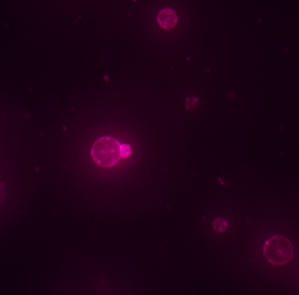
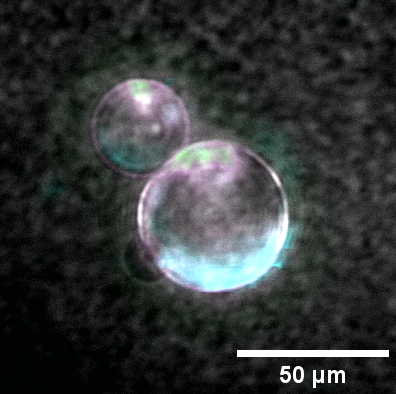
KATE ADAMALA: You would recognize it as a cell. It has a membrane. It looks like a blob, like you would expect simple cells to look like.
IRA FLATOW: Is this a philosophical project or a practical one? What is the practical goal here?
KATE ADAMALA: The practical goal is to make biology better, that there are some cool, philosophical implications, but that’s not what motivated our work. The biggest problem in biology and bioengineering right now, which actually translates into the biggest problem in economy and to some civilization too, is that we cannot make biology do everything we want it to do.
And what we want it to do is to make molecules, move atoms. Right now, most of the molecules that run our civilization come from dead biology. They come from petrochemicals. To get away from that, we need to teach renewable biology how to make all those molecules, or we can just give up on civilization, but I don’t think that’s an attractive idea.
So if we want to keep doing everything we’re doing– use plastics, fly places, use fuels, have medicine– we need to find a better way of making molecules. And there’s a lot of molecules that are very difficult to make with natural biology. Because natural cells are not stupid, they’re not going to make a toxic molecule just because you ask them nicely. Their metabolism is going to either reject that pathway, or the cell is just going to die.
So the idea is instead of trying to understand why natural biology has those problems and engineer them out of a natural cell, let’s engineer a cell from scratch. And because we engineered that cell from scratch, we have a full control over what it does over its metabolism. Eventually, we’re going to build it up to the point when it can move all the atoms that we need to move for our economy.
IRA FLATOW: Why do you call it a spud cell? A spud is a potato, is it not?
KATE ADAMALA: A spud is a potato. And I’m Polish, so I’m made of potatoes. But the name, I can tell you that pretty story about the name invokes Sputnik, which was the first satellite started the space age. We’re hoping that the first replicating synthetic cell is going to really give a boost to progress in bioengineering.
But it really came to be because we needed a name, and people in my lab and our collaborators started calling it by my last name. And I don’t like that. I don’t own this technology. I think this is an open source. I want everyone to use it.
And so I said, call it whatever. Call it a potato. And people started calling it a spud cell, and the name kind of stuck, and I like it.
IRA FLATOW: I love it. I love it. It’s great. Now, you’ve talked about engineering a cell from scratch. What is wrong with cells we already have? We have E. coli or yeast that are chemical factories like this. What is the shortcoming of those producers?
KATE ADAMALA: They’re too good at what they’re doing. Imagine an E. coli is a Dreamliner. It’s a very modern, highly efficient, highly advanced plane. And if you wanted to fly from point A to point B or reroute it to another destination, that’s great at it. But if you want to make a hovercraft, you’re not going to make a hovercraft out of a Dreamliner.
If you want to make something that the very engineered advanced design is not meant to do, you can either try to do a lot of creative and possibly not very good re-engineering of an existing chassis, or you can go back to the basics and say, OK, how do we fly, and how do we build this hovercraft from the ground up? And that analogy holds for biology.
E. coli sits on four billion years of evolution. All of that DNA accumulated over time that gave rise to this amazing biofactory, that’s E. coli. But it’s highly specialized and not very flexible. If we want a flexible biomanufacturing that can be programmed to do a lot of things that natural biology is not meant to do, then it sounds kind of crazy to say it’s easier to make a cell from scratch than modify an existing one, but it really is easier to just redesign the whole metabolism from scratch than try to adapt a very complex metabolism that we don’t fully understand. Because we don’t have a full map of E. coli metabolism where every molecule goes.
IRA FLATOW: When you say it’s easier, is it just as simple as putting a lot of chemicals in a beaker?
KATE ADAMALA: Well, we use tubes, not beakers. We’re not rich enough to make those molecules at a bigger scale.
IRA FLATOW: I see.
KATE ADAMALA: But no. None of this is easy. It’s easier in relative terms. We want to make proteins, drugs, small molecules that are made out of building blocks that E coli or any other natural cell just simply doesn’t tolerate. So instead of trying to figure out how to take apart an existing complex metabolism that’s fighting you every step of the way, we want to start from scratch, build it from the ground up.
IRA FLATOW: Have you actually made something useful yet, or is this just in the testing phase?
KATE ADAMALA: Nope. We’re not in the business of making anything useful at this point. It’s testing phase. We made proteins that are the size of a useful protein, but they’re all reporter proteins. This technology is very early. It really is the very beginnings of being able to assemble those lifelike systems from fully-defined chemical components.
IRA FLATOW: We have to take a quick break, but don’t go away. More on this when we get back.
In the movies, I’m thinking of Frankenstein. There’s always a point where the lightning strikes or the scientist flips a switch, and it’s alive. Now, you’re saying this is not really living, or it may not be dead, it may be alive. When do you know it just switches from non-functional to functional?
KATE ADAMALA: It switches to functional when it starts making proteins. That’s my personal boundary. When all the conditions are right, the media composition is optimal, it starts eating, and then eventually, it starts dividing. There is not a single light bulb moment, unfortunately, not very spectacular, but to me, it’s the most beautiful thing, ever.
IRA FLATOW: Well said the spud cell eats. What does your spud cell eat?
KATE ADAMALA: It eats pretty much everything but the kitchen sink. It cannot biosynthesize its own building blocks. It has to be fed all of its building blocks. So all the small molecules, amino acids. With humans, there are those so-called essential amino acids that you have to eat, and the rest you can make yourself.
For spud cell, every amino acid is essential. They have to eat all of the building blocks of their DNA and RNA and all of the energy components. And they have to eat lipids because they don’t biosynthesize their own lipids.
IRA FLATOW: If it divides, does it evolve? I mean, can one of your synthetic cells interbreed with another?
KATE ADAMALA: Our cells right now can undergo selection, but not Darwinian evolution. And the distinction here is– and again, it’s not a very strict scientific definition. It’s just my personal definition. For a Darwinian evolution, you need spontaneous rise of mutations. In our cell, we can select for beneficial mutations, but we have to introduce those mutations.
That DNA replication system is too good to introduce spontaneous mutations at the right rate. So it can undergo selection, and we show that in our paper that you can select the one that grows faster. But those mutations are artificially introduced. And to me, that’s a key distinction because it’s not yet Darwinian evolution, because those mutations don’t spontaneously rise in the population.
IRA FLATOW: I get it. Speaking of reproducing, does it reproduce indefinitely in your lab?
KATE ADAMALA: No it doesn’t. That’s part of it not being very robust. It accumulates waste products and eventually, it just kind of tapers off. That’s part of the work that we’re going to build on it with the Biotic Foundation. And the community we’re building around it is we have to, basically, teach it how to take the trash out.
Right now, all of the nonfunctional proteins and RNAs just accumulate in the spud cell, and that eventually poisons the metabolism. It’s this ability to be able to clean up the waste is something that we urgently need to build into that system, so then it can keep going.
IRA FLATOW: So there’s no fear that something might crawl out of your lab and take over the Earth.
KATE ADAMALA: No, it’s not going to be crawling anytime soon.
IRA FLATOW: But you have to take extra care to keep it alive then, so to speak.
KATE ADAMALA: You have to take extra care to keep it functioning. Yes. You have to feed it. It’s pretty fragile to changes in its conditions, in its environment, which is why I think it’s not robust enough to earn the right to be called alive.
IRA FLATOW: So what do you need to make it better?
KATE ADAMALA: Lots of things. We need to teach it how to assemble a full ribosome. Ribosome is that enzyme that makes proteins. And it’s the most ubiquitous enzyme in cells, and that’s, basically, what powers the cell. Right now, our spud cell needs to be given ribosomes. It doesn’t make its own ribosomes.
We need to teach it– actually, it sounds counterintuitive, but we need to teach it how to make mistakes. Right now, the genome replication system is very high fidelity. It doesn’t introduce enough random mutations for true evolution, Darwinian evolution, to take over and help us. So we need to teach it how to do just the right amount of mutations, and we need to teach it how to organize itself better.
Right now, it’s kind of like a messy teenager’s room. It’s doesn’t have cytoskeleton, so everything inside is commingled. It’s basically, a bag of everything. And natural cells are very highly organized. That’s one feature that I do admire about natural cells is everything has its own place. So we need to teach ourselves how to build that internal structure, that internal scaffolding organization.
IRA FLATOW: If you’re looking to create a certain object or product, why would you like it to mutate?
KATE ADAMALA: I would like both. I want to be able to introduce genes into it, but I’m also not smart enough to think about every probability, every possibility. That’s why I would like mutations, because I can sketch out the pathway that I want. But maybe I made a mistake. Maybe it’s suboptimal. Maybe it’s like two mutations away from being actually perfect.
And that’s why I would like to give myself the ability to introduce some mutations, because then it can learn itself. If I give it a pathway, it can run with it for a while, for a few generations and hopefully, develop a better improved pathway.
IRA FLATOW: How hard is this to do, to create these artificial cells? Is it the kind of thing that other groups can read your paper and easily replicate?
KATE ADAMALA: There are parts of that protocol that are very easy to replicate, and many groups already do those experiments, part of that process. There is one part of the process that’s particularly challenging, and we were only able to teach other labs to do it with hands-on instruction. And that is creating the compartment, creating the liposome, the vesicle that encapsulates the spot cell.
This is a tricky process. I call it tricky rather than difficult because once you get a hang of it, once you have that knowledge in your hands, muscle memory, you can do it every time. But to learn that, the learning curve is pretty steep. And that’s one of the problems that we want to solve with the biotech community, is to turn that protocol into something that you can truly just pick up by reading, not by this medieval style, hands-on instruction.
IRA FLATOW: So when do we expect to see a product? I imagine you’ll be patenting this if you haven’t already, creating a company.
KATE ADAMALA: We filed IP on the spud cell, and that IP is going to be used by the biotech, which is the foundation we started. We want to keep the spud cell, the chassis or the kernel of that biological operating system in a public domain. So basically, everyone can use it to develop non-profit applications. So academia and non-profit researchers can use it to improve on it. We hope they will use it to improve on it.
But we did patent it because that’s part of our strategy to keep this growing. Because it’s patented, once we get better at applications, we hope that companies will spun out of it, and then licensing fees from the products that those companies we’ll make will go back to Biotic, the foundation that supports the research in this field. So it’s going to be– pun absolutely intended– as self-sustaining, self-replicating cycle of applications bringing in money back into the foundational research development.
IRA FLATOW: Well, we wish you good luck. And will you return to us when you’ve got some stuff to show us, more stuff?
KATE ADAMALA: Thank you very much. Next Friday.
IRA FLATOW: Next Friday. That’s soon. We’ll see if we can fit you in. Dr. Kate Adamala, a synthetic biology researcher at the University of Minnesota in Minneapolis.
This episode was produced by Charles Bergquist, and if you have a comment or a question or a story idea, we do want to hear from you. Give us a call, 877-4-SCIFRI. 877, the number 4, SCIFRI. Thanks for listening. I’m Ira Flatow.
[MUSIC PLAYING]
Copyright © 2026 Science Friday Initiative. All rights reserved. Science Friday transcripts are produced on a tight deadline by 3Play Media. Fidelity to the original aired/published audio or video file might vary, and text might be updated or amended in the future. For the authoritative record of Science Friday’s programming, please visit the original aired/published recording. For terms of use and more information, visit our policies pages at http://www.sciencefriday.com/about/policies/
Meet the Producers and Host
About Ira Flatow
Ira Flatow is the founder and host of Science Friday. His green thumb has revived many an office plant at death’s door.
About Charles Bergquist
As Science Friday’s director and senior producer, Charles Bergquist channels the chaos of a live production studio into something sounding like a radio program. Favorite topics include planetary sciences, chemistry, materials, and shiny things with blinking lights.