Subscribe to Science Friday
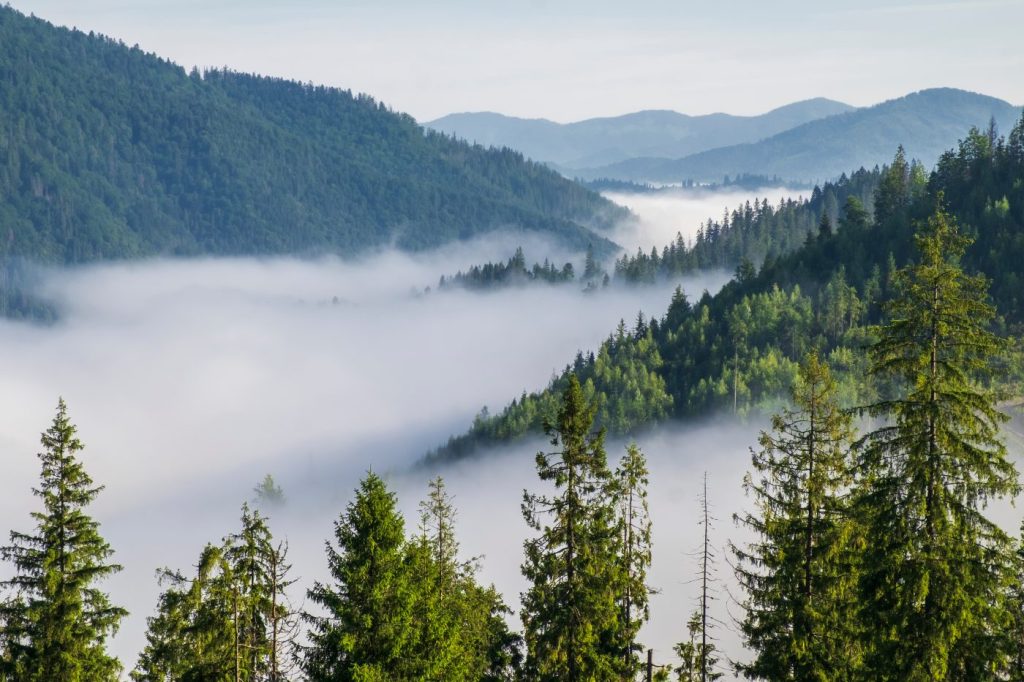
As far as campy horror movie tropes go, fog is an underrated fan favorite: “The Fog,” “The Mist,” even the new TV show “Widow’s Bay” features fog as a shapeless, spooky presence. But what is actually in the fog? It’s a question a team of microbiologists set out to answer. And they discovered that not only do bacteria live in some types of fog, but some of them eat pollutants in the mist.
Host Flora Lichtman chats with cloud researcher Thuong Cao about her fog hunting adventures and what her team found.
Donate To Science Friday
Invest in quality science journalism by making a donation to Science Friday.
Segment Guests
Thuong Cao
Dr. Thuong Cao is a postdoctoral researcher at Virginia Tech, based in Blacksburg, Virginia.
Segment Transcript
FLORA LICHTMAN: This is Science Friday. I’m Flora Lichtman. Later in the hour, a look into China’s rapidly growing biotech industry, including being the first country to approve an invasive brain computer interface. And what will it take to make global health initiatives more resilient? The founding director of the Africa CDC shares his thoughts. But first–
SPEAKER 1: Get inside and lock your doors. There’s something in the fog.
FLORA LICHTMAN: What is in the fog? It’s a question, as it turns out, not just for campy horror. Microbiologists also wanted to know, and they found something. My next guest went searching for fog life and is here to share her results.
Thuong Cao is a postdoctoral researcher at Virginia Tech. Welcome to Science Friday.
THUONG CAO: Thank you for having me today.
FLORA LICHTMAN: Thank you for being here. So fog seems mysterious, when it rolls in, when it rolls out. Is it a challenge to actually track it down, to study it?
THUONG CAO: Yes. This is really challenging because fog is the natural event, and we cannot predict everything. So for my specific research, where I had to go down to the field to collect the fog water in Pennsylvania, so I go down there checking the forecast, there is the fog tonight.
So I drove down the field, about two hours before the forecast said that there is the fog, but sometimes the fog never come, or sometimes you see something, but it dissipates so fast. So this is kind of like long experiments.
FLORA LICHTMAN: When you’re in the field, are you camping? Are you just waiting out in a field and waiting for that fog to appear?
THUONG CAO: I camp in the car, so that’s what I can say. It’s a really fun experience, as a scientist. And because I love that, even it’s stressful, the very first day, we were just teasing about that when doing the fog collection that we already missed the first night that the first day that you arrived, the field, you’re exhausted, and the fog came.
And my first day that I can officially collect the sample, I wait the whole night, from midnight until 5:00 AM until the fog came. And it’s only an hour, and it’s end. So I think this is the interesting of doing science that you cannot predict anything.
FLORA LICHTMAN: Yes, I guess that is the adventure of it. Yeah. Why does the fog call to you?
THUONG CAO: It’s an interesting question. Fog or cloud water is the only form of water in liquid phase in the atmosphere. So when you climb up the mountain, you’ll be surrounded by the cloud. Or in the morning when you wake up, you see the fog around you. So I just pick up the question, so what exactly present in that tiny droplet in the atmosphere?
So we know that bacteria is around us in the air, so we just wonder that when the water present over there, what happened to those bacteria in the air.
FLORA LICHTMAN: What did you find in the fog? What’s living in there?
THUONG CAO: So in the fog water, we felt very diverse bacteria living in the fog. And if we average the concentration of bacteria in the fog, it is comparable with the bacteria we found in the ocean, like average on the droplet.
FLORA LICHTMAN: Really?
THUONG CAO: Yes. So this is why we think that we should call fog water is the microhabitat. And one group of bacteria really stand out in Methylobacterium, the one that can consume formaldehyde, the pollutant in the air. And they use that formaldehyde to grow inside the fog droplet.
FLORA LICHTMAN: Methylobacterium, tell me about them.
THUONG CAO: So this group of bacteria is specified by their ability to eat up methanol or formaldehyde. And we want to emphasize that because formaldehyde is one of the most common compound that we found in the fog water.
FLORA LICHTMAN: Pause for a second. Formaldehyde is one of the most common chemicals you found in fog?
THUONG CAO: Yes, because they dissolve in the water. So it’s heavy in the air.
FLORA LICHTMAN: It’s is in the air already, and then it dissolves into the fog water.
THUONG CAO: Yes, that’s correct. And now, we found the bacteria eating that formaldehyde, and they grow inside the droplet.
FLORA LICHTMAN: They’re eating the formaldehyde?
THUONG CAO: Yes, they can use formaldehyde, and they grow. And we test this in a separate experiment to confirm that with formaldehyde as the only carbon source, yes, they use it to grow.
FLORA LICHTMAN: This sounds like science fiction, because I think we know formaldehyde as a toxic preservative.
THUONG CAO: Yes. So this is an interesting thing that we found that, not only that bacteria is present a lot in the fog water, we also see that maybe they help us to clean some pollutant formaldehyde when they are in the liquid phase. So this is what we found interesting.
FLORA LICHTMAN: How is the formaldehyde getting into the air in the first place?
THUONG CAO: So formaldehyde, basically, generates from human activities, such as vehicle emissions or industrial process. And this is pretty common all around us in the air.
FLORA LICHTMAN: Do you think that these methylobacteria are adapted to living in fog? It seems like a hard place to live, because it’s like your environment appears and disappears rapidly.
THUONG CAO: So this is one of the things that we found that Methylobacterium, they present in the dry atmosphere. And during the fog event, we detect more of them in the liquid phase, rather than in the dry air. So yes, we can say that bacteria prefer to stay in the liquid. And we think that is because when they get into that tiny droplet, they multiply because they have water, like life, need water. That also increased the total number of Methylobacterium inside the fog.
So it can be either because fog provides formaldehyde for them to grow. So this is like you have nutrients to grow on.
FLORA LICHTMAN: It’s fascinating to think about fog as this tiny, little ecosystem. Transient ecosystem.
THUONG CAO: Yes, under microscope, we see that from the fog water that we collect, there is some growing cells and dividing cell. And this is at the higher proportion that the dividing cell, we see in the dry air. So it’s confirmed that, yes, with the water, they can divide, so multiply.
FLORA LICHTMAN: They’re loving life in this toxic fog.
THUONG CAO: Yes, it’s amazing, right?
FLORA LICHTMAN: It is amazing. Do the findings have a practical component? Like, I know that there’s efforts to convert fog into drinking water. Does this change our understanding of whether that’s a good idea?
THUONG CAO: So from our point of view, we think that we just want to bring some awareness for people about the presence of bacteria in that drinking water. And another thing that we want to raise awareness is that, normally, they can say that fog water is the clean water.
So from our point of view, I think that we need to be careful when using the word clean water because if you use it for drinking water, it might still need to go through the process for treatment before you can really use it as drinking water. So this is not our expertise, but I think that we bring the view there that we should be thinking more about that.
FLORA LICHTMAN: Right. It’s not as pristine as it may seem. I mean, I know we made a joke at the top with the movie clip from The Fog, but why do you think fog captures our imagination? Why do you think it pops up in horror movies?
THUONG CAO: I think that, so from my point of view, it happened during the night time. You cannot predict when it comes. It come like some creature that come from the night time. And when the sunlight come up, it dissipates. And yes, I think that is not about the fog themselves, but I think it’s like what inside the fog, like what I see inside the tiny droplet. What inside, is matter.
FLORA LICHTMAN: Thuong, thank you for taking the time.
THUONG CAO: Yes, thank you. It’s nice to having the chance to talk with you and bring it to the public. And I appreciate that.
FLORA LICHTMAN: Well, we appreciate you taking the time to talk to us. Thuong Cao is a postdoctoral researcher at Virginia Tech. And she started this research when she was a PhD student at Arizona State University.
Speaking of the stuff of horror movies, we recently did a segment on the show where we tried to convince you to love scorpions. And perhaps, unsurprisingly, not all of you were convinced. Here’s John from Monroe, Louisiana.
JOHN: I’m one of those guys who has a severe phobia to scorpions, and I’m actually happy to hear that I’m actually not the only one. Arachnids, spiders freak me out. Scorpions just absolutely paralyze me with a kind of irrational fear that has never been caused by anything else in my life. And there’s nothing that I think can be told to me that is going to change that.
FLORA LICHTMAN: OK, so we didn’t turn John, and I don’t think Shayla, from Chicago, is going to come around anytime soon either, thanks to this memorable scorpion story.
SHAYLA: When I lived in Texas, we occasionally would have scorpions in the house. And our dog took this position that was so specific, we could tell by looking at him that there was a scorpion. Anyway, one day, I was getting dressed, and I put on my sports bra and felt an incredibly painful pinch right on my back.
And I screamed and squealed and wriggled out of the sports bra, and the scorpion dropped out onto the floor. And I stepped on it. And it hurt for only about maybe 15 or 20 minutes. And then it wasn’t so bad. So that’s my scorpion story.
FLORA LICHTMAN: But for all of you who told us why no amount of information was going to change your minds, we did have some scorpion converts, and I would like to celebrate these listeners now.
SPEAKER 2: I am now completely amazed by scorpions. So yes, I am over the ick and just the fact that they are so unique among arachnids, saving the sperm, self-insemination, live birth, and an embryonic-type sac, they’re amazing.
AMY: Hi there. This is Amy calling from Berkeley, California. And wow, I just heard the report on scorpions, and it blew my mind. I have this picture now, of scorpions as community members. The story of the mating dance, with their little claws dancing each other. And they’re kissing.
And this is why I listen to Science Friday, to have my world expanded. And as a scorpion little baby sheds its exoskeleton, Science Friday has me continuously shedding my fears and my naivete about how our world works. And I’m just so incredibly grateful for this show every single week.
FLORA LICHTMAN: Amy, we are just so incredibly grateful that you listen to this show every week. Thank you to our listeners, and thank you to everyone who called. And if you want to leave us some feedback, 877-4-SCIFRI is our number.
Copyright © 2026 Science Friday Initiative. All rights reserved. Science Friday transcripts are produced on a tight deadline by 3Play Media. Fidelity to the original aired/published audio or video file might vary, and text might be updated or amended in the future. For the authoritative record of Science Friday’s programming, please visit the original aired/published recording. For terms of use and more information, visit our policies pages at http://www.sciencefriday.com/about/policies/
Meet the Producers and Host
About Flora Lichtman
Flora Lichtman is a host of Science Friday. In a previous life, she lived on a research ship where apertivi were served on the top deck, hoisted there via pulley by the ship’s chef.
About Dee Peterschmidt
Dee Peterschmidt is Science Friday’s audio production manager, hosted the podcast Universe of Art, and composes music for Science Friday’s podcasts. Their D&D character is a clumsy bard named Chip Chap Chopman.