Subscribe to Science Friday
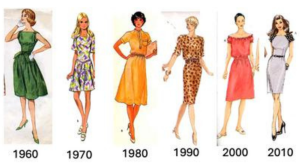 Bucket hats. Low-rise jeans. Track suits. As you might’ve noticed, Y2K fashion is in right now. People say that fashion moves in 20-year cycles, and it turns out…it does! At least according to math.
Host Flora Lichtman sits down with mathematician Emma Zajdela to figure out how she analyzed over 35,000 images of women’s clothing dating all the way back to the 1860s to confirm this theory.
Donate To Science Friday
Invest in quality science journalism by making a donation to Science Friday.
Segment Guests
Emma Zajdela
Dr. Emma Zajdela is a Franco-American mathematician and science diplomacy activist.
Segment Transcript
[THEME MUSIC] FLORA LICHTMAN: Hey, I’m Flora Lichtman. And you’re listening to Science Friday.
[TLC, “NO SCRUBS”]
(SINGING) Mm-hm
Fire up TLC, get out your bucket hats, your low-rise jeans, your Furbies– the original Labubus– because as you may have noticed, Y2K fashion is in right now. They say fashion moves in 20-year cycles. And it turns out it does, according to math. Here with us now is Dr. Emma Zajdela, a mathematician at Princeton University, who analyzed over 35,000 images of women’s clothing, spanning back to the 1860s, to confirm this theory. She uses mathematical models to understand complex systems. Emma, welcome to Science Friday.
EMMA ZAJDELA: Great to be here.
FLORA LICHTMAN: This must be a gigantic field, math fashion.
EMMA ZAJDELA: Oh, definitely not.
[LAUGHTER]
I think quite the opposite. Most mathematicians really don’t think about fashion. There’s actually a joke in the math community, which is, how do you know that a mathematician is well-dressed? And the answer is, because his T-shirt doesn’t have holes.
FLORA LICHTMAN: [LAUGHS]
OK, so why did you take this on?
EMMA ZAJDELA: I’ve always been really interested in patterns around me as a mathematician, and in general, this idea that fashion comes back or history repeats itself. So I started to think, is it just a perception that fashion comes back? Or is it actually true? And could we prove this mathematically?
FLORA LICHTMAN: Do you have any connection to fashion, any personal connection?
EMMA ZAJDELA: I do a little bit. I grew up in Paris, France, which is the capital of fashion–
FLORA LICHTMAN: So you’re like, I know about fashion. I grew up in Paris.
EMMA ZAJDELA: I love fashion, I definitely do. My mom also has worked in fashion. She worked for Nina Ricci at some point. So I definitely grew up at least being a lover of fashion myself.
FLORA LICHTMAN: What were you looking at specifically with this study?
EMMA ZAJDELA: Well, when we first set out to do this, we wanted to figure out a way to even quantify fashion because what does that even mean? There’s so many dimensions to fashion– color, pattern, shape. So we looked at women’s dresses because there’s this idea that’s been going for a while that hemline is inversely related to the economy, hemline length. So this actually came from the 1920s, when women used to wear silk stockings. And when they could afford real silk, they would wear short dresses to show off their silk stockings. And when they couldn’t, they would wear longer dresses. So there’s been this idea floating around.
We also teamed up with a fashion historian at Northwestern University, Alicia Caticha. And she’s the one who helped us decide on the measures of women’s fashion that we looked at. So what we did is we measured neckline, waistline, and hemline of women’s dresses over about 100 years. Like you mentioned earlier, 35,000 images that we analyzed for this.
And we found something really exciting to us, which was that there actually are cycles in fashion. And not only that, these cycles are 20 years long. We found this in the data, and we had no idea that this was something that was well-known in the fashion industry. We only found this out about six months later. And we were, wow, this is so crazy that we find exactly in the data what’s been pretty well-known in the industry for a while.
FLORA LICHTMAN: Yeah, it’s backed up, right, by the data?
EMMA ZAJDELA: Exactly.
FLORA LICHTMAN: At least this particular case study. I mean, why did you focus on hemline and neckline? Was there a math reason to focus on these variables in particular?
EMMA ZAJDELA: Yes, definitely. So as mathematicians, we typically try to simplify systems as much as possible. And we wanted to try to analyze fashion along one dimension. So we did it along what I like to call the vertical axis, from the head to the feet. What do you have? You have neckline length, waistline, and hemline.
FLORA LICHTMAN: And then the images, where did they come from? What were you looking at?
EMMA ZAJDELA: We used two data sources for these images. The first one is this amazing data set called the Commercial Pattern Archive, or CoPA. This is a data set of sewing patterns archives from 1869 till 2015 is the latest one. So that was about 25,000 of the images that we used. But there was sparser data in more recent years. So we turned to Vogue runway images.
And there’s actually two kinds of runways. The first one is what’s called couture, or high fashion. That might be what you think of typically like Dolce & Gabbana or Ralph Lauren. So we used some images from that. And then the other was Vogue Ready-to-Wear. That might be something like H&M clothes that more typical people would wear.
FLORA LICHTMAN: Hmm. OK, so how should I imagine these trends mathematically? Is it like a sine curve or something, where you have short dresses, long dresses, short dresses, long dresses over the 20-year span?
EMMA ZAJDELA: Yeah, pretty much. It’s a little bit more complicated than that, actually. And this was something else that was surprising to us. So if you imagine the data, there’s, first of all, one cluster of floor-length dresses that’s just always existing. And maybe that’s for–
FLORA LICHTMAN: Black tie.
EMMA ZAJDELA: –just the maxi skirt. Yeah, basically.
FLORA LICHTMAN: Yeah.
EMMA ZAJDELA: Maxi skirt is always in, always has been. That’s one cluster. And then there’s a secondary cluster which is the shorter dresses. And from about the 1920s to the 1980s, that looks exactly like a sine wave. But what happens is, starting in the 1980s, we see a split in this upper cluster of dresses. So it splits into two. And you start having the coexistence of three kinds of styles– mini skirts, midi, which is this ankle or calf-length skirts, and the floor-length dresses at the same time.
FLORA LICHTMAN: How do you interpret that, the emergence of another category?
EMMA ZAJDELA: I think there’s two main reasons that we find based on our model that explains why there’s a split. The first reason is just that there’s an acceleration in trends overall. So trends are changing faster and faster. And this could lead to the split. And this is not only true in fashion, but actually, there’s scientific evidence of this across many other domains in society that there’s an acceleration of trends.
FLORA LICHTMAN: You mean acceleration of trends like they move in and move out faster?
EMMA ZAJDELA: Exactly. Also, people are consuming more. So people are buying more and more clothes, which means that it needs to be different faster and faster. And reason number two is what you pointed to, which is that there’s just a greater diversity of styles, which maybe reflects this greater diversity in society, and also the fact that there is less conformity in society, where in the past, women were kind of all expected to wear the same clothes. But then starting from the mid-1980s, there was a greater diversity and the kinds of styles that were acceptable for women to wear.
FLORA LICHTMAN: Hmm. Does this tell us anything about predicting future fashion? And what about outside of the realm of hem length?
EMMA ZAJDELA: Definitely. So we developed a model to explain these trends. And this model is actually based on a very simple idea from psychology called optimal distinctiveness. And optimal distinctiveness is this idea that for innovations to succeed, they need to be different but not too different. Because if you’re too different, you’re just weird. And if you’re just different enough, then you can be cool. So–
FLORA LICHTMAN: I’m familiar with the former, personally. Yeah.
EMMA ZAJDELA: Yeah.
[CHUCKLES]
So optimally distinct. And we find that there’s three aspects of this optimal distinctiveness that explain these trends. The first one is that you need to be different but not too different from the past. So for trends to keep being fashionable, they need to be different from what happened last year. That’s number one. Number two, you need to be different from others, but not too different. So there’s this social aspect to it.
And then third, there’s some physical constraints because, obviously, dresses can only be so short or so long. Although, fun fact, we actually find trains, for example, in the 1850s. So there’s very long. You can extend, in some ways, past floor length. But typically, there’s more or less some of these physical constraints. So you need to be different but not too different from a reference point of some sort, like the knee.
FLORA LICHTMAN: Hmm.
EMMA ZAJDELA: And these three ingredients are enough for us to replicate the dynamics that we see. So these cycles, this split, this acceleration of trends. And we think that this model could help us understand future trends as well, not just in fashion, but also trends in other aspects of society as well.
FLORA LICHTMAN: I mean, it actually makes perfect sense when you describe it that way. Because it’s like, you’ll have people who are pushing to be slightly different. But they’ll get to a max, where the skirt can’t get any shorter or whatever, and then you have to come back down the slope again. So is that the idea?
EMMA ZAJDELA: Yeah, that’s exactly what we think is happening, that because you have these boundaries and you have this fact that you need to be different, the system wants to oscillate, and the system wants to create cycles. Because at some point, there’s nowhere else for it to go but back up.
FLORA LICHTMAN: All right, hang on for just a stitch. We’ll be right back. We’re going to talk about how math helps us understand everyday life, even outside of fashion.
FLORA LICHTMAN: OK, so I want to talk about your work with cycles and complex systems generally. What is that field? And why are those things interesting to mathematicians?
EMMA ZAJDELA: Complex systems is this field that’s been taking off, I would say, a little bit lately. And what’s really cool about complex systems is this idea that the whole is greater than the sum of its parts. So in the case of fashion, for example, you have a lot of different designers, a lot of different consumers. They’re all interacting individually. But on the whole level, we get these cycles, we get these clusters that we’re able to understand mathematically.
Some other examples of kinds of things that mathematicians are interested in are groups of animals. So you can imagine flocks of birds flying around in groups. They have these really interesting patterns. Geese form these V shapes, for example. Or schools of fish, if you’ve ever seen these videos of fish that are swimming around and you sometimes have a shark that comes, the whole group of them manages to do this very fast. So this is what complex systems is about, looking at these systems where you have a bunch of different individuals interacting to form some greater pattern.
FLORA LICHTMAN: And the idea with the math is to understand what that greater pattern might be?
EMMA ZAJDELA: Exactly So in our model, for example, for the fashion, we don’t necessarily need to understand what’s happening with every single individual. What we want to understand is, why are there clusters? Why are there these cycles in fashion over time? And math allows us to do that.
FLORA LICHTMAN: Do you think math has been underutilized to help us understand culture or everyday life?
EMMA ZAJDELA: I think so. For me personally, it was really mind-blowing when I first heard about the fact that we could use math to understand human behavior because I find people extremely puzzling. People are very complicated, very unpredictable. But I find math very simple and elegant, and 1 plus 1 is always 2, which is why I was really excited about this idea that we could use math to understand human behavior.
And that might be for fun things like fashion or culture. But it’s also the case for health care, for example, the idea that we need to understand not just in a pandemic, for example, how the epidemic is spreading itself, but how people interact so that we can make better decisions as a society.
FLORA LICHTMAN: Emma, you work in one of the most male-dominated research fields. I think it’s something like 30% of PhD mathematician grads are women. Did it feel radical in any way to take on fashion?
EMMA ZAJDELA: Actually, we’ve had a really positive response from pretty much everyone that I’ve talked to about this. And the math that we’ve done for this is actually very rigorous math that’s applicable to a lot of other fields. The model that we developed, this optimal distinctiveness model, is actually, I think, going to have implications in many other different fields.
I also think for women, it’s been a lot of fun to see men, as you said, that are dominating this field get really excited about something that’s maybe typically associated more with women, which is fashion, and specifically women’s fashion. That’s been a lot of fun. This is what’s cool about this kind of topic, that you can use very elegant, very rigorous math to study any variety of systems. And if you do it in that way, I think people generally get pretty excited about it.
FLORA LICHTMAN: OK, one more burning question for you on Y2K fashion. Have you embraced the bucket hat personally?
EMMA ZAJDELA: I have embraced the bucket hat. I have a bright yellow bucket hat.
[LAUGHTER]
I don’t how good it looks, to be honest. But I love it.
FLORA LICHTMAN: Do you have any takeaways from these mathematical models on how to be stylish?
EMMA ZAJDELA: The takeaway is this idea of optimal distinctiveness, I think. So if you’re constructing an outfit, you want to be different, but not too different, which means maybe you wear a pretty standard outfit. So some jeans and a white shirt. But then you pair it with your yellow bucket hat. Or maybe you wear, in a more professional context, a blazer, but then you put a cool vintage pin on it or a cool pair of earrings. Just accessorizing is a really good way to distinguish yourself without going into the a little too far–
FLORA LICHTMAN: The weird zone. What can–
EMMA ZAJDELA: Yeah, the weird zone. I like that.
[LAUGHTER]
FLORA LICHTMAN: Emma, thank you for taking the time to talk today.
EMMA ZAJDELA: Thank you so much.
FLORA LICHTMAN: Dr. Emma Zajdela is an applied mathematician at Princeton University. And she started this fashion research while she was a PhD student at Northwestern University. This episode was produced by Dee Peterschmidt. If you think SciFri is the French tuck of podcasts, I don’t– actually, is that a good thing or a bad thing now? I don’t know where we are in the cycle. Anyway, the point is, if you like the show, please rate and review us wherever you listen to podcasts. It really does help. Thank you for tuning in. I’m Flora Lichtman.
[THEME MUSIC]
Copyright © 2026 Science Friday Initiative. All rights reserved. Science Friday transcripts are produced on a tight deadline by 3Play Media. Fidelity to the original aired/published audio or video file might vary, and text might be updated or amended in the future. For the authoritative record of Science Friday’s programming, please visit the original aired/published recording. For terms of use and more information, visit our policies pages at http://www.sciencefriday.com/about/policies/
Meet the Producers and Host
About Flora Lichtman
Flora Lichtman is a host of Science Friday. In a previous life, she lived on a research ship where apertivi were served on the top deck, hoisted there via pulley by the ship’s chef.
About Dee Peterschmidt
Dee Peterschmidt is Science Friday’s audio production manager, hosted the podcast Universe of Art, and composes music for Science Friday’s podcasts. Their D&D character is a clumsy bard named Chip Chap Chopman.