Subscribe to Science Friday
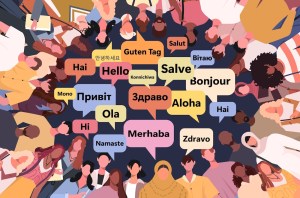
There are more than 7,000 languages used across the globe today, but this is just a fraction of what once existed. In a new study, researchers homed in on what they call the “golden age” of language, when linguistic diversity reached its peak. They suggest that this was somewhere between 1,000 to 3,000 years ago and that people may have used up to 10 times as many languages as we do today.
Producer Kathleen Davis chats with language researcher Damián Blasi about why there were so many more languages—and what happened to them.
Donate To Science Friday
Invest in quality science journalism by making a donation to Science Friday.
Segment Guests
Damián Blasi
Dr. Damián Blasi studies the diversity and evolution of languages at the Catalan Institute for Advanced Research and Study in Barcelona.
Segment Transcript
KATHLEEN DAVIS: This is Science Friday. I’m producer Kathleen Davis. These days, there are more than 7,000 different languages used across the globe. But what we see and hear now is just a fraction of what once existed. In a new study, researchers homed in on what they call the golden age of language, aka when linguistic diversity reached its peak. They suggest that this was somewhere between 1,000 and 3,000 years ago and that people may have used up to 10 times as many languages as today.
Why were there so many more languages then, and what happened to them? Here to discuss is study co-author Dr. Damián Blasi, who studies the diversity and evolution of languages at the Catalan Institute for Advanced Research and study. DAMIÁN, welcome to Science Friday. Thank you for being here.
DAMIÁN BLASI: Thank you so much, Kathleen, for having me here.
KATHLEEN DAVIS: Tell me about this golden age of language. What makes it golden?
DAMIÁN BLASI: Well, essentially the sheer size, which came as a surprise. The main motivation of the study was to essentially come up with an estimate on the total number of languages over the last 12,000 years. And unexpectedly, we found that between, as you said, 1,000 to 3,000 years ago, there was a huge surge in the total number of languages in such a way that– we are talking about anything between 20,000 to over 70,000 languages at the same time in the Earth.
KATHLEEN DAVIS: I mean, there’s a big difference between 20,000 and 75,000. How did you make this estimate?
DAMIÁN BLASI: Absolutely. The reason for the uncertainty has to do with the generality of our assumptions. If you think about what we are trying to model, we are trying to model social processes, migration, human organization at a large scale for a long period of time. So there were essentially two assumptions. The first one had to do with the fact that before agriculture, before pastoralism, before we aggregated into largescale social organizations, there was a limit to the number of people you could coordinate in a single group.
So when we were hunter-gatherers and foragers, we were talking about 800 to 1,000 individuals. And as I was saying, agriculture, pastoralism, before all of these technologies took place, the number of different human populations around the world was rather connected to the total number of languages. So that’s the first component of our inference.
The second part, which is what allow us to detect this golden age of language diversity, have to do with assumption that over the last 12,000 years, the rate of growth of languages has been smaller than the growth of humans. There is a large number of technologies that have made humans to survive for longer, to reproduce more, to inhabit essentially every corner around the world.
But at the same time, those very technologies allow you to control a larger number of people in the same population. So both factors result in humans exploding and the number of languages growing, but still below the rate of humans.
KATHLEEN DAVIS: Does it make your head hurt to imagine that there were, like, 10 times more languages back then as there were now?
DAMIÁN BLASI: That’s exactly my first reaction, was like, oh. Oh, gosh. Because the current discourse is that, you know, we have to put our act together soon, right now, because there’s a lot of languages in danger, and we lose the possibility of having a better insight on what makes language language. But then, on a second reflection, I think there is something about this study that is very liberating.
Because what we get to see is just a small fraction of what existed until very recently. So in that respect, I think this is a gush of fresh air because there is a lot of new unknowns that come with this finding.
KATHLEEN DAVIS: Yeah. I mean, tell me a little bit more about why these languages started to disappear.
DAMIÁN BLASI: So our insights in that direction come from the timing of this event. And the question is, what could have happened 3,000 years ago that might have resulted in this drastic reduction in the number of languages? And at that time, you see the rise of the Iron Age in the Old World. And there were a number of new technologies, for instance, the plow and weapons made of iron.
At the same time, there was a rapid development of the domestication of horses, all of which resulted in certain human groups becoming much more powerful when it comes to military prowess, social organization, and essentially, how much territory they could control. So we think that might have happened is that this early Iron Age empires, they started to spread. They started to have to gain influence well beyond the initial population. And that could have resulted in a number of situations.
One possibility, which is unfortunately very common in history is that of genocide, right? Another possibility is that there was a cultural draw that made groups, essentially, to switch identities and to give up their cultural identities and languages.
It could have been the case that as these groups started to exploit agriculture more intensively, then hunter-gatherer groups were pushed into regions that were less productive, less fertile. And either their chances of perishing increased dramatically, or they have to band with other groups in order to survive. So any of those causes and any combination of those could have been responsible for the rapid decrease.
KATHLEEN DAVIS: Are we still losing languages now?
DAMIÁN BLASI: Absolutely. I would say that the consensus might be between three to four languages a year go dormant, dormant, meaning they don’t have any active users. Nowadays, scholars prefer the term “dormant” over “dead language” because there is a chance of reviving the language.
One thing that people find puzzling is that some of the most important predictors of language endangerment today have to do with the presence of formal schooling and the presence of paved roads. Of course, upon reflection, this makes sense, right? Formal schooling is a device to introduce largescale national languages into populations, and paved roads facilitate people moving from rural to urban setups. And when that happens, sometimes they give up their languages.
KATHLEEN DAVIS: Yeah. How has studying languages changed how you see the world?
DAMIÁN BLASI: We Kathleen surprisingly little about language. And we think that we know language, right? It’s intuitive. You’re– the moment you gain consciousness, language is with you. And there is this deep familiarity with language that we all feel. You know, I keep thinking about in which ways we could have communicated in the past or we could communicate in the future. Is language as we know it just a byproduct of our time and era? And how far can we go?
So to me, the question of language, the plasticity of language, and the perimeter of languages, is one that speaks directly to the very condition of what it means to be human.
KATHLEEN DAVIS: Dr. DAMIÁN Blasi is a scientist studying languages at the Catalan Institute for Advanced Research and Study. DAMIÁN, thank you so much for joining me.
DAMIÁN BLASI: Thank you so much, Kathleen.
Copyright © 2026 Science Friday Initiative. All rights reserved. Science Friday transcripts are produced on a tight deadline by 3Play Media. Fidelity to the original aired/published audio or video file might vary, and text might be updated or amended in the future. For the authoritative record of Science Friday’s programming, please visit the original aired/published recording. For terms of use and more information, visit our policies pages at http://www.sciencefriday.com/about/policies/
Meet the Producers and Host
About Kathleen Davis
Kathleen Davis is a producer and fill-in host at Science Friday, which means she spends her weeks researching, writing, editing, and sometimes talking into a microphone. She’s always eager to talk about freshwater lakes and Coney Island diners.
About Rasha Aridi
Rasha Aridi is a producer for Science Friday and the inaugural Outrider/Burroughs Wellcome Fund Fellow. She loves stories about weird critters, science adventures, and the intersection of science and history.