Subscribe to Science Friday
Imagine this: You’re an astronaut, you’ve landed on the moon, and as you’re taking one small step for mankind, you kick up a bunch of lunar dirt. Now, tiny, jagged particles of dust are on your spacesuit, sticking to the spacecraft, getting in the machinery, and into your lungs. These are the kinds of problems planetary geologist Erica Jawin is trying to solve as NASA prepares for future moon bases.
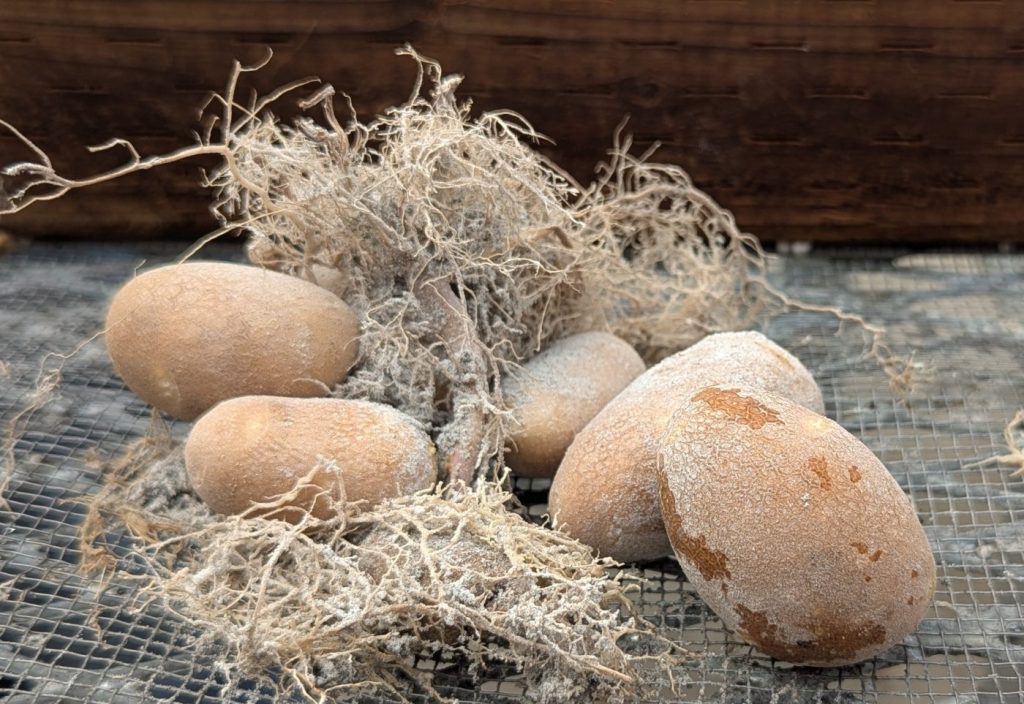
And what will you eat as an astronaut on the moon? Turns out that lunar dirt, or regolith, can be used to grow potatoes and other crops, just like Matt Damon did in “The Martian.” Flora talks to space biologist David Handy to learn more.
Donate To Science Friday
Invest in quality science journalism by making a donation to Science Friday.
Segment Guests
Erica Jawin
Dr. Erica Jawin is a planetary geologist at the National Air and Space Museum and a participating scientist on NASA’s Artemis science team.
David Handy
Dr. David Handy is a space biologist studying how to grow potatoes in moon dirt at Oregon State University.
Segment Transcript
FLORA LICHTMAN: This is Science Friday. I’m Flora Lichtman. With the Artemis missions, NASA aims to begin construction on a lunar base in late 2028. There is a lot of tech that needs to be worked out, including what’s for dinner. You got to eat to live. Remember the movie The Martian, where Matt Damon botanies the dung out of his situation?
[AUDIO PLAYBACK]
– I now have 400 healthy potato plants. I dug them up, being careful to leave their plants alive. The smaller ones I’ll reseed. The larger ones are my food supply, all natural, organic, Martian-grown potatoes.
[END PLAYBACK]
FLORA LICHTMAN: And it turns out this is not just science fiction. There’s real-life research on growing spuds in space. So how far off are we from successful space gardening? Here to hash it out is Dr. David Handy. He’s a space biologist studying how to grow potatoes in moon dirt. And he’s at Oregon State University. Welcome, David.
DAVID HANDY: Hi. Thanks for having me.
FLORA LICHTMAN: Thanks for being here. How often do people name-check The Martian with you?
DAVID HANDY: Oh, all the time. I got my start in the space biology stuff right around the time that The Martian came out. And I was actually working with plants in Martian dirt back then. And so it was perfect. I got to say, you saw The Martian? I was on a tech school campus. So the answer was always yes. And I said, that, but I’m working with lettuce.
FLORA LICHTMAN: So how do you go about doing these experiments, growing food in lunar dirt? Where do you get the dirt, for instance?
DAVID HANDY: So sadly, we cannot afford to get the genuine thing. So we work with what’s called lunar regolith simulants. So it’s fake moon dirt. And there’s a few places that you can get it. NASA has teams that survey places around the globe for mineralogically similar are areas that we can then dig up, maybe add a few things to make it a little more accurate.
There’s also companies that specialize in making these simulants where it’s fully synthetic. They just get bulk mineral of pure mineral. And they grind it and mix it into the proportions needed to simulate the moon.
FLORA LICHTMAN: And does it have all the nutrients you need to grow food? How is it different from regular soil?
DAVID HANDY: So the main distinction between regolith and soil is there’s no biology going on in regolith. So soil here on Earth– things are living in it. Things are dying in it. There’s microbes. There’s plants that are living and dying and decomposing and giving this biological component to the dirt, whereas regolith is biologically sterile. There’s no life going on, especially the genuine thing.
FLORA LICHTMAN: Do the potatoes grow differently?
DAVID HANDY: They do, yes. For one thing, they tend to grow a lot smaller. And part of that is soil texture, compaction, preventing the roots from growing too well. We’re also looking into if there might be some issues with certain heavy metals in the soil. Many of those can cause stunting, even the ones that are needed as micronutrients.
If you have too much of a good thing, it can become a problem. So one thing that we’re learning is that when we do this for real on the moon, we’re going to need to really tailor our fertilizer system to the soil itself.
So we worked with regolith from the lunar mare, which are the darker colored portions of the moon when you’re looking at it. Those are low-elevation. It’s called the mare as in maritime because if the moon did have water systems, those parts would be where the ocean is because of the low elevation.
And then there’s the lunar highlands, which are mineralogically different. That’s the lighter colored portion of the moon that we see that reflects all that bright light back at us. And so what we are finding is that just between these two types, there’s a lot of differences, which that’s to be expected here on Earth.
I’m here in Oregon. And the dirt between Western and Eastern Oregon alone is very different. You look at that compared to the dirt back in Florida, where I did my grad school– very different soil chemistry, mineralogy, texture. All these things are different. And all these things will impact how plants grow.
FLORA LICHTMAN: Is there something special about potatoes that make them a good candidate for a space garden? You also mentioned the lettuce.
DAVID HANDY: Yes. So potatoes specifically are going to be our prime candidate for that caloric-dense staple crop. So a lot of other things that NASA is looking at– they’re looking at pick-and-eat crops, like lettuces and tomatoes, things that require very little preparation so that the astronauts don’t have to spend all their time processing the plants into something edible. But they still need calories. And especially once we’re on the moon and can have a large structure where we can grow a large amount of crops, potatoes are one of the largest outputs of calories per unit area that we have.
So they’re very calorie-dense. They are also very nutritious. And also, they’re very versatile. You can do a lot of things with them. You can make them into chips, French fries. You can mash them, just bake one whole.
So one thing that space biologists consider is menu fatigue. And if you’re eating the same thing over and over again, you get sick of it. You will want to eat less of it. And if it’s the only thing you have to eat, you’re not going to want to eat it.
FLORA LICHTMAN: They’re versatile?
DAVID HANDY: Yeah.
FLORA LICHTMAN: Of course. It’s the idea that astronauts would be relying on this lunar garden to survive.
DAVID HANDY: Yes.
FLORA LICHTMAN: What about all the freeze-dried stuff?
DAVID HANDY: So the freeze-dried stuff will be useful at first. All these systems will need time to be built and become established and start cycling and recycling. But eventually, even the freeze-dried stuff– it has mass. And it costs money to ship mass into space. And as we have more and more people up there, that’s just going to be more and more food that we need to ship if we’re relying on the freeze-dried stuff from Earth.
FLORA LICHTMAN: There’s been a lot of attention on the moon recently, obviously, with these Artemis missions and this talk about a future moon base. Has your work felt more urgent? Is your phone ringing more than it has been in the past?
DAVID HANDY: The work does feel more urgent. I wish my phone were ringing more.
FLORA LICHTMAN: [LAUGHING]
DAVID HANDY: I’m currently a postdoc. And our funding runs out in July. So I’m hoping to land somewhere, preferably at a university, or maybe even with NASA themselves, if any positions are open, for me to keep doing this kind of work.
FLORA LICHTMAN: Good luck.
DAVID HANDY: Thank you.
FLORA LICHTMAN: Dr. David Handy, space biologist at Oregon State, thank you for being here.
Imagine this– you’re an astronaut. You’ve landed on the moon. And as you’re taking one small step for mankind, you kick up a bunch of lunar dirt. It’s on your spacesuit. It’s sticking to the spacecraft. It’s getting in the machinery.
It turns out that moondust is a huge pain in the butt for NASA. Here to tell us why is Dr. Erica Jawin. She’s a planetary geologist at the National Air and Space Museum in DC. And she’s also a participating scientist on NASA’s Artemis science team. Erica, thanks for being here.
ERICA JAWIN: Oh, thanks so much for having me.
FLORA LICHTMAN: Is moon dirt somehow more annoying than regular dirt?
ERICA JAWIN: [LAUGHING]
I would say it’s much more of a problem than dust that we have on Earth. The technical term that we use for the ground-up layer of rock on the surface of planetary bodies is “regolith.” So it’s regolith on the moon. It’s regolith on Mercury or Mars. And Earth, if we didn’t have life here, would also have regolith. And it’s actually kind of a big problem.
FLORA LICHTMAN: We have all these grand plans for a lunar base with these Artemis missions. How big of a problem is the regolith?
ERICA JAWIN: So when you talk about things like building and living on the surface of the moon, the regolith itself is a little bit tricky because it’s this potentially deep, maybe tens of centimeters thick, layer of ground-up rock. But specifically, what we’re talking about here is the very, very finest fraction of the regolith, specifically what we call dust.
So the size of lunar dust is anything smaller than 20 microns in diameter. So for reference, a single human hair is around 50 microns. So at the very largest size, lunar dust is half as thick as a single human hair. But in general terms, dust can be about 50 times smaller than a single hair– so really, really tiny pieces of rock and glass.
And the critical thing that’s the reason that lunar dust is so dangerous is that it’s tiny particles of angular, jagged rock and glass. So on Earth, we have life, of course. But we also have geological processes like wind and rain. And these active geologic processes can actually round particles, including tiny particles of dust, so that they’re not that sharp.
But because the moon has no atmosphere, it doesn’t have active wind or water flowing across the surface, those particles get broken into shards. And they stay really sharp. And so what happens is if you kick up dust off the surface, it is sharp. And so it can actually stick into things, whether that’s your spacesuit. If it gets lofted in the habitat, you can breathe it in. And it’s very irritating.
FLORA LICHTMAN: It’s like tiny needles?
ERICA JAWIN: It’s like tiny, little jagged shards. So physically, it’s quite abrasive. But there’s actually a second part to it that because the moon doesn’t have an atmosphere or a global magnetic field to protect the surface from radiation, the surface of the moon is constantly being bombarded by radiation from the sun and from space in general. And so this dust actually gets electrostatically charged.
So not only is it tiny and jagged, but it actually can loft off the surface and get attracted to things because of static electricity, basically. So it will stick to things because of static, but also because it’s sharp and jagged.
And then even a third thing is that the moon is smaller than the earth. And it has less gravity. So these tiny particles of dust– once they’re lofted, they’ll actually stay lofted for longer than they would on Earth. It’s just a big mess.
FLORA LICHTMAN: That’s just so annoying. Just everything about it seems very annoying. Did the Apollo astronauts have lunar dust issues?
ERICA JAWIN: So yes, the Apollo astronauts definitely had issues with dust. And so if you think about– this issue is not completely alien. On Earth, there are definite risks of exposure from fine-grained minerals. If anyone’s worked in construction or worked with really fine-grained rocks, like pumice, there’s a very known risk of things like silicosis. If you inhale that in, it can do a lot of damage to your lungs.
FLORA LICHTMAN: Yes. This is the countertop issue, too, right?
ERICA JAWIN: Yeah, exactly. It’s quite common on Earth. You don’t want to be breathing in rock dust anywhere. So this was an issue that the Apollo astronauts also had to contend with. And starting with Apollo 11, every Apollo astronaut noted some sort of irritation from lunar dust. And this irritation included things like irritated eyes, maybe scratchy throats, like a cough.
Jack Schmitt on Apollo 17 actually called it lunar hay fever. You’re just irritated and itchy. And it’s from these tiny, jagged shards of rock that’s getting into your eyeballs, into your lungs. And the good news from Apollo is that it seemed like these symptoms were pretty short-lived. Most of those lunar hay fever symptoms cleared up after about a day.
So the later missions tried to mitigate this and reduce the dust contamination inside the habitat from things like using brushes and vacuums. But it was still a problem. This dust gets into everything. Even if it’s only on your outer suit, it works its way in. And it got into the habitat. And it’s just– got everywhere.
FLORA LICHTMAN: We’ve gotten better at purification and masks. I imagine COVID has helped with that.
ERICA JAWIN: Yeah, absolutely, which is crazy to think about, that something like COVID could help to make us safer living on the moon. But think about how we treat personal protective equipment using masks. Think about the improvements in air filtration technologies. So the ways to approach dust mitigation for human exploration on the surface of the moon has changed fundamentally in the last five or 10 years.
FLORA LICHTMAN: How does lunar dust affect spacecraft and robots and machinery?
ERICA JAWIN: So it’s kind of the same process with any sort of equipment or rovers or any sort of electronics you have on the surface of the moon. Any movable parts, any hinges, joints, gaskets, the dust is going to get into those parts. And it’s going to cause irritation– so physical abrasion. It can wear down parts. It can break vacuum seals.
And then this additional component of this electrostatic charging could potentially pose a risk. If you have very delicate electronics, it could cause shorts or interference, just noise. So it’s a factor that really needs to be considered if we’re going to do very detailed analyses on the lunar surface.
FLORA LICHTMAN: How do we mitigate this? Is it just, bring the vacuums?
ERICA JAWIN: [LAUGHING]
We certainly can bring some vacuums. We saw from Apollo that it’s not that easy. You can vacuum up what you can see. But it’s tiny dust. And it’s everywhere.
So there’s certain aspects that are being designed for currently. So if you can make something like a spacesuit out of a different textured material, maybe it would be a little bit more resistant to having the dust stick into the fabric.
And then there actually was a really cool instrument that was flown to the moon recently. So this is a technique for dust shielding called the Electrodynamic Dust Shield. And this was just recently tested on the lunar surface from the Blue Ghost mission.
So this used electrodynamic forces to lift and remove dust off of surfaces after it was deposited. And it was tested out and totally worked. So this is a really promising technology that could be adapted and better deployed in the future to remove dust and maybe repel it from accumulating in the first place.
FLORA LICHTMAN: What do we need to do between now and 2028 to be ready to build a moon base?
ERICA JAWIN: So one of the big open questions for long-term human habitation on the moon is the long-term health impacts of dust on the human body. And these studies have been going on for years now. And as I mentioned, the Apollo astronauts didn’t have any long-term symptoms from dust interactions.
But using lunar samples and lunar simulants, there have been more longitudinal studies of the impacts of dust on human health. And those studies are ongoing. And those are going to be the really foundational studies to see how humans can live on the surface of the moon and stay healthy for a long time.
FLORA LICHTMAN: Keep us posted.
ERICA JAWIN: Sure will.
FLORA LICHTMAN: Dr. Erica Jawin is a planetary geologist at the National Air and Space Museum in DC. Thanks, again, for coming on the show.
ERICA JAWIN: Thanks so much.
Copyright © 2026 Science Friday Initiative. All rights reserved. Science Friday transcripts are produced on a tight deadline by 3Play Media. Fidelity to the original aired/published audio or video file might vary, and text might be updated or amended in the future. For the authoritative record of Science Friday’s programming, please visit the original aired/published recording. For terms of use and more information, visit our policies pages at http://www.sciencefriday.com/about/policies/
Meet the Producers and Host
About Flora Lichtman
Flora Lichtman is a host of Science Friday. In a previous life, she lived on a research ship where apertivi were served on the top deck, hoisted there via pulley by the ship’s chef.
About Kathleen Davis
Kathleen Davis is a producer and fill-in host at Science Friday, which means she spends her weeks researching, writing, editing, and sometimes talking into a microphone. She’s always eager to talk about freshwater lakes and Coney Island diners.