Subscribe to Science Friday
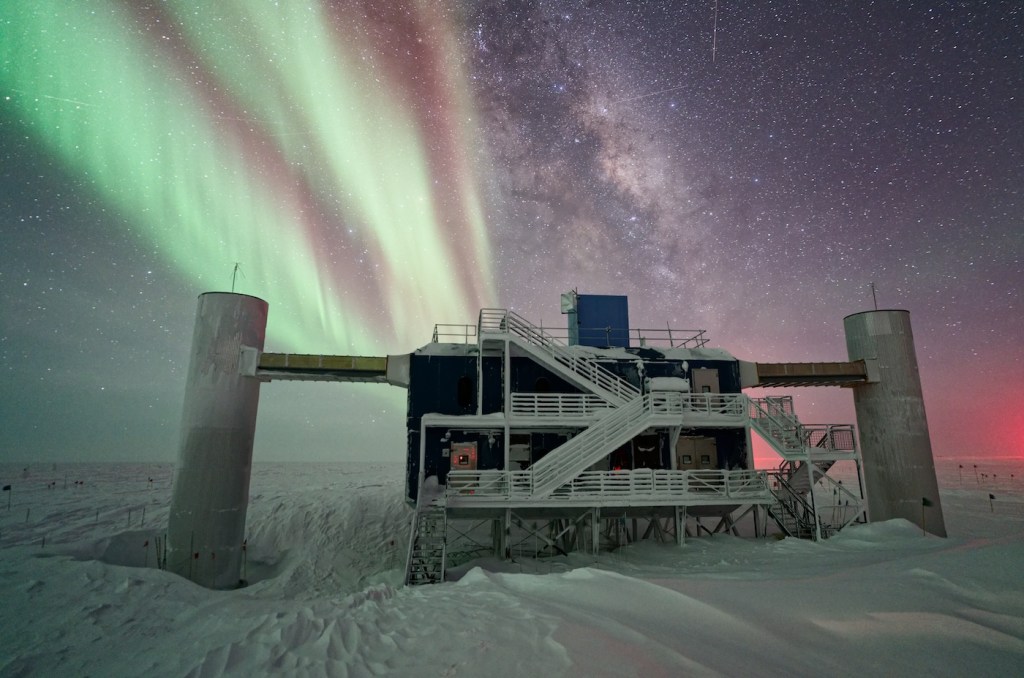
It’s Nobel Prize week, and this year’s prize in physics went to Francis Halzen “for decisive contributions to the IceCube Neutrino Observatory and the discovery of high-energy neutrinos of astrophysical origin.” The IceCube is a massive neutrino detector that covers a cubic kilometer of Antarctic ice, and looks for high-energy neutrinos coming from deep space.
In 2013, Ira spoke with physicist Francis Halzen about the decision to build the IceCube at the South Pole and the challenges of constructing a map of the cosmos with neutrinos.
Donate To Science Friday
Invest in quality science journalism by making a donation to Science Friday.
Segment Guests
Francis Halzen
Dr. Francis Halzen is a professor of physics at the University of Wisconsin–Madison and the 2026 recipient of the Nobel Prize in physics.
Segment Transcript
[MUSIC PLAYING] FLORA LICHTMAN: Hey, it’s Flora, and you’re listening to Science Friday. This week is Nobel Prize week, and this year’s prize in physics went to researcher Francis Halzen, quote, “for decisive contributions to the IceCube Neutrino Observatory and the discovery of high-energy neutrinos of astrophysical origin.” But way before all that excitement, back in 2013, Ira traveled to Madison, Wisconsin, and talked with Dr. Halzen about his work. And I think you’ll enjoy the conversation. Here’s Ira.
IRA FLATOW: Astronomers and astrophysicists have traditionally, for centuries, looked upwards to the sky to learn more about the universe. We’ve launched telescopes into space. We have sent probes beyond our solar system to study dark matter, colliding galaxies, how the planets formed. But there is a group of scientists that is turning its eyes downward. And I mean way down. They have built a telescope a mile deep into the ice at the South Pole. Wow. What if you have to fix that?
The frozen observatory is appropriately named IceCube. And it’s not looking for your typical star stuff, but the elusive neutrino. What are neutrinos? Why build a telescope a mile deep in the Antarctic ice? Well, here’s a man with all the answers. Francis Halzen is the Hilldale and Gregory Bright Professor in the physics department, University of Wisconsin in Madison. Welcome to Science Friday.
FRANCIS HALZEN: Glad to be here.
IRA FLATOW: What are neutrinos, and why are we so interested in them?
FRANCIS HALZEN: Well, I think your introduction was to the point. I mean, when we know of another way to look at the sky and at the universe, we have never been able to resist it. And this was probably the hardest way to do it. And that made it a challenge.
And so neutrinos you can think of as just another way, another form of light. And we discovered them in 1956. And as they have no electric charge, they make beams just like light beams. And so we knew we could look at the sky with them. The only problem is that we collect light with our eyes and with a mirror.
Neutrinos come as elementary particles. And we know how to detect elementary particles. The only problem is that to actually look at the sky in an effective way, you had to build a kilometer cube detector. And this had never been done before. And so it took us about, since the idea to now, it took just half a century.
IRA FLATOW: Just half a century.
FRANCIS HALZEN: Just half a century.
IRA FLATOW: Yeah. Well, why do you build it a mile down beneath the ice, where it’s absolutely dark, right?
FRANCIS HALZEN: Well, as I said, it’s a particle detector. If we build it on the surface, in fact, it’s not impossible, but it would be much more complicated because the surface of the Earth is bombarded by cosmic rays in incredible numbers. And you would have to find these neutrinos in this rain of cosmic rays, and it would be very challenging.
If you go a mile deep, then you have to only find one neutrino in a million events that impersonate a neutrino. So your background is much lower. Most of the radiation that can impersonate a neutrino is shielded. And of course, the best way to shield the radiation that impersonates neutrinos is to detect them through the Earth. So our favorite way to look at the universe at the South Pole is to look at the sky above Madison.
IRA FLATOW: Wow. It’s focused at Madison? The other end of the telescope looks at Madison from the South Pole?
FRANCIS HALZEN: That’s our favorite direction.
IRA FLATOW: Well, then you’ve come to the right place, then.
FRANCIS HALZEN: Yes.
IRA FLATOW: Neutrinos are really tiny, aren’t they? They go through just about everything, don’t they?
FRANCIS HALZEN: They are just like light.
IRA FLATOW: Yeah.
FRANCIS HALZEN: And they almost travel at the speed of light. They have a small mass, but that’s irrelevant in this talk. And so they are identical, except they go through walls.
IRA FLATOW: Oh, except they go through walls.
FRANCIS HALZEN: Yeah.
[INTERPOSING VOICES]
IRA FLATOW: Light’s not going through the wall, but the neutrino, like light, but it is dissimilar that it can go through walls.
FRANCIS HALZEN: Yes. And they go through the Earth and they go through our detector.
IRA FLATOW: They go through everything, just about.
FRANCIS HALZEN: They go through everything. And it’s only occasionally that you can catch one. And that’s why you have to build this big device.
IRA FLATOW: So if you eliminate all the interference from the other particles, you hope you get to see a few neutrinos.
FRANCIS HALZEN: Yes.
IRA FLATOW: Because they go through everything, and they may occasionally go through your device.
FRANCIS HALZEN: That’s about it.
IRA FLATOW: And what is so special about them that we go through all this trouble to try to catch them? What do we want to know about them that we don’t know?
FRANCIS HALZEN: Well, that’s a different question. In fact, I’m a particle physicist. I don’t know any astronomy. I learned very little. But I’m a particle physicist. And of course, my interest in this, and of most of my colleagues who built this detector, was it was a challenge at building a particle detector. In fact, after we spent 20 years on it, it came quite as a shock when it was finished that we actually had to do something with it.
IRA FLATOW: You never expected to finish it.
FRANCIS HALZEN: And in fact, I hope that the science is as exciting as building this thing.
[INTERPOSING VOICES]
IRA FLATOW: Oh, go ahead. So a particle physicist, you like to study the particle.
FRANCIS HALZEN: Well, yes. In fact, we have a big international collaboration, and about one third of my colleagues are only interested in the neutrinos themselves. They don’t care where they come from in the sky.
IRA FLATOW: Someone else’s problem.
FRANCIS HALZEN: Yes, exactly. And these neutrinos have about 1,000 times the energy of any neutrino we have ever produced with an accelerator. And so this is a whole other aspect.
IRA FLATOW: It’s another flavor of neutrinos. In other words, the ones you build in the accelerators are just puny compared to the ones you–
FRANCIS HALZEN: Exactly.
IRA FLATOW: –can detect coming from outer space.
FRANCIS HALZEN: Exactly.
IRA FLATOW: And in fact, neutrinos were very mysterious for a while. There are a lot of different kinds of neutrinos.
FRANCIS HALZEN: Yeah. And so that’s the particle physics side of this. And they oscillate and do all kind of interesting things. And so if you look at particles in a different energy range, you usually discover something new about them. And that’s, of course, what we are after also.
IRA FLATOW: They talk about all this dark energy, things that inhabit– most of the universe is made out of this dark energy. Could it be neutrinos?
FRANCIS HALZEN: No.
IRA FLATOW: OK, we’ve eliminated it.
FRANCIS HALZEN: Actually, this was an excellent idea that died about 20 years ago.
IRA FLATOW: I know I’m always up there on the times with the latest thinking.
FRANCIS HALZEN: On the other hand, you must have by now the idea that we just built this thing because nobody had built it before. And when you build something that nobody’s built before, you usually discover something. And so it’s basically a shot in the dark.
But one aspect that’s not a shot in the dark, which is related to your question, is that I’m now going to tell you what another third of my colleagues are doing. The last third is actually looking at the sky. But one of the goals of this experiment– and in fact, that’s why we got our first meager funding 20 years ago, was because it could see dark matter.
IRA FLATOW: Oh, because you– ah. So you went in under the we’re going to find the dark matter–
FRANCIS HALZEN: That’s right. And we are still looking, like everybody else. Of course, dark matter exists. It’s real as the–
IRA FLATOW: Yeah.
FRANCIS HALZEN: –the table–
[INTERPOSING VOICES]
IRA FLATOW: We can’t see it, though.
FRANCIS HALZEN: We just don’t know what it is.
IRA FLATOW: It holds those galaxies together.
FRANCIS HALZEN: So we have found the hardest way of seeing it. That is, dark matter, over time, as it interacts gravitationally, has been trapped in the sun. And so the sun is actually a reservoir of dark matter.
IRA FLATOW: No kidding.
FRANCIS HALZEN: And so the dark matter in the sun is concentrated in the center. And when the dark matter particles collide, they make stuff that we know. And some of this stuff will decay in neutrinos. So we are looking for neutrinos coming from the center of the sun that are made by dark matter. And that would be our way to, A, detect it, and then B, maybe some learn something new about it.
IRA FLATOW: How long does it take a neutrino to get from the center of the sun to the outside of the sun and to Earth?
FRANCIS HALZEN: It comes immediately.
IRA FLATOW: Immediately.
FRANCIS HALZEN: A photon we see, light we see from the sun has spent, like, 100 million years working its way out–
IRA FLATOW: It’s 100 million years for light to get from the center of the sun out?
FRANCIS HALZEN: It’s something like that. It’s a very long time.
IRA FLATOW: And a neutrino–
[INTERPOSING VOICES]
FRANCIS HALZEN: –comes at the speed of light.
IRA FLATOW: Wow. No wonder you want to study this stuff. This is very mysterious. How many kinds of neutrinos are there?
FRANCIS HALZEN: There are three types.
IRA FLATOW: Three types.
FRANCIS HALZEN: Yes. And so but we take any type.
IRA FLATOW: Whatever. You build it, the neutrinos will come, is what you’re saying.
FRANCIS HALZEN: You must know that the neutrinos we are really interested in for any of these subjects I have mentioned up to now come about at a rate of 10 to 100 a year.
IRA FLATOW: That’s it.
FRANCIS HALZEN: Yes. So we know them all by name.
IRA FLATOW: Each neutrino– you’ve named all the neutrinos you’ve discovered. Give me a couple of names. Come on.
FRANCIS HALZEN: We named them after Sesame Street characters.
[LAUGHTER]
IRA FLATOW: So you have a Big Bird and you have a–
FRANCIS HALZEN: Yeah, so after we ran the detector for a year, we looked at what we had. And so we found two really interesting events. And we called them Bert and Ernie.
IRA FLATOW: Wow. Who else you got?
FRANCIS HALZEN: When we find a more energetic one, you know what it will be called.
IRA FLATOW: Cookie Monster?
FRANCIS HALZEN: No. Big Bird.
IRA FLATOW: Big Bird. You got Cookie Monster in there, too?
FRANCIS HALZEN: Cookie Monster already been used.
IRA FLATOW: Yeah?
FRANCIS HALZEN: No, I’ve lost track, actually. But it’s not funny because a block of ice in the South Pole has more than 5,000 light sensors in them, and they also have each a name. And you would think you would number them 1 to 5,000. It’s much easier when you work with a system like that. Occasionally, you want to say it was sensor number 5,120. It’s much easier to remember them. We know them by name. And it’s the same for our neutrinos.
IRA FLATOW: So this is Bernie over here, and it’s Gilda there, and it looks like Leo’s not picking up anything.
FRANCIS HALZEN: Yeah.
IRA FLATOW: That sort of– so you actually, you anthropomorphize, I guess, or whatever the–
FRANCIS HALZEN: Yeah, so we have two of our post-doc who named them. And they promised me that they don’t spend more than one hour a week on it.
IRA FLATOW: And they name it.
FRANCIS HALZEN: Yes.
IRA FLATOW: This is fascinating. It’s fascinating about neutrinos. Thank you very much. Thank you very much, Dr. Halzen, for taking time to be with us today. More than you’ve ever wanted– and now, can we name the neutrinos ourselves if we get new ones? Can we have a contest? We’ll talk about it.
FRANCIS HALZEN: We’ll arrange.
IRA FLATOW: We’ll arrange, OK. Francis Halzen is the Hilldale, Gregory Bright Professor in the physics department at the University of Madison in Wisconsin.
[MUSIC PLAYING]
FLORA LICHTMAN: That interview was recorded in 2013 and was produced by the one and only Alexa Lim. And one last thing. It’s Cephalopod Week, of course, and you can celebrate with a game. SciFri teamed up with Grand Gamers Guild on an escape room card game all about the one and only chambered nautilus.
Every purchase supports Science Friday. Play, learn and support SciFri all at the same time. Go to sciencefriday.com/cephalopodweek. Thank you for listening. Happy Nobel week to those who celebrate. We will see you tomorrow. I’m Flora Lichtman.
[MUSIC PLAYING]
Copyright © 2026 Science Friday Initiative. All rights reserved. Science Friday transcripts are produced on a tight deadline by 3Play Media. Fidelity to the original aired/published audio or video file might vary, and text might be updated or amended in the future. For the authoritative record of Science Friday’s programming, please visit the original aired/published recording. For terms of use and more information, visit our policies pages at http://www.sciencefriday.com/about/policies/
Meet the Producers and Host
About Ira Flatow
Ira Flatow is the founder and host of Science Friday. His green thumb has revived many an office plant at death’s door.
About Charles Bergquist
As Science Friday’s director and senior producer, Charles Bergquist channels the chaos of a live production studio into something sounding like a radio program. Favorite topics include planetary sciences, chemistry, materials, and shiny things with blinking lights.
About Flora Lichtman
Flora Lichtman is a host of Science Friday. In a previous life, she lived on a research ship where apertivi were served on the top deck, hoisted there via pulley by the ship’s chef.