Subscribe to Science Friday
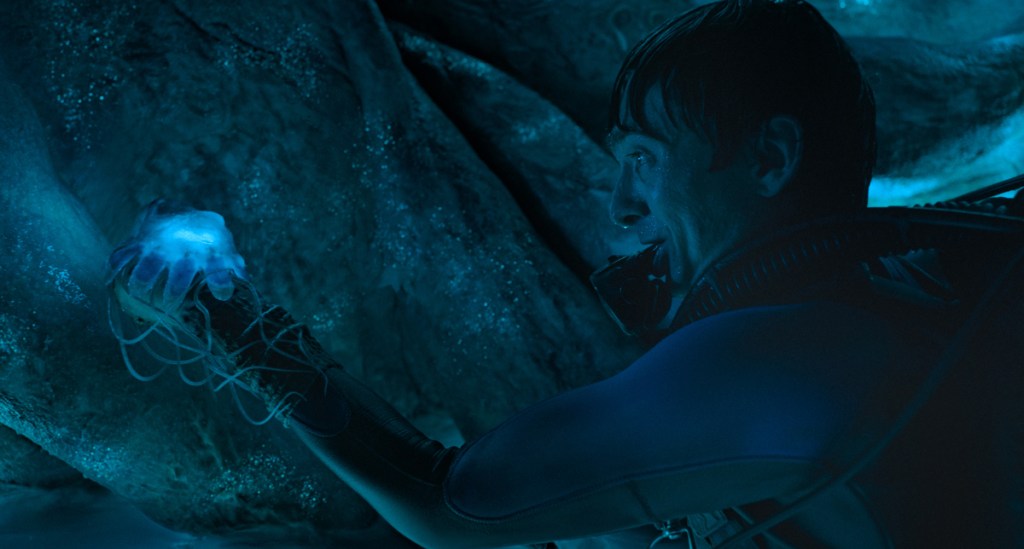
In the new film “Whalefall,” a scuba diver has a very bad day. On what should be a routine dive off the California coast, Jay Gardiner (Austin Abrams) gets caught up in a battle between a giant squid and sperm whale. The sperm whale wins, swallowing the squid; but poor Jay goes down the gullet, too.
Could this actually happen? Science Friday consulted Shane Gero, sperm whale researcher and biology lead for Project CETI, and “Whalefall” director Brian Duffield, to get the facts.
Sperm whale vs. giant squid
The inciting incident of the film is a fight between a giant squid and a sperm whale. Gero says this battle takes place in the ocean every day, but there’s no documentation of it. We only know sperm whales dine on giant squid because of evidence left behind: The whales often have scarring around their mouths that aligns with giant squid tentacles and barbs. And giant squid have been found in sperm whale stomach contents and feces.
Duffield says it was a unique challenge to portray a common but never-before-seen occurrence with scientific accuracy. “There’s almost no footage of giant squid alive, and definitely no footage of [sperm whales] really engaged in a hunt,” Duffield says. “While we were shooting there was one video that popped up of a dead squid in a sperm whale’s mouth, but that’s the extent of the footage we have.”
Could a whale eat a human?
To be clear, there’s no documented evidence that a sperm whale has ever swallowed a human. But it’s not an impossibility, according to Gero. A large sperm whale’s esophagus can be 30-40 centimeters in diameter. “That’s like fitting through a tennis racket, maybe a little bigger than that,” he says. “It’s not gonna happen without you noticing.”
Sperm whales have the largest esophaguses of any whale. While most whales eat a slurry of krill and fish, sperm whales prefer giant squid, which are much meatier. “Giant squid are huge, they can be 30 to 60 feet long,” Gero says. “If anyone’s had calamari recently, this is a tough body that they’re swallowing.”
Sperm whale stomachs have four separate chambers, each in charge of a different part of the digestive process. In “Whalefall,” we see two of them: The first stomach squeezes and crushes food (and our main character). The second stomach is filled with acid that breaks down food chemically.
The “Whalefall” team made practical sets of these two stomachs, complete with squeezing walls and faux stomach goo. They also created the whale’s esophagus, and a true-to-scale sperm whale head.
”What was so fun about this movie was that the more scientifically accurate we went, it just made everything worse for Austin Abrams’ character,” Duffield says. “The whale is designed to digest food in a fascinating way, and poor Austin is a food source. Every time a note would come back, we’d go, ‘Oh, that’s so much worse for him,’ and implement it.”
Could you escape a whale’s stomach?

Gero says the chances of a person finding themself in a “Whalefall” situation are slim to none. And that’s a good thing, because the odds for survival would not be good. Sperm whale stomachs have evolved specifically to kill and digest things, not to keep them alive. These whales dive more than 3,000 feet deep, where the pressure alone would be enough to kill a person. And the stomachs would be filled with things the whale can’t digest, like hundreds of piercing giant squid beaks the size of a human fist.
“I don’t think you would have very much time to consider how you’re gonna get out,” Gero says. But, in a pinch, some human ingenuity could provide an answer.
“ I think there are lots of resources that, that you might find in the belly of a whale, both that should be there and unfortunately that shouldn’t, that you could use to sort of MacGyver your way out, should you ever find yourself in this impossible predicament.”
— Kathleen Davis, SciFri Producer
This is an article from our newsletter “Science Goes To The Movies.” To get a story about the science of popular movies and TV in your inbox every month, subscribe here.
Segment Guests
Shane Gero
Dr. Shane Gero is a whale biologist at Carleton University, founder of The Dominica Sperm Whale Project, and biology lead for Project CETI. He’s based in Ottawa, Canada.
Brian Duffield
Brian Duffield is a writer, director and producer based in Los Angeles, California.
Meet the Producers and Host
About Kathleen Davis
Kathleen Davis is a producer and fill-in host at Science Friday, which means she spends her weeks researching, writing, editing, and sometimes talking into a microphone. She’s always eager to talk about freshwater lakes and Coney Island diners.
About Flora Lichtman
Flora Lichtman is a host of Science Friday. In a previous life, she lived on a research ship where apertivi were served on the top deck, hoisted there via pulley by the ship’s chef.