25,000 trilobites and the dizzying biodiversity of the ancient ocean
In “What the Wild Sea Can Be,” a snapshot of plankton and trilobites from eons past hints at the scale of the ocean’s existence.
The following is an excerpt from “What the Wild Sea Can Be: The Future of the World’s Ocean” by Helen Scales.
When you purchase products through the Bookshop.org link on this page, Science Friday earns a small commission which helps support our journalism.
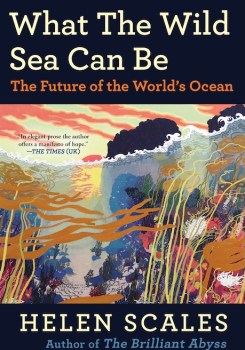
What the Wild Sea Can Be: The Future of the World’s Ocean
In a desk drawer, among all sorts of things I’m saving, is a small witness to the changing ocean. The thumb-size piece of slate is etched with narrow silver lines that are smooth along one edge and serrated on the other. I found it at the base of a crumbling cliff that was folded and twisted by an eon of orogeny. The marks look like the script of some long-lost language penciled on the rock. In fact, these are fossils of animals that lived 430 million years ago, or thereabouts, and I like them especially for the name they’ve been given: graptolites—from ancient Greek words graptos, meaning “marked with letters,” and lithos, meaning “stone.”
The impressions graptolites left behind hold messages that took paleontologists a long time to decipher. Many assumed these markings were fossilized plants. Others realized they were animals but had differing views on which kind, variously labelling them as corals, hydroids, or the mossy-looking creatures known as bryozoans. Ultimately the matter was settled, and it was agreed that graptolites belong among an obscure group of ocean dwellers called pterobranchs. Each sawtooth line on my stone was once a colony of tiny animals. They lived together inside a house of interconnected tubes, which they actively built around themselves, like a spider making its web. Their homes were the only parts of graptolites that fossilized, but these are enough to tell us what their colonies looked like and what kind of lives they led. Early on in their evolution, graptolites grew on the seabed, fixed to boulders or rooted in mud. Then in time, some varieties floated away and were among the first animals to become plankton. These abundant drifters colonized open seas all around the world and swiftly evolved into flurries of different-shaped species. Some graptolites were Y-shaped, some poker-straight or two-pronged like a tuning fork, and some grew into spirals that twirled up and down as they sifted floating microbes from the water.
Now, though, the open ocean is empty of graptolites. The last of the planktonic species went extinct around three hundred million years ago. That seemed to be the end of them all, until recently, when a group of tiny animals, the Rhabdopleurida, were deemed to be living graptolites. It wasn’t a new finding but a new interpretation of animals that scientists already knew about, microscopic, seafloor-bound colonies, which live all through the ocean, from polar seas to the tropics, from coastlines to a half mile down, and are the color and translucence of amber. Only five living species have been found, a fragmentary recollection of the once-ubiquitous graptolites, the ghosts of a vanished world.
While contemplating the future of the ocean, it’s worth pausing to turn around and look back. The ocean’s backstory matters because it provides context for what’s happening now. It lets us see what the ocean has been like and how it changed in a prehuman world. Long before us, great tides of ocean dynasties have risen and fallen, and the seas have been both a cradle of evolution and an arena for extinction. Looking back offers a chance to compare humanity against other planetary life-shaping forces. We can search for clues as to what changes lie ahead, note the warnings against misleading assumptions, and seek solace in the fact that, one way or another, life in the ocean goes on.
To think about the past requires an obvious and dizzying shift in perspective, because ocean life stretches behind us for more time than our human brains can instinctively grasp. We must briefly let go of our customary horizons of hours and days, years and decades, centuries and, at a stretch, millennia. Think instead like paleontologists, who have learned to find ancient moments trapped in stone, then to gather them up and piece together stories that take millions of years to be told. While we try not to get overwhelmed by the scale and intricacy of it all, we can pick out details that tell a wider story of the changing ocean. From there we can begin to sense the rhythm and pace of ocean life.
Trilobites look oddly familiar, as if a pill bug scuttled under a rock and then emerged on the other side much larger, more ornate, and more than a half billion years older. Were I a more skilled and patient fossil hunter, I might find trilobites lodged in rocks not far from my graptolite-embossed slate. There are fossil trilobites on continents across the world. These animals existed in the earliest of three great chapters of complex life on earth—the Paleozoic, meaning “ancient life,” which was followed by the Mesozoic (“middle life”) and then the Cenozoic (“new life”). Trilobites in the Paleozoic weren’t the first large animals to evolve, but they were undoubtedly trailblazers. They worried Charles Darwin because they seemed to confound his theory of gradual evolution via natural selection. Trilobites emerged far too quickly, too completely, and too long ago to fit his theory, as perfect creatures pressed into stone.
Trilobites evolved shortly after a three-billion-year prelude in which the only living things were single-celled microbes colonizing the ocean, followed in the fullness of time by enigmatic wisps of simple, mostly jelly-based creatures that paleontologists are still trying to make sense of. Then the Paleozoic era opened with a dramatic twist in the history of life on earth. This era is divided into six periods; the first was the Cambrian, when evolution suddenly accelerated and ran at full tilt, churning out a mob of animals, including many that looked wildly different to anything alive today, from nozzle-nosed predators to luxuriantly spiky worms. The trigger for this flurry of life, known as the Cambrian explosion, is still a matter of debate. It may have had something to do with the fact that, for a long time leading up to it, the whole planet was frozen. As snowball Earth thawed, likely due to volcanoes spewing planet-heating carbon dioxide, the climate became more favorable for life to flourish. Rocks on land, as yet devoid of living things, began to erode and release nutrients into the ocean that organisms used to grow and build their skeletons, including enormous numbers of trilobites.
Darwin needn’t have agonized over trilobites. It was partly a matter of timing. He was quite right when he surmised that ancient seas must surely have been swarming with life, though in his day nobody had yet found any evidence for it. When Darwin was writing and thinking about evolution, most of the world’s oldest animal fossils remained unfound underground, including the extraordinary variety of Cambrian life in the Burgess Shale in Canada’s Rocky Mountains, which wasn’t uncovered until after his death.
A recent study of trilobite fossils has shed light on the timing of the Cambrian explosion and strengthened the idea that evolution can run at different speeds and has sometimes been breathtakingly fast (geologically speaking). A team based at the Natural History Museum in London used a large new collection of Cambrian trilobites to track how their appearance changed over time. The fossils went through an early, short burst of frantic innovation, showing that the Cambrian explosion may have truly gone off with a bang, lasting a brief twenty million years. Once the explosion died down, the rate of evolution among the trilobites levelled off and ticked steadily along.
By the Ordovician, the Paleozoic period after the Cambrian, the ocean was brimming with trilobites. They ranged from flea-size swimmers to shovel-shaped diggers two and a half feet long, although most species were neatly pocket-size, measuring between one and three inches. Their basic anatomy was a head, thorax, and tail, with a ridged shell divided lengthwise into three sections, hence the name trilobite, and multiple pairs of legs underneath, like a centipede. These simple creatures were molded and embellished into a phenomenal variety of forms. Many trilobites sprouted impressive spines and barbs, elegant quills, and devil horns. Some were smooth and rounded, like Bumastus, which looked just like an armadillo if you popped off its head and hid its tail. And like armadillos and pill bugs, most trilobites could curl up into a ball when they were scared.
From their fossilized remains, it’s possible to interpret the ways many trilobites lived their lives. Masses of them scurried across the seabed, leaving footprints as if they had walked over wet cement; these imprints were preserved by rapid burial in sediment and then slowly turned into stone. Fossil trails captured the details of a hunting foray: a line of worm tracks joined by those of a trilobite, and then the trilobite walking off by itself, worm presumably in belly. Cryptolithus evolved to be filter-feeding trilobites that stirred up the sediment by scrabbling the seabed with their forelegs, then straining suspended food particles through their perforated, colander-like heads. Others never set a foot down but chased after prey through the water, aided by hydrodynamic shells. Chunks bitten out of their shells show that trilobites were prey for other animals, such as the giant sea scorpions that also roamed the Paleozoic seas. Planktonic trilobites floated in great midwater swarms, occupying a pelagic niche similar to the one that krill occupy today. In shallow tropical seas, trilobites were beetling around the world’s first true coral reefs, which had been built in the Ordovician by horn- and honeycomb-shaped corals. Some trilobites ventured between the tides and foraged on exposed tidal flats, but it seemed they never moved into rivers or lakes or made a permanent move onto land.
Uniquely among animals, trilobites’ eyes were made from crystals of the hard mineral calcite, which means they were often exquisitely preserved, and their shapes and arrangements tell us even more about these creatures’ lives. From their inception, Cambrian trilobites had complex, multifaceted eyes, similar in general form to the compound eyes of living insects and crustaceans. Some had eyes on long stalks, which scanned for prey while their bodies lay hidden in the mud. Erbenochile trilobites had columnar eyes that gave them almost 360-degree vision, each eye with a small, overhanging brow that shaded it in bright light. In deep waters of the twilight zone, where sunlight is dim, Cyclopyge trilobites soaked up rare photons with enormous eyes that occupied much of their heads, like the helmet eyes of dragonflies. Deeper still, trilobites evolved to be eyeless and blind, vision serving no purpose in the dark midnight zone.
Some trilobites resembled their nearest living relatives, the horseshoe crabs. Olenellus had a rounded, helmetlike head, rearward-pointing body spines, and a long prong for a tail. Not in fact crustaceans, the trilobites and horseshoe crabs are more closely aligned with spiders.
In all, more than twenty-five thousand species of trilobites are known, and more are constantly being found. (For comparison, there are roughly one thousand named dinosaurs.) They were fossilized in the millions, thanks in part to their tough exoskeletons. Trilobites periodically molted their outer layer, growing new, bigger ones and tossing the casts into the fossil record, duplicating themselves and increasing the chances of being remembered through the passage of time.
The enormous diversity of species and ecology of trilobites show what very early ocean ecosystems were like, with habitats and food webs that are broadly recognizable in the contemporary ocean. More than five hundred million years ago, although the shape of the global ocean was very different, ocean ecology was already working, in many similar ways, as it does today.
Excerpted from What the Wild Sea Can Be © 2024 by Helen Scales. Reprinted with the permission of the publisher, Atlantic Monthly Press, an imprint of Grove Atlantic, Inc. All rights reserved.

Dr. Helen Scales is a marine biologist and author of several books, including “What the Wild Sea Can Be: The Future of the World’s Ocean.”