Subscribe to Science Friday
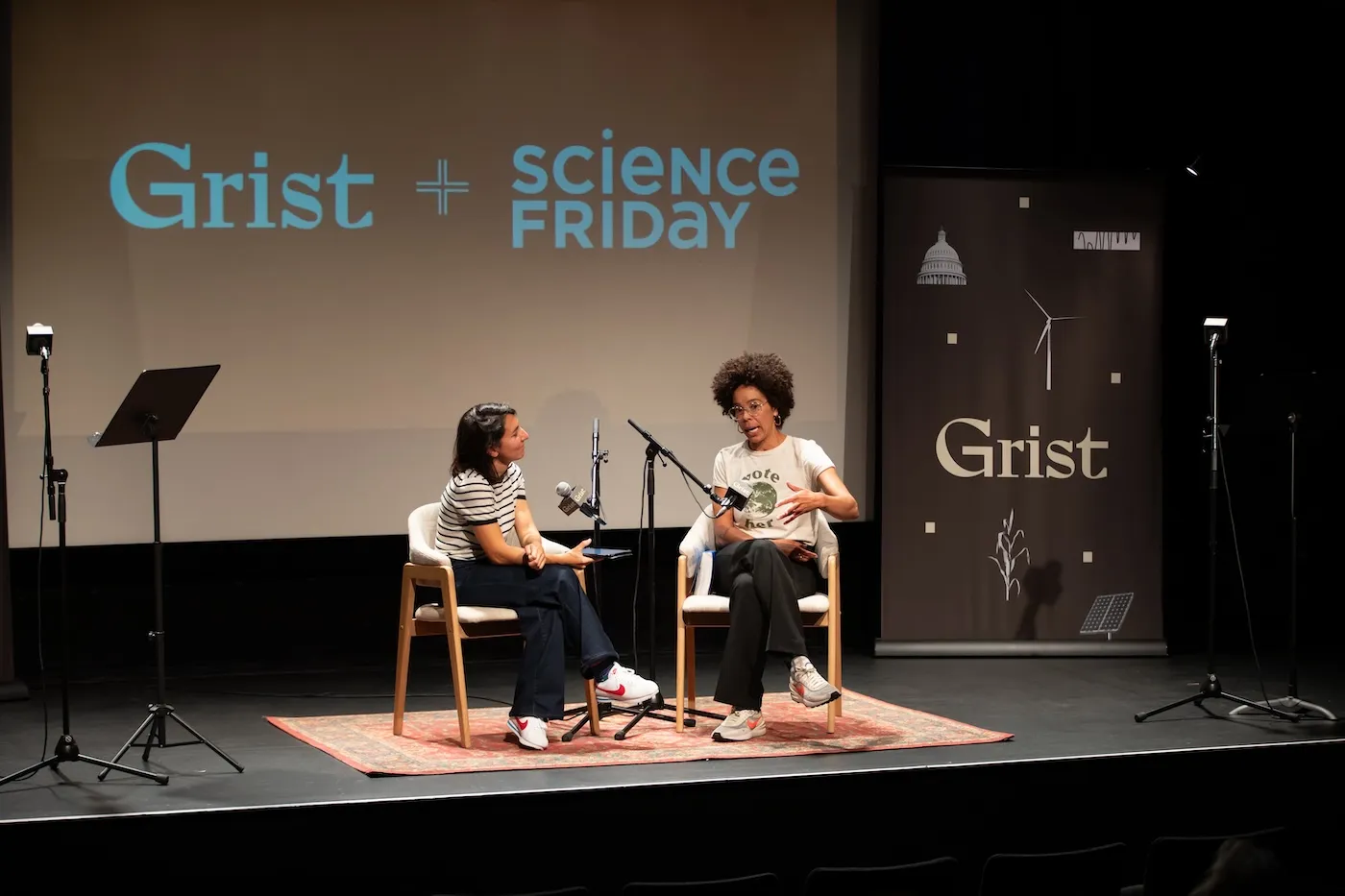
Ayana Elizabeth Johnson is one of the most prominent voices in the climate movement. She’s a marine biologist by training, but as she saw the effects of the climate crisis intensify, she took on more public-facing advocacy work.
Her work is expansive: She helped organize the March for Science, she founded a think tank focused on coastal cities, she’s started two podcasts about climate solutions, and she’s published a couple books, most recently “What If We Get It Right?”
Flora sat down with Johnson on stage at a show produced by Grist to discuss the climate movement, climate solutions, and her path to becoming one of the foremost climate thinkers.
Donate To Science Friday
Invest in quality science journalism by making a donation to Science Friday.
Segment Guests
Ayana Elizabeth Johnson
Ayana Elizabeth Johnson is a marine biologist and the author of “What If We Get It Right? Visions of Climate Futures.” She’s based in Brooklyn, New York.
Segment Transcript
FLORA LICHTMAN: This is Science Friday. I’m Flora Lichtman. Later in the hour, calls for safe AI are mounting, but what does that mean exactly? Plus, the latest concussion science and how our understanding of concussions is changing how we treat them.
But first, it’s Climate Week in NYC. That’s the annual summit where a bunch of climate nerds flood the city to brainstorm, commune, and consider all things climate. And as part of an onstage show produced by the media organization Grist, we sat down with Dr. Ayana Elizabeth Johnson, one of the most prominent voices in the climate movement. She’s a marine biologist by training.
But as she saw the effects of the climate crisis intensify, she started to take on more public-facing advocacy work, and that work is expansive. She helped organize the March for Science. She founded a think tank focused on coastal cities. She started two podcasts about climate solutions. And she’s published a couple of books, including, most recently, What If We Get It Right?
So today, I’m excited to share that conversation where we explore the state of the climate movement, solutions, and Ayana’s path to becoming one of the foremost climate thinkers. Dr. Ayana Elizabeth Johnson, welcome to Science Friday.
AYANA ELIZABETH JOHNSON: I am so pleased to be here. I love science. I love Fridays. I love the radio.
FLORA LICHTMAN: And our show.
AYANA ELIZABETH JOHNSON: Mm-hmm.
FLORA LICHTMAN: So I know that solutions are your jam. Are you a glass-half-full kind of person?
AYANA ELIZABETH JOHNSON: No.
FLORA LICHTMAN: Really?
AYANA ELIZABETH JOHNSON: No, I find it to be very disconcerting and also hilarious that everyone assumes I’m an optimist.
FLORA LICHTMAN: Your book’s called What If We Get It Right?
AYANA ELIZABETH JOHNSON: It’s a question. It’s like a huge question mark. I love that we have climate solutions. We have so many that are ready to deploy, ready to implement in every city, in every town, in every rural area across the world, in the oceans, forests, agriculture, buildings, transportation. We have so many solutions. Will we implement them quickly enough to address the crisis that we face? I have no idea.
There are so many political headwinds. There’s so much entrenched interests, and lobbyists from the fossil fuel industry and our freakin’ government, Congress. The Republican Party is the party of climate denial now. Our president says climate change is a hoax. So there’s no reason to assume that we’re going to get it right. But there is a possibility that we could get it more right than it would be if we did not bother to try, which is the secret title of the book, which would not have become a bestseller.
[LAUGHTER]
What if we get it as right? Is it still possible? Because species are already going extinct. The planet is already warmer. Sea level is already rising. Ice is already melting. We don’t have a time machine among the things that we’ve invented to help address this crisis. So I’m not an optimist. I’m not motivated by hope, but I am absolutely not a quitter. I’m like, why would we not be trying to do this, especially on an issue where increments matter so much? The difference between 1 and 1/2 and 2 degrees and 3 degrees Celsius of warming is hundreds of millions of lives.
FLORA LICHTMAN: You are still a scientist, of course, but you’re a scientist and then became a very public figure in the last–
AYANA ELIZABETH JOHNSON: It’s so weird.
FLORA LICHTMAN: Is it weird?
AYANA ELIZABETH JOHNSON: So when we first met, like in gimlet, in podcast world, there were not video podcasts. People wouldn’t recognize you on the street if you had a podcast. And so, also, being a marine biologist– and my first jobs were in the federal bureaucracy at EPA and NOAA and the policy office. And I thought that was going to be my whole life. As a public servant or as maybe a manager of some small team in a nonprofit, I didn’t have any of those ambitions. And so the whole thing is just extremely weird to me that anyone knows who I am.
FLORA LICHTMAN: So how did you find yourself here? Was there a turning point for you?
AYANA ELIZABETH JOHNSON: 2020 was this incredible confluence of events for all of us. But that was the year that I co-created How to Save a Planet podcast with Alex Blumberg. It’s also the year my first book came out, All We Can Save. I was a surrogate for Elizabeth Warren’s campaign and wrote the Blue New deal with her policy team, thinking about how to put the ocean into federal climate policy.
So it was that kind of year. It was Me, Too meeting the climate crisis, meeting people in isolation, wanting to be in book clubs together, meeting Black Lives Matter. And so it was this perfect storm, so to speak, where a Black woman climate policy nerd was hitting, checking all the boxes. Like, not something you could plan, you know?
FLORA LICHTMAN: Do you feel like you have a lot of responsibility now?
AYANA ELIZABETH JOHNSON: Yes, and no. There are days when I feel like I have completed a lifetime’s worth of work in my 46 years, which is a weird thing to say, maybe. And I’m not giving up or disappearing, but I don’t actually feel a lot of pressure because I’m definitely doing my part.
And because I’m involved in so many different approaches to being useful, I don’t feel like there’s a specific expectation of me. There’s not a clear progression of things that I’m supposed to be doing. It’s just keep being helpful and trying new ways to engage more people in climate solutions. And because there’s no roadmap, I think there’s actually less pressure. And I think it would be fine if I disappeared.
But the thing that I’ve been trying to do is just leave enough breadcrumbs that anyone could follow the trail, which we all know how that fable works out. The breadcrumbs get eaten, and it doesn’t work. But if you leave pebbles or whatever is the alternative. But yeah, it’s a complicated one for me because I’m not terribly interested in legacy and certainly not interested in fame. That is awful. I hate getting recognized in the street. I don’t like taking selfies with strangers. I’m at the farmer’s market for heirloom tomatoes. We’re just off.
FLORA LICHTMAN: Leave me alone.
AYANA ELIZABETH JOHNSON: So yeah, if there were a way to do the things that I enjoy doing and have them be impactful without my face being associated with them, that would be the ideal.
FLORA LICHTMAN: Let’s talk about what people get wrong about the climate conversation. And I want to do it in the format of this is my hill. What is your hill? What’s the hill you would die on?
AYANA ELIZABETH JOHNSON: I feel like it’s more like a mountain range with multiple peaks. Definitely many things. The politics part is actually one that if you are not a super-engaged climate voter, you’re actually a [BLEEP] environmentalist because there are no perfect candidates. But we need the best one, and then we need to push them once they’re in office.
We’ve seen through these two rounds of the Trump administration what happens when you elect people who don’t care, who do not care if we’re breathing dirty air, who do not care if we all get cancer, who want to sell off public lands to oil and gas mining, who want data centers everywhere, who don’t care if they’re powered by gas turbines and communities of color. But we’ve seen how much of a difference it makes when there’s a thriving environmental movement pushing from the outside. We just get a lot more. I also really think that working on climate solutions should be fun.
FLORA LICHTMAN: Say more. How–
AYANA ELIZABETH JOHNSON: Well, climate change is terrible and depressing and deadly and all those things that we know. But working on the solutions could be delightful. There’s no reason it has to be miserable to– I don’t know– plant mangroves, install solar panels, fight for high-speed rail, build green roofs– anything you want to think of– eat vegetables and ride your bike. It could all just be delightful.
And I feel like we’ve done a really bad job of pitching that, that if we get it right, it’s a better, nicer world to live in. It’s not just sacrifice. It’s different. But a lot of that is extremely good for our quality of life. And the work of getting there or as close to there as we can is just so gratifying.
And my colleagues are awesome. I get to work with the best people. Climate people are actually cooler than you think might be another hill. There’s many options for this.
FLORA LICHTMAN: Climate people are cooler than you think. I feel like that’s a good tagline.
AYANA ELIZABETH JOHNSON: It’s kind of a weak tagline. Like, we’re not so bad.
FLORA LICHTMAN: Do you feel like we need more climate change in culture?
AYANA ELIZABETH JOHNSON: Yes. Oh, my god, yes. This is actually the direction that my work is going in. So when I launched What If We Get It Right two years ago in September, we did it at the Brooklyn Museum. And I co-hosted a climate variety show with Jason Sudeikis, actor from Ted Lasso.
And we had magicians and musicians and comedians and climate scientists and activists and a supermodel wearing a heat pump costume because I was like, Cameron Russell, can you please help me make climate solutions sexy? And she was like, yes, I can. And I feel like we need to do the work of welcoming people in and changing the status quo in culture. What are the celebrities that we look to doing? What are we seeing in films?
FLORA LICHTMAN: We need the rom-com.
AYANA ELIZABETH JOHNSON: We need the rom-com of the hot, shirtless solar installer and the businesswoman coming home at the end of the day, and she’s like, what’s happening on my roof?
FLORA LICHTMAN: Like that Diet Coke commercial.
AYANA ELIZABETH JOHNSON: Ugh, yeah. All of that stuff, because these are actually very plausible scenarios that happen in the world.
FLORA LICHTMAN: Let’s give it up for Ayana Elizabeth Johnson.
[APPLAUSE, CHEERING]
Dr. Ayana Elizabeth Johnson is a marine biologist and climate solutions expert. She’s the co-founder of the Urban Ocean Lab and author of the book What If We Get It Right? She also has a podcast by the very same name, which she hosts with Bill McKibben. Ayana, thank you so much for joining me today.
AYANA ELIZABETH JOHNSON: Oh, thank you for having me.
FLORA LICHTMAN: This was fun.
AYANA ELIZABETH JOHNSON: What a treat.
[APPLAUSE, CHEERING]
Copyright © 2026 Science Friday Initiative. All rights reserved. Science Friday transcripts are produced on a tight deadline by 3Play Media. Fidelity to the original aired/published audio or video file might vary, and text might be updated or amended in the future. For the authoritative record of Science Friday’s programming, please visit the original aired/published recording. For terms of use and more information, visit our policies pages at http://www.sciencefriday.com/about/policies/
Meet the Producers and Host
About Flora Lichtman
Flora Lichtman is a host of Science Friday. In a previous life, she lived on a research ship where apertivi were served on the top deck, hoisted there via pulley by the ship’s chef.
About Rasha Aridi
Rasha Aridi is a producer for Science Friday and the inaugural Outrider/Burroughs Wellcome Fund Fellow. She loves stories about weird critters, science adventures, and the intersection of science and history.