Subscribe to Science Friday
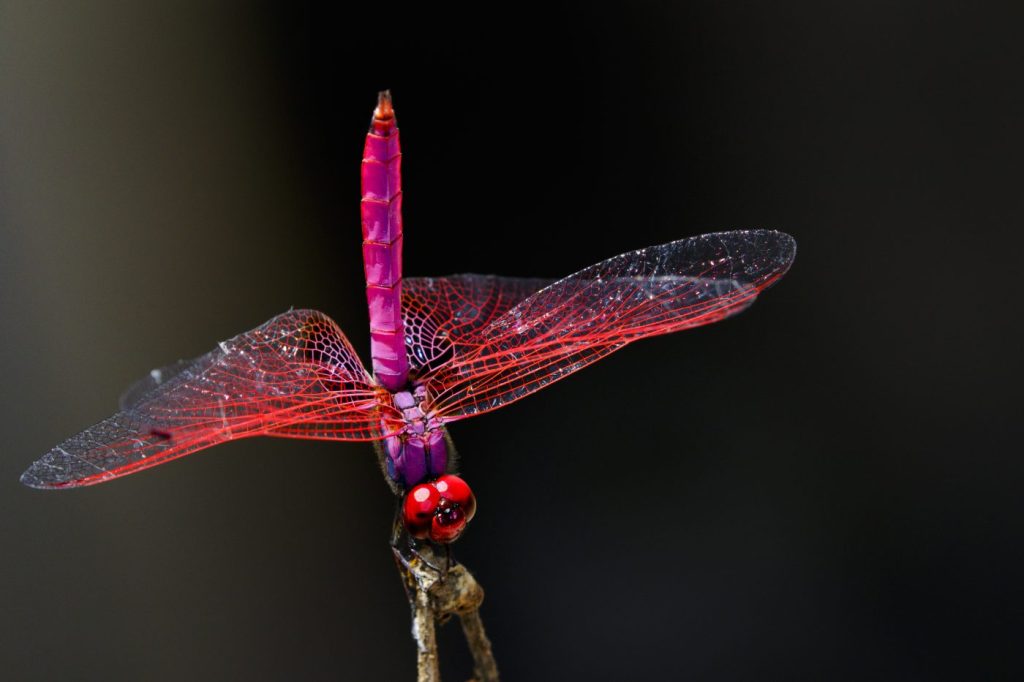
Summer is a great time to observe one of the fiercest aerial predators out there. Creatures capable of hovering, pulling turns at 6 Gs before effortlessly dropping into a downward spiral: dragonflies. Dragonfly-lover and zoology curator Jessica Ware explains some new research on their flying style.
Then, we head over to Lake Malawi in East Africa to explore the feats of another aquatic insect. Every morning, to avoid getting eaten by fish, lake fly larvae sink 600 feet deep, where there’s little oxygen and very high pressure, especially for an insect that’s basically a squishy body with an air sac. Zoologist Phillip Matthews went to the lake to figure out how these submarine-like insects make this daily commute without imploding. He joins Host Flora Lichtman to explain why they’re so rare in the insect world.
Donate To Science Friday
Invest in quality science journalism by making a donation to Science Friday.
Segment Guests
Jessica Ware
Dr. Jessica Ware is the curator and chair of the Division of Invertebrate Zoology at the American Museum of Natural History in New York City.
Philip Matthews
Dr. Philip Matthews is an associate professor at the University of British Columbia in Vancouver, Canada.
Segment Transcript
FLORA LICHTMAN: This is Science Friday. I’m Flora Lichtman. Summer is a great time to observe one of the fiercest, most agile predators cruising the skies, creatures capable of hovering and pulling turns at 6 Gs before effortlessly dropping into a downward spiral. I’m going to give you a hint– they have four wings, and they come in a lot of colors, including hot pink.
I’m talking about dragonflies. Here to tell us about some new research on their flying style and much, much more is American Museum of Natural History curator, invertebrate zoologist, and dragonfly lover, Dr. Jessica Ware. And a warning that against all odds, this conversation gets a little racy at the end, so you should probably stick around. Welcome to Science Friday, Jessica.
JESSICA WARE: Hey, thanks for having me.
FLORA LICHTMAN: Thank you for being here. I’ve heard people compare dragonflies to fighter pilots. Is that your analogy of choice?
JESSICA WARE: You could. I like to think of them more as aerial dancers. They’re engaged in an epic dance battle in the sky.
FLORA LICHTMAN: Are they especially good fliers?
JESSICA WARE: Yes, dragonflies are really probably among the first things to fly. Flight evolved around 400 million years ago, and it probably looks something like a dragonfly. So they’ve had a really long, evolutionary history to perfect turns, twists, acceleration, deceleration, takeoff, landing. They’re very good at it.
FLORA LICHTMAN: I can’t believe they were, what, maybe one of the first creatures to fly. What else is in competition there?
JESSICA WARE: Well, actually, when they first started, they were among the first things to take to the sky. There was nothing in the sky. No birds, no bats, no pterosaurs, no other insects. Just imagine a completely empty sky, an expanse. And so, that was a totally new niche space. And something that looked like a dragonfly, they were actually very large. We call them Meganeura, [? Meganeurity. ?] They had a wingspan that was about 37 centimeters for each wing, so they were pretty big.
They weren’t probably really great fliers, but over evolutionary history, the sky started to fill up. Other aerial predators evolved. We see the rise of modern birds. We see pterosaurs. And then modern dragonflies got really good at turning on a dime and escaping.
FLORA LICHTMAN: 37 centimeters, just, if you’re like me and needed to google it, is over a foot. So that’s a big per wing. So that’s a big dragonfly. OK, so there was new research out from scientists at Imperial College London focusing on this sort of zigzagging flight of dragonflies. What did we learn?
JESSICA WARE: This paper is so interesting. Anybody who’s spent time near water has seen dragonflies flying around each other. Often, it seems like they’re chasing each other. It’s hard to know sometimes when they’re doing this to look for love, looking for mates, or whether they’re doing this to defend their territories or if they’re looking for food.
So what this paper did was they tried to distinguish those types of flight that you see when dragonflies are capturing food versus when males are controlling a territory. So for them, a territory might be a twig or a branch.
And it’s near freshwater. That’s where females congregate, so they could lay their eggs. They lay their eggs in freshwater, and the juveniles develop in freshwater from eggs. They stay there for a while, and then they emerge as adults. So males need to control a spot near their water, so they can have access to females. And those territories, they defend. And they defend by chasing other males away. [LAUGHS]
And so, what this study did was they actually modeled the way the exact movements that males were doing when two males– one was the pursuer, one was the one that was being pursued. And they looked to see whether or not– when they’re eating, they often try to be below their prey item. And they looked to see whether or not that was true when males were in competition with each other. And they also tried to look at, as you mentioned, how fast they can turn, the speed at which they were flying, and how long the combatant interactions happened.
FLORA LICHTMAN: And what did they find? What were the big take-homes?
JESSICA WARE: Big take-homes are that much like in the analogy that they use, a dogfight, like a military dogfight, where you have two fighter pilots that are facing off against each other, similar decisions were made. So, if another male dragonfly was behind the dragonfly that was controlling the territory, they didn’t pay them much mind. And if they were too far ahead of them, they didn’t pay them much mind.
But if they were in a certain range, then they would chase them. And that chasing involved a lot of evasive maneuvers. They often would face off with each other. And then there was acrobatics going up in the air column, down the air column, with very, very quick turns. And the speed at which they were doing this was remarkable.
So I think the fastest speed that they were recording was around 20 miles an hour. And the slowest speed that they were recording during some of these bouts was around 4 miles an hour. And that’s pretty amazing, considering these are little tiny animals.
FLORA LICHTMAN: Does their body shape help them fly? Is there something about how they’re put together that allows them to be so agile?
JESSICA WARE: Well, their wings have evolved and have been selected for by natural selection to have certain features that facilitate speed, they facilitate gliding. So that was an important part of this research, was that they showed there was different styles of flight that happened. Sometimes they’re flapping their wings for powered flight. And sometimes they’re simply gliding on the air. And so, depending on whether or not a dragonfly is spending a lot of time flapping or gliding, they have slightly different shapes to their wings.
Things that tend to spend a lot of time gliding have wider bases to their wings, for example. The wings themselves look flat. If you look at a dragonfly wing, just from the side of a pond, it looks flat, but it’s not. It’s actually corrugated. Air flows over the top, the fore wing, the front wing, and flows over the hind wing. And the relative position of those wings, the corrugation, all those little vein patterns that you see in the wings, all of those have evolved to have efficiency in aerobatic maneuvers.
FLORA LICHTMAN: Hmm. It’s interesting, because I have so many memories of sitting by this lake that I went to as a child where my grandparents lived and thinking of the dragonflies peacefully buzzing around, and they look so majestic. And now I know it’s really stressful, and it’s a matter of life and death for them.
JESSICA WARE: Yeah, in a lot of ways, it’s like watching a lion on the Serengeti. They’re the lions of the sky. It’s stressful when you watch the lion hunting the antelope. But that’s kind of what you’re seeing here. It just looks beautiful because they’re colorful, and they’re doing it in a way– as I said, the analogy I might use is more almost like a dance-off. They’re in the streets of the Bronx. It’s 1986, and they’re doing a dance-off in a beatbox arena. That’s what they’re doing.
FLORA LICHTMAN: Why do they come in so many colors? Hot pink is not a very common color in nature.
JESSICA WARE: That’s true. I mean, I wish I could say it was just for beauty and aesthetics. And there is some female preference. Females, in some types of dragonflies and damselflies, tend to like the extreme when it comes to color. But color has a lot to do with species recognition. But it also has a lot to do with thermoregulation.
So, depending on the color of the dragonfly, that allows them to absorb more heat or reflect more heat. They do different things, actually, with the way that they position their wings, so they can make a shadow. Some of them have a waxy color that they secrete. They almost look kind of waxy blue or waxy white. That’s actually to prevent dehydration and also to reflect sunlight off for thermoregulation.
They can see a lot of colors. So we know that males and females are able to recognize the color patterns that are on their bodies. And there also is some disruption signals that they have for some of the stripy dragonflies. And that’s because they have a lot of aerial predators and fish and frogs and things like that jump up from the water. And they’re also trying to avoid being eaten while they’re at the water.
FLORA LICHTMAN: They have the most badass name in the animal kingdom, too. Why are they called dragonflies?
JESSICA WARE: Well, they’re not called dragonflies everywhere. It’s funny. Here in North America, we distinguish dragonflies and damselflies, but in most parts of the Eastern Hemisphere, people just say dragonflies for everything. So it depends, regionally, where you are. There’s a legend about a devil fly, a horse that got turned into a flying demon. And when it was translated into English, some people say that perhaps that’s how the name dragonfly, instead of devil fly, got mistranslated as dragonfly.
But there’s certain families like the Darners. They have a long ovipositor. They have an egg-laying apparatus at the tip of their abdomen. These are the big green and blue ones. And some people, there’s a legend that if you fall asleep near water, they’ll sew your lips shut. That’s what my nana used to say. Because I spent time with my grandparents near the water, too. If I fell asleep on the dock, near the lake–
FLORA LICHTMAN: Oh.
JESSICA WARE: –my nana would say, oh, girl, you should not fall asleep on the dock.
[LAUGHTER]
A dragonfly will sew your lips shut. But they don’t do that. That’s not true. But the tip of their abdomen, I mean, it’s really just– it does look like a darning needle, in a way. But it’s evolutionary selection has acted on it to lay their eggs in plant material. So that’s why it’s a long, pointy, needle-like structure.
FLORA LICHTMAN: What’s the fact that you share at dinner parties when you’re trying to convert people to team dragonfly?
JESSICA WARE: Well, I think when we think about the world and the things that give us a feeling of awe, often, it’s flying. When you say, oh, what’s your favorite dream, people are like, oh, I have a dream where I can fly. So I like talking to people about the fact that dragonflies are the first to fly, because I think that’s exciting.
But they also have really weird sex lives. And so, I feel like if you’re at a dinner party, that’s what you want to give people. Give people something that–
FLORA LICHTMAN: Juicy.
JESSICA WARE: –they want to know about. Yeah.
FLORA LICHTMAN: OK, well, why don’t you give us a tidbit before we go?
JESSICA WARE: Males and females are both trying to control paternity. Females actually have sperm storage organs in her body. She can make multiple times. And she stores sperm in either short-term or long-term storage inside of her body. Males have two penises. So they have their regular penis at the tip of their abdomen. They take sperm from that and put it in their second penis, which is at the base of their abdomen, kind of like where your navel would be if you were imagining this on a human-type form.
FLORA LICHTMAN: This feels so inefficient already, just going to say.
JESSICA WARE: No, no, it’s so efficient because they do two things with it. They use it– the first primary function of that secondary penis is, it’s kind of like a little scoop or a little spoon. So they scrape out the previous male sperm, and then they transfer the sperm to her. So that way, they try and control which sperm she uses to fertilize her eggs by removing any previous male sperm.
And for the longest time, people thought that was the end of it. But it turns out females actually don’t just have sperm storage. They have short-term and long-term storage. So maybe she puts the primo genetic combination in her long-term storage.
[LAUGHTER]
FLORA LICHTMAN: OK, I’m sold. [LAUGHS] That’s amazing. Thanks for filling us in, Jessica.
JESSICA WARE: Thanks again.
FLORA LICHTMAN: Dr. Jessica Ware, curator at the American Museum of Natural History. Speaking of aquatic insects and their wild adaptations, up next, we’re headed to meet a fly that’s on a fantastic voyage. It lives in Lake Malawi in East Africa. And it has a pretty stressful daily commute. Every morning, when the sun comes out, to avoid getting eaten by fish, they sink 600 feet deep into the lake, where there’s very little oxygen and high pressure– at least high for an insect that is basically a squishy body filled with an air sac.
My next guest went to the lake to figure out how these flies make this daily commute without imploding and why it’s so rare in the insect world. Dr. Philip Matthews studies the respiratory systems of insects at the University of British Columbia. Phil, welcome to Science Friday.
PHILIP MATTHEWS: Thank you very much for having me.
FLORA LICHTMAN: Phil, take us to Lake Malawi. What does it look like? And what’s the situation for flies there?
PHILIP MATTHEWS: So, Lake Malawi is very deep. It’s over 700 meters deep at the deepest point. And it’s also home to, I think, one of the most diverse assemblages of fish of any lake in the world. It’s also very clear. So if you’re a light fly larva, you’re in water which is very clear. And it’s very deep, and it’s full of fish that want to eat you. So, in order to survive in this kind of environment, you need to find somewhere to escape the fish during the day, particularly, because that’s when the fish can easily see you to eat you.
So they’re doing incredibly well, almost despite the fact that they’re living in a neighborhood that’s full of much bigger, much faster creatures that are wanting to gobble them up as a snack. And you can tell they’re doing incredibly well because when the larvae pupate and turn into the flies, they erupt out of the lake in such high densities that it looks like the lake is smoking. Basically, you see great plumes of black clouds drifting off the surface of the lake. We’re talking like thousands per square meter of lake surface.
FLORA LICHTMAN: Wow. And it seems like the larvae are kind of like little submarines. Is this unusual, being able to traverse those kind of depths?
PHILIP MATTHEWS: Absolutely. I mean, aquatic insects, most are stuck either floating at the surface, because they have so much air inside their respiratory system that they’re positively buoyant, or they sink to the bottom, because they have so little air in their respiratory system that they’re basically negatively buoyant. There are only a couple that have figured out how to float in the midwater zone. And these flies, these lake flies are the only ones where the larva has actually figured out how to regulate their buoyancy, to the extent that they can float neutrally buoyant without moving up or down. But then they can also float up and down, all under active control.
FLORA LICHTMAN: How do they do it?
PHILIP MATTHEWS: So the clever thing is, they have modified their respiratory system from being this system of air-filled tubes that all insects possess to breathe. They’ve taken these tubes, and they basically reduce them to two pairs of banana-shaped, air-filled sacs. So they can actually use these pairs to float horizontally in the water, almost exactly like a submarine with its ballast tank. So they’re not floating tail up or head up. They’re floating horizontal, like a little spirit level, by controlling the buoyancy in these front and back pairs of air sacs.
FLORA LICHTMAN: There’s a lot of water on this planet. If these bugs have figured this out, why don’t we see other bugs doing this? Why don’t we see more deep sea bugs?
PHILIP MATTHEWS: It’s a very good question. I mean, if you’re a small aquatic insect, if you’re hanging out in the mid-water zone, the other animals that you’re going to find there are fish. And fish tend to like eating small invertebrates that hang out in the mid-water zone. So it’s a very dicey place to live. And so, it seems like these flies have figured out a way to coexist in these habitats with fish because they can regulate their buoyancy.
But specifically, they can regulate their buoyancy in such a way that they can hide from the fish during the day by either sinking down, going incredibly deep, to find a region where there’s no oxygen. The fish can’t chase them in there. And then they can float up at night when the fish find it really hard to see them and eat them. And then they can spend their time eating the zooplankton up in the surface waters at night.
FLORA LICHTMAN: How do they breathe down there?
PHILIP MATTHEWS: So when they’re in the deep water in Lake Malawi, where there is basically no oxygen, these larvae have figured out a neat trick that allows them to respire without oxygen. And what they do is, when they’re up in the shallow water, where there is oxygen at night, they start accumulating this metabolite called malate. And then when they sink down into the depths during the day, they have this store of this molecule, which they can then break down to release energy without needing oxygen.
So they can power themselves through a day, hiding from fish in water where there’s no oxygen. The fish obviously, can’t chase them in there because they will asphyxiate as soon as they dive down into this layer. And so, they have this kind of escape mechanism where they can hide down there, they can respire anaerobically, and then when the sun starts to set again, they can journey out of the anoxic layer and back up to the surface water at night.
FLORA LICHTMAN: That’s a lot of tools in the tool bag for these guys.
PHILIP MATTHEWS: It is. And again, maybe that’s one reason why we don’t see so many insect groups having evolved the ability to do any of this stuff. It required a lot of separate adaptations to come together in the one insect to make the whole system work.
FLORA LICHTMAN: Amazing. Thanks for taking the time, Phil.
PHILIP MATTHEWS: My pleasure.
FLORA LICHTMAN: Dr. Phillip Matthews, associate professor at the University of British Columbia.
Copyright © 2026 Science Friday Initiative. All rights reserved. Science Friday transcripts are produced on a tight deadline by 3Play Media. Fidelity to the original aired/published audio or video file might vary, and text might be updated or amended in the future. For the authoritative record of Science Friday’s programming, please visit the original aired/published recording. For terms of use and more information, visit our policies pages at http://www.sciencefriday.com/about/policies/
Meet the Producers and Host
About Dee Peterschmidt
Dee Peterschmidt is Science Friday’s audio production manager, hosted the podcast Universe of Art, and composes music for Science Friday’s podcasts. Their D&D character is a clumsy bard named Chip Chap Chopman.
About Flora Lichtman
Flora Lichtman is a host of Science Friday. In a previous life, she lived on a research ship where apertivi were served on the top deck, hoisted there via pulley by the ship’s chef.