Backyard birds have a deep dino history
In “The Story of Birds,” the familiar creatures in our skies and backyards are reintroduced as the last surviving dinosaurs.
The following is an excerpt from “The Story of Birds: A New History from Their Dinosaur Origins to the Present” by Steve Brusatte.
When you purchase products through the Bookshop.org link on this page, Science Friday earns a small commission which helps support our journalism.
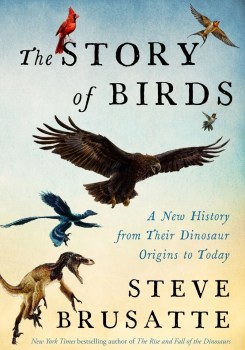
The Story of Birds: A New History from Their Dinosaur Origins to the Present
Some 40 million people in the United States enjoy birdwatching as a hobby, and every year more than 100 million sightings are uploaded to the eBird online platform, one of the world’s great scientific databases, which allows anyone with an eye for birds and access to a phone or computer to document what they’ve seen—a crowd-sourced archive invaluable for conservation efforts. Many of us keep birds as pets, and many more of us relish their eggs for breakfast, or the feel of a downy pillow stuffed with their feathers.
Birds are fascinating. Billions of them share the planet with us, and we encounter them regularly in our daily lives, whether we see them, or hear them, or are forced to sidestep the shed feathers and pasty droppings they leave behind. While our mostly drab-colored mammal cousins largely hide away, keeping to the shadows or coming out at night, birds are exhibitionists. With their flamboyant plumage and joyous songs, we can’t help but notice them. And when we do, they inspire us. They can do something that humans have longed to do since time immemorial: to fulfill the dreams of poets and slip the bonds of Earth and dance the skies.
To do so—to defy gravity—they have transformed their bodies into feathery, winged, lightweight, beaked, toothless, hyperenergetic, fast-growing flying machines. Some of the most unusual, the best adapted, the most fine-tuned animals that live today, and that have ever lived, in the 4.5-billion-year history of the Earth.
While we cannot fly like birds, in other ways we see ourselves in them. Birds are smart. They are attentive. They solve problems and learn from their mistakes, and some can even fashion tools and plan for the future. You can almost sense human emotions when watching them: cunning at times, often playful, sometimes mournful or ebullient. They can go to outlandish extremes to woo a mate—like us, companionship is important to them. Many of them take great care in building nests—they ache for a safe home. Many of them spend enormous amounts of time and energy raising their babies—they value their families. Some will stretch the bounds of belief and migrate thousands of miles to find food or shelter or a place to lay their eggs. Others are so proficient in songwriting that they voice something akin to a human language—so much so that some can even mimic our own speech. I’ve heard a parrot repeat words in English more clearly than my five-year-old son.
When I look at a bird, I feel awe. But I also recognize something familiar. Something perceptible to me because of my professional life as a paleontologist. The reason those dinosaur footprints on the Isle of Skye resemble bird tracks, and reason the dive-bombing gull reminded me of a hunting Velociraptor, boils down to one simple fact.
Birds are dinosaurs.
This realization is one of the greatest achievements in the history of paleontology. It is not a new insight proclaimed by brazen scientists of my generation. Rather, it goes back to the time of Charles Darwin and the earliest days of his theory of evolution in the 1860s. But like so many bold ideas from the past, it gradually fell out of favor. It disappeared from the textbooks, as new discoveries of immense dinosaur skeletons in the 1870s and beyond stereotyped these ancient reptiles as brutish and dim-witted monsters, ill-suited to a changing world and destined for extinction. It was only in the 1990s, with the discovery of fossil dinosaurs shrouded in feathers, that we truly understood that not all dinosaurs fit this mold, and that some were small, agile, energetic, and downy. And thus, the dinosaur-bird theory came back in vogue. Yet, although I think many people are generally familiar with the idea, and although by now there are feathery dinosaurs in the newer Jurassic World films, the fact that birds are dinosaurs has yet to really sink into the public consciousness.
It is truly a startling concept. When we think through its ramifications, it forces us to confront a mind-bending, if not unsettling, fact. Dinosaurs, those great icons of extinction, aren’t really dead. Sixty-six million years ago, when a six-mile-wide asteroid fell from the sky and ended the dynasty of T. rex and Triceratops, it didn’t finish the job. There was no clean break between the prehistoric era and the modern world. The past isn’t completely in the past.
So I will repeat it again: Birds are dinosaurs. On its face, it may seem so astounding that it can’t be true. After all, a sparrow or a finch or even a dive-bombing gull looks nothing like a T. rex or Brontosaurus. You may be thinking: There must be some catch. Maybe it’s a rhetorical sleight of hand—academic scientists harping on a technicality, or shifting the definition of words you thought you understood, like those astronomers who say that Pluto is a planet one day, but backtrack the next.
But that’s not what the dinosaur-bird connection is about. It’s much simpler. Birds evolved from dinosaur ancestors, and in a genealogical sense are direct descendants of dinosaurs, and part of the dinosaur family tree. Scientists classify species by ancestry, so birds are dinosaurs in the same way I am a Brusatte. For me, it is because I descended from the Italian ancestors who came to America, changed the spelling of their name, and established a new family. For birds, it is because they descended from the reptilian ancestors who modified their pelvis, started walking upright, and established a new evolutionary line. This line is what we call dinosaurs. Although we sometimes think of dinosaurs as a catch-all term for a bunch of prehistoric, primeval giants, that’s not what a dinosaur is—no, a dinosaur is a member of this one particular group on the family tree. T. rex, Brontosaurus, Triceratops, and thousands of other species are part of this group, and they have those signature features of the pelvis, and thus they are all called dinosaurs. So, birds must be too.
But ironically enough, not pterodactyls: those flying reptiles of the Age of Dinosaurs were not dinosaurs, or birds, or bird ancestors, as they evolved flight independently, with wings of skin not feathers, and are not part of the dinosaur group on the family tree.
I can guess what you might be thinking. Birds look mighty odd when lined up alongside noodle-necked behemoths bigger than jet planes and T. rexes that crushed the bones of their prey. They seem so different from other members of the family, so why not regard them as something else? But that’s not how families work. Not all members of the Brusatte clan look the same, and just because one of my cousins might be taller or shorter, or freckled, or have more luscious hair than most of us balding Brusattes, they do not cease being members of the family. When it comes down to it, though, the words we use to name and classify things are labels we devise. People can, after all, change their names. But no matter what you call yourself, you cannot escape the DNA of your family bloodline. So call a bird what you want, but the reality is, birds evolved from dinosaurs. And once they got started, they’ve been adapting and changing ever since, for over 150 million years.

Dr. Steve Brusatte is a paleontologist and author of “The Story of Birds: A New History from their Dinosaur Origins to the Present.”