Subscribe to Science Friday
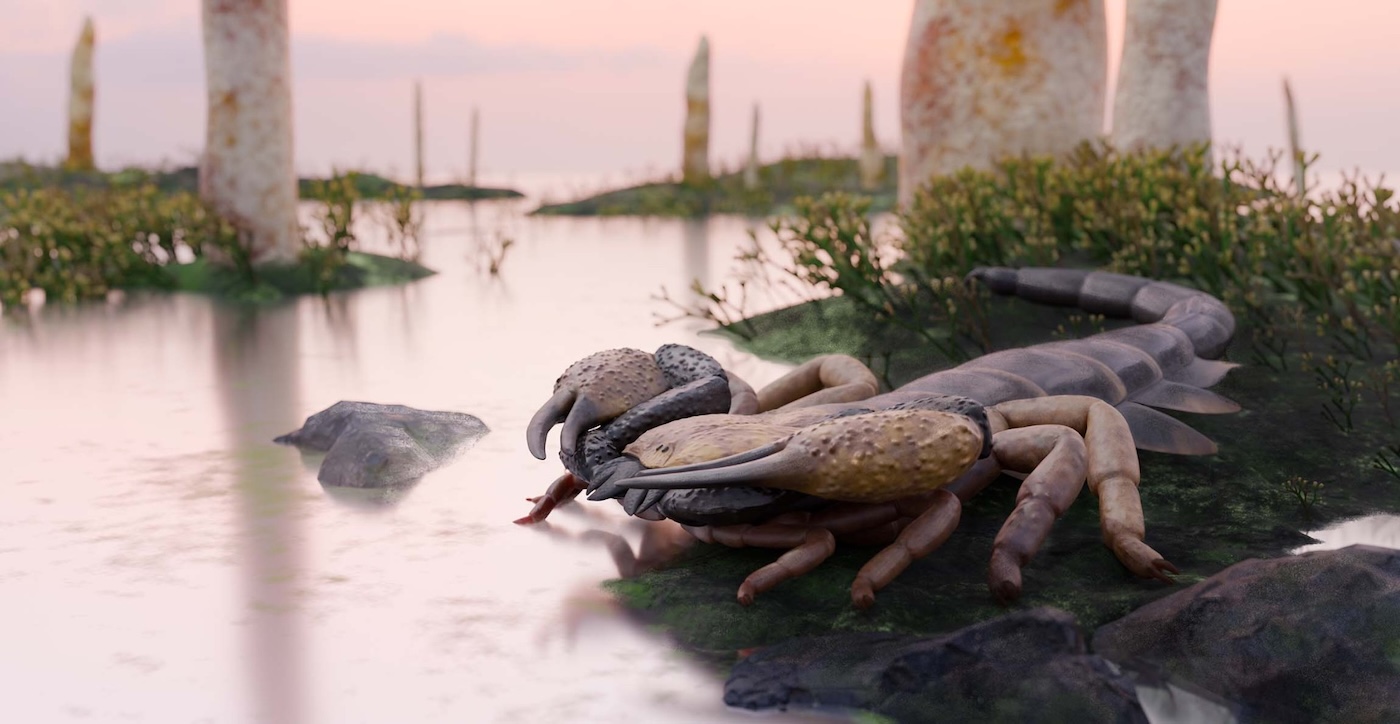
If you have arachnophobia, consider this your opportunity to try exposure therapy: A new study suggests that 415 million years ago, in modern-day England and Wales, a scorpion the length of a golden retriever was scurrying around, complete with 6-inch pincers. Flora talks with lead study author Richie Howard about the finding.
If you’re grossed out by a 3-foot scorpion, you’re not alone. But, scorpion researcher Lauren Esposito says we’ve got it all wrong—scorpions are wonderful and caring creatures.
Donate To Science Friday
Invest in quality science journalism by making a donation to Science Friday.
Segment Guests
Richie Howard
Dr. Richie Howard is an invertebrate paleontologist and curator of fossil arthropods at the Natural History Museum in London, England.
Lauren Esposito
Dr. Lauren Esposito is a scorpion researcher and director of the non-profit Islands and Seas and founder of 500 Queer Scientists.
Segment Transcript
[AUDIO LOGO] FLORA LICHTMAN: Hey, it’s Flora, and you’re listening to Science Friday.
If you have arachnophobia, consider this your opportunity to try exposure therapy because scorpions ahead. A new study suggests that 415 million years ago in modern day England and Wales, a scorpion the length of a golden retriever was scurrying around complete with 6-inch pincers. Some of these specimens were discovered long ago, and paleontologists had categorized them as sea-dwelling crustaceans. But a fresh look at these old fossils suggests they’re not an ancient lobster at all. Dr. Richie Howard is the curator of fossil arthropods at the Natural History Museum in London, England, and the lead author on this gigantic scorpion study. Richie, welcome to Science Friday.
RICHIE HOWARD: Hey, great to be here. Thank you very much.
FLORA LICHTMAN: I’ve seen this– these specimens described as chonky. Does that sound right to you?
RICHIE HOWARD: Yeah, I would say so. They are pretty big. They are an order of magnitude larger than any other fossil scorpion that we know of. But it’s also worth considering that the fossils are incomplete. It’s a jigsaw puzzle of an animal.
So we have multiple parts of its body but not the whole thing in one place, so it’s difficult to say exactly how big it was. That’s why it’s roughly, we’re saying roughly about a meter, roughly 3 feet long.
FLORA LICHTMAN: Wow. From the pieces you have, does it seem like it looked like just an inflated version of a modern scorpion, or is the morphology different?
RICHIE HOWARD: Yeah, it did look really different to modern scorpion. So in an arachnid, the posterior part of the body is called the opisthosoma. And the opisthosoma is divided in scorpions specifically into the mesosoma, which is the fat bit, and the metasoma, which is the tail with the sting on the end. On the mesosoma of the scorpion, we have what are called lateral epimere extending out of the segments. So these are like wing-shaped bits. They’re very reminiscent I think of a horseshoe crab or a trilobite.
FLORA LICHTMAN: Should I picture those lobster bits on the tail?
RICHIE HOWARD: Kind of. Yeah, yeah. These are unique among scorpions. So that suggests it was– this was doing something different to other scorpions. I think the most likely explanation for that is that it was at least partially aquatic.
FLORA LICHTMAN: Were these– these scorpions, can we extrapolate what they were with their role in the ecosystem? Were they like the grizzly bears of their time?
RICHIE HOWARD: Yes, this is one of the weirdest elements of the whole study really. So the early Devonian period when pre-Arcturus lived is a strikingly alien landscape. So I think people are vaguely aware that there were giant arthropods in Earth’s deep paleontological past–
FLORA LICHTMAN: Like the 2-foot dragonfly and the 8-foot long millipede, right?
RICHIE HOWARD: Yeah, exactly, exactly. But they lived in the Carboniferous period. This was 55 million years after when pre-Arcturus lived. That’s a world where there are jungles because trees have evolved. It’s a world where there is a much more complicated, complex landscape in terms of ecology. In the early Devonian, life has only really just started spreading onto the land. There’s just some gigantic scorpion running around as well.
It’s crazy. It’s walking around in between all these primitive moss-like plants and these tall, weird fungus things called prototaxites. Basically look a bit like standing stones. Really, really, really weird landscape this animal lived in.
And, of course, that answers the question how on Earth did it sustain itself unless there’s loads of other large animals on the land at this point that we just don’t have the fossils of which I think is probably unlikely because how would we just missed– we’ve missed all of them. I think what’s more likely is that it was an amphibious animal. There’s much larger prey for it in the water, things like armored fish. They’ve been found at some of these sites as well.
FLORA LICHTMAN: So your work revolves around to me– I’ll just show my cards– this terrifying ancient, ancient arthropods. What are your feelings on modern ones?
RICHIE HOWARD: Well, I never would have got interested in fossil ones if I hadn’t been interested in modern ones as well because the modern ones are all around us. I love the modern ones. I can’t go outside without taking photos. I always want to know what our spots are because they’re literally like little Pokemon that are everywhere. So, yeah, I think if you’re not interested in arthropods, you’re not interested in life.
[MUSIC PLAYING]
FLORA LICHTMAN: Don’t sleep on the arthropods is what I’m hearing. Richie, thank you for being here.
RICHIE HOWARD: No worries. Thank you for having me.
FLORA LICHTMAN: Dr. Richie Howard, invertebrate paleontologist and curator of fossil arthropods at the Natural History Museum in London, England. After the break, can you learn to love the scorpion? We’re going to try. Stay with us.
[AUDIO LOGO]
If you are icked out by a scorpion the length of a Labrador, you’re likely not alone. A study in the museum section of American entomologists found that people feared scorpions above even spiders, and they’re a phobia chart topper in America. But my next guest says we have it all wrong. Here to help us stop worrying and to help learn to love the scorpion is arachnologist Dr. Lauren Esposito, a scorpion researcher and director of the nonprofit Islands and Seas. Lauren, welcome back to Science Friday.
LAUREN ESPOSITO: Happy to be here.
FLORA LICHTMAN: Give me three words to describe your feelings on scorpions?
LAUREN ESPOSITO: My three words are caring, ancient, and I would say intriguing is the biggest thing that has kept me interested in scorpions for the last 20 years of my life.
FLORA LICHTMAN: Intriguing. Oh my gosh. I’m not hearing repulsion coming through.
LAUREN ESPOSITO: Absolutely not.
FLORA LICHTMAN: Well, I’m going to stand in for the vast majority of people who feel the opposite, who would rather never encounter a scorpion, and your mission today if you choose to accept it is to change our minds with facts. And I’m also going to give you categories like Jeopardy, and I want you to hit me with a story or some facts from the category that you think will make me and mostly our listeners see scorpions the way you do. Do you accept?
LAUREN ESPOSITO: I accept the mission.
FLORA LICHTMAN: First category is food and drink.
LAUREN ESPOSITO: Food and drink. Well, food, and drink is a big one because scorpions have the lowest metabolic rate of any recorded land animal, which is move over weight loss drugs because it should be the scorpions that we’re studying.
FLORA LICHTMAN: Wait, Gila monsters I feel like are the poster child for low metabolism.
LAUREN ESPOSITO: I would say that that’s true when we think about things that have a backbone like vertebrates. Gila monsters are great for low metabolism, but scorpions, they only need to eat really once a year or maybe even less frequently than that. They don’t typically need to drink water. They get all the water that they need from their prey items, and they have these really cool adaptations to be able to restrict the amount of water that they lose.
So they have book lungs. The way that they breathe is through these internalized gill structures. So they don’t actively respire like [DEEP BREATHING], breathing in and out, which definitely helps reduce their metabolism.
FLORA LICHTMAN: Oh my gosh, so book lungs like the pages of a book. I should be imagining the leaves of a book?
LAUREN ESPOSITO: You should. If you think about a fish gill if you ever seen a fish opening their gill slits in and out and there’s all these pages inside their gills, imagine if they just took all those gills and they squished squish them down and they stuck them inside a pocket in their body. So a lot of arachnids have book lungs, and it’s really a leftover from their ancestors that lived in the ocean. So before they moved on land, these were gills that were functioning in the ocean just like fish gills.
FLORA LICHTMAN: Which we talked about in this last segment with this giant scorpion. I feel like my wonder meter is going up, but I’m still not– I’m not getting caring really.
LAUREN ESPOSITO: We’ll get there.
FLORA LICHTMAN: OK. Our next category is anatomy.
LAUREN ESPOSITO: Anatomy. Anatomy is a good one. One of my favorite things about scorpions and I like to say that we’re in the midst of a scorpion renaissance period where we are discovering more information about scorpions than we’ve known cumulatively across all of history every single year.
FLORA LICHTMAN: Really?
LAUREN ESPOSITO: Yeah, really.
FLORA LICHTMAN: Is it because people are just jumping on the scorpion bandwagon?
LAUREN ESPOSITO: I think that you’ll be jumping on the scorpion bandwagon at the end of this conversation, but, yes, that’s part of it. Part of it is that there are simply more researchers studying scorpions than there’s ever been. But I think the other part of it really has to do with a recent revelation that does have to do with anatomy.
Scorpions have an exoskeleton, so their skeleton is on the outside of their body. But what’s really cool about scorpions is that they have this pigment embedded in their exoskeleton that fluoresces under ultraviolet light. And so if you take a blacklight, a party light, normally you’d shine it on your shoelaces and you’d see they’re really bright and purple, but if you shine them on a scorpion, they glow this bright green color.
And what that’s allowed us to do is to go out at night when they’re active and look for them with UV light. It’s like a secret weapon for detecting scorpions, and it’s allowed us to discover way more species than we ever knew about. So 100 years ago, we knew about something like 200 scorpions on Earth, and now we about over 2,500.
FLORA LICHTMAN: What about their venom?
LAUREN ESPOSITO: Let’s get to the brass tacks, which is scorpion venom. That’s the thing that we’re scared of. We’re scared of scorpions stinging us because that’s the legends that we hear. You’re going to die instantly if a scorpion stings you.
And I’m not going to say that that’s not true entirely universally that that’s untrue because there are places in the world where there are genuinely dangerous scorpions. But often the thing that makes them more dangerous is people’s access to medical care. So nowadays we have really effective antivenoms that can counteract the effects of scorpion venom very well. And so if you can reach a hospital and get antivenom, you’ll be able to survive a scorpion sting.
So the vast majority of scorpions pose no danger whatsoever to humans. Of the 2,500 scorpions on Earth, there’s only about 50 or less that are dangerous to humans. 99% of scorpions don’t pose any harm to humans.
FLORA LICHTMAN: But that is– that’s helpful. Go ahead, go on.
LAUREN ESPOSITO: The 1% are really interesting, not because they could kill you, which– it’s not actually the scorpion venom itself that can kill you. It’s the effects of your body responding to this trick that the venom plays on your brain. And so venom is a cocktail, and one of the things in this cocktail is a neurotransmitter inhibitor. And so what it does is it goes in, and it interferes with the way that your cells signal each other, your nerve cells.
And so it tells your brain that your hand is experiencing some severe trauma when all that’s actually happened is you got a prick on your finger. Nothing else is going on other than the scorpion venom tricking your brain to think that you’re being smashed with a sledgehammer. And what happens is that your brain turns on this immune response that raises your blood pressure, and that really rapid increase in blood pressure can have downstream consequences, like a heart attack. And the heart attack is ultimately what kills you.
So it’s not technically the scorpion. It’s you.
FLORA LICHTMAN: It’s me killing me as always. Let’s get to my favorite category, mating and dating.
LAUREN ESPOSITO: Scorpion dating is pretty serious business. So here’s how it works.
Scorpions are out at night. Checking– surveying the scene, seeing who’s around. A male finds a female. He approaches her, and as he approaches her, he starts doing this shuddering movement that’s almost like, hey, check me out. Look at me.
FLORA LICHTMAN: Flashing his little– his pincers or his tail–
LAUREN ESPOSITO: No, he’s shaking his entire body.
FLORA LICHTMAN: What’s going on?
LAUREN ESPOSITO: His whole body is shaking.
FLORA LICHTMAN: Cool.
LAUREN ESPOSITO: Yeah. And as if she doesn’t react aggressively or run away, he keeps making slow movements towards her, and eventually he reaches out and grabs her hands with his hands and begins–
FLORA LICHTMAN: Hands?
LAUREN ESPOSITO: Hands like their claws are grabbing each other. So they’re facing each other. They’re holding hands, and they start to dance. And we call this– in a scientific term, we call it a pas de deux like a couples dance, a ballroom dance.
And while all arachnids do some kind of mating ritual, all of them kind of dance for each other or do some thing that’s interactive, scorpions are like the ballroom dancers of arachnids. So when I say it’s like dating, it’s really kind of a courtship that is picky.
And they continue this dance for a while, and eventually, if the male does a good enough dance, then he’ll finally deposit sperm onto the ground– deposit it on this kind of jelly stalk that comes out of their body, and at the top of the stalk, they put a little package of sperm. And he’ll guide the female towards it because they’re still holding hands. Oh, I forgot to say that they– sometimes they kiss each other, and they do occasionally sting each other in what we call a sexual sting.
FLORA LICHTMAN: On the mouth? What?
LAUREN ESPOSITO: Yes. They’re facing each other, and they’ll put their– squish their little scorpion mouths together. And they’ll kiss each other with their mouthparts.
FLORA LICHTMAN: I feel like you’re making this up, Lauren, and we’d never know because no I studies scorpions.
LAUREN ESPOSITO: There’s 25 of us. Come on.
And then sometimes there’s a sting, which is like the kinky side of dating. But eventually if she’s pleased with all of this, then she’ll pick up the sperm package that he’s left for her. And she’ll store his sperm until she feels like the conditions are good for having babies, at which point she’ll inseminate herself.
FLORA LICHTMAN: Wow. So she has control over when she’s getting pregnant.
LAUREN ESPOSITO: She has control over when she’s getting pregnant. So she evaluates the environment, and if the conditions are good, if it’s a good rainy year with lots of prey, then she’ll allow for internal fertilization using the sperm. And the craziest thing–
FLORA LICHTMAN: Wait. Where does she keep the sperm? In a purse? I don’t understand.
LAUREN ESPOSITO: Yes. It’s in a little scorpion purse inside her body. Genuinely. There’s a little pocket, and she stores the sperm inside the pocket.
FLORA LICHTMAN: Let me just tuck this away for later. I got to live my life. I got to live my full life right now.
LAUREN ESPOSITO: Exactly. She’s living her best life until she gets pregnant. So scorpions, unlike all other arachnids and basically all insects, for the most part, they get pregnant, so they inseminate themselves. And then that sperm combines with all the eggs that she has in her body, and those eggs start to grow into embryos inside her body just like a mammal gets pregnant. And they don’t come out until they’re fully formed little scorpionlings.
FLORA LICHTMAN: Wait, live birth?
LAUREN ESPOSITO: Live birth.
FLORA LICHTMAN: Is that what you’re telling me?
LAUREN ESPOSITO: Yes, live birth.
FLORA LICHTMAN: That’s unusual, right?
LAUREN ESPOSITO: It’s pretty unusual, and they even– it’s so crazy because they come out in a little amniotic sac just like a vertebrate does. And then the sac burst as she’s giving birth, and then they crawl up onto her back. And she takes care of him after that.
FLORA LICHTMAN: How many in a litter?
LAUREN ESPOSITO: Well, it depends. So scorpions vary a lot in size, and some smaller species maybe only have two scorpionlings. That’s a technical term, scorpionlings.
FLORA LICHTMAN: That’s the first cute thing I’ve heard.
LAUREN ESPOSITO: It is.
FLORA LICHTMAN: Go ahead.
LAUREN ESPOSITO: It’s cute. And then like in other species, the highest number recorded is 156.
FLORA LICHTMAN: Oh.
LAUREN ESPOSITO: That’s a lot of babies.
FLORA LICHTMAN: That’s a lot of babies. And then she takes care of them?
LAUREN ESPOSITO: Then she takes care of them. She keeps them on her back for the first what instars, the technical term, but it means the first time they molt their exoskeleton and grow a new one. And at that point, they’ll start to wander away from her. Sometimes they’ll stay a little longer, sometimes they’ll leave immediately, but that’s the end of the parent-child relationship.
FLORA LICHTMAN: Oh my God. What’s your favorite scorpion fact?
LAUREN ESPOSITO: My favorite scorpion fact is that we are still describing new species every single year from the United States, which I think for me that’s an important fact because as a kid, I always grew up thinking that we’ve discovered everything there is to discover. And if we find something, it’s from some remote jungle out there in the world somewhere that nobody’s ever been in before.
But the reality is we’re finding things from the Central Valley of California, which is one of the most high intensity agricultural areas in the world. So I think the really cool thing about scorpions is there’s so much left to learn, and we need so many more scorpion biologists to do it.
FLORA LICHTMAN: That’s right. Get over your ick, young budding scientists. There’s a whole scorpion world out there. Lauren, I think you’ve convinced me. I think you’ve done it. They’re amazing, and there’s so much more to learn.
LAUREN ESPOSITO: Yay for scorpions.
FLORA LICHTMAN: Thank you. Thank you for coming on and doing this.
LAUREN ESPOSITO: Thank you. It was a pleasure.
FLORA LICHTMAN: Dr. Lauren Esposito is a scorpion researcher and director of the nonprofit Islands and Seas and founder of 500 Queer Scientists.
[MUSIC PLAYING]
What about you, listeners? Did we convince you scorpion skeptics to become scorpion stans. Give us a call 877-4SCIFRI is our number. And if you have any other scorpion questions, we know who to call. This episode was produced by Shoshannah Buxbaum. I’m Flora Lichtman. We’ll catch you next time.
Copyright © 2026 Science Friday Initiative. All rights reserved. Science Friday transcripts are produced on a tight deadline by 3Play Media. Fidelity to the original aired/published audio or video file might vary, and text might be updated or amended in the future. For the authoritative record of Science Friday’s programming, please visit the original aired/published recording. For terms of use and more information, visit our policies pages at http://www.sciencefriday.com/about/policies/
Meet the Producers and Host
About Flora Lichtman
Flora Lichtman is a host of Science Friday. In a previous life, she lived on a research ship where apertivi were served on the top deck, hoisted there via pulley by the ship’s chef.
About Shoshannah Buxbaum
Shoshannah Buxbaum is a producer for Science Friday. She’s particularly drawn to stories about health, psychology, and the environment. She’s a proud New Jersey native and will happily share her opinions on why the state is deserving of a little more love.